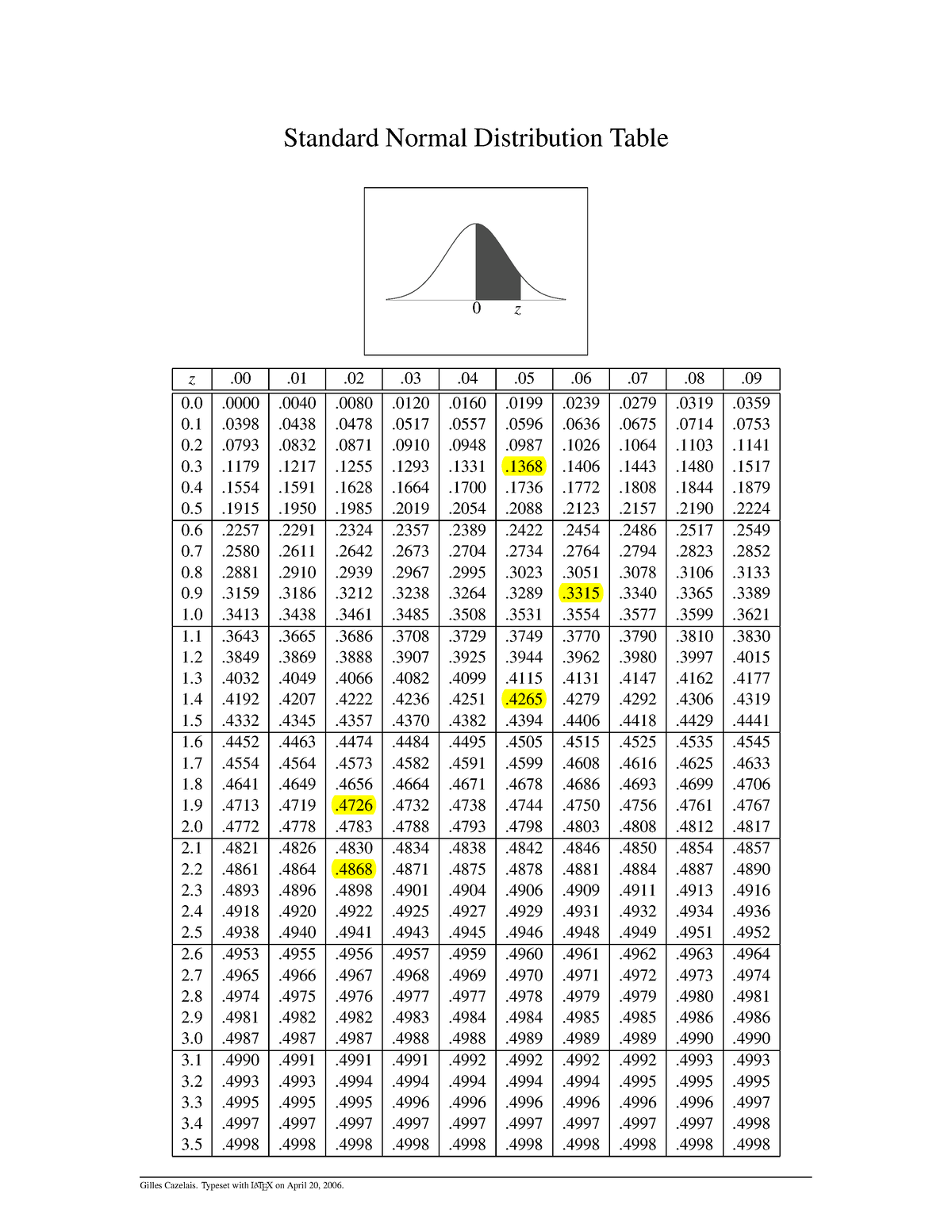

Understanding the Z Table PDF is crucial for anyone involved in statistics, particularly those dealing with normal distributions. The Z Table, also known as the standard normal distribution table, is a fundamental tool used to find probabilities associated with the standard normal distribution. This table is invaluable for converting Z-scores into probabilities, which is essential for hypothesis testing, confidence intervals, and other statistical analyses.
What is a Z Table?
A Z Table, or standard normal table, provides the cumulative probabilities for the standard normal distribution. The standard normal distribution has a mean of 0 and a standard deviation of 1. The Z Table helps in determining the area under the normal curve to the left of a given Z-score. This area represents the probability that a variable will take on a value less than or equal to the Z-score.
Understanding Z-Scores
Before diving into the Z Table PDF, it's important to understand what a Z-score is. A Z-score measures how many standard deviations a data point is from the mean. The formula for calculating a Z-score is:
Z = (X - μ) / σ
Where:
- X is the raw score.
- μ is the mean of the population.
- σ is the standard deviation of the population.
For example, if a data point has a value of 70, the mean is 50, and the standard deviation is 10, the Z-score would be:
Z = (70 - 50) / 10 = 2
This means the data point is 2 standard deviations above the mean.
Reading the Z Table PDF
The Z Table PDF is typically organized in a way that makes it easy to find the cumulative probability for a given Z-score. The table is usually divided into two parts: the body of the table and the margins. The margins contain the Z-scores, while the body contains the cumulative probabilities.
Here is a simplified example of what a Z Table might look like:
| Z | 0.00 | 0.01 | 0.02 | 0.03 |
|---|---|---|---|---|
| 0.0 | 0.5000 | 0.5040 | 0.5080 | 0.5120 |
| 0.1 | 0.5398 | 0.5438 | 0.5478 | 0.5517 |
| 0.2 | 0.5793 | 0.5832 | 0.5871 | 0.5910 |
| 0.3 | 0.6179 | 0.6217 | 0.6255 | 0.6293 |
To find the cumulative probability for a Z-score of 0.23, you would look at the row for 0.2 and the column for 0.03. The intersection of these gives you the cumulative probability of 0.5910. This means there is a 59.10% chance that a variable will take on a value less than or equal to a Z-score of 0.23.
Using the Z Table PDF for Statistical Analysis
The Z Table PDF is used in various statistical analyses, including hypothesis testing and confidence intervals. Here are some common applications:
- Hypothesis Testing: In hypothesis testing, the Z Table is used to determine the p-value, which helps in deciding whether to reject the null hypothesis.
- Confidence Intervals: The Z Table is used to find the critical values for constructing confidence intervals around the mean.
- Probability Calculations: The Z Table is used to calculate the probability of a variable falling within a certain range.
For example, if you want to find the probability that a variable falls between two Z-scores, you would subtract the cumulative probability of the lower Z-score from the cumulative probability of the upper Z-score.
If you want to find the probability that a variable falls between Z = -1.5 and Z = 1.5, you would look up the cumulative probabilities for these Z-scores in the Z Table PDF. The cumulative probability for Z = -1.5 is 0.0668, and for Z = 1.5, it is 0.9332. The probability that the variable falls between these two Z-scores is:
0.9332 - 0.0668 = 0.8664
This means there is an 86.64% chance that the variable will fall between Z = -1.5 and Z = 1.5.
📝 Note: Remember that the Z Table provides cumulative probabilities for the left tail of the distribution. For right-tailed probabilities, you may need to subtract the cumulative probability from 1.
Interpreting Z-Scores and Probabilities
Interpreting Z-scores and probabilities is crucial for making informed decisions based on statistical data. Here are some key points to consider:
- Positive Z-Scores: A positive Z-score indicates that the data point is above the mean. The higher the Z-score, the further the data point is from the mean.
- Negative Z-Scores: A negative Z-score indicates that the data point is below the mean. The lower the Z-score, the further the data point is from the mean.
- Probabilities: The probability associated with a Z-score represents the likelihood of a variable taking on a value less than or equal to that Z-score.
For example, a Z-score of 1.645 corresponds to a cumulative probability of 0.95. This means there is a 95% chance that a variable will take on a value less than or equal to a Z-score of 1.645.
Common Misconceptions About the Z Table PDF
There are several common misconceptions about the Z Table PDF that can lead to errors in statistical analysis. Here are a few to be aware of:
- Confusing Z-Scores with Raw Scores: Z-scores are standardized scores, not raw scores. They represent the number of standard deviations from the mean, not the actual values of the data points.
- Ignoring the Standard Normal Distribution: The Z Table is based on the standard normal distribution, which has a mean of 0 and a standard deviation of 1. If your data does not follow this distribution, the Z Table may not be applicable.
- Misinterpreting Probabilities: The probabilities in the Z Table represent cumulative probabilities for the left tail of the distribution. For right-tailed probabilities, you need to subtract the cumulative probability from 1.
Understanding these misconceptions can help you avoid common pitfalls when using the Z Table PDF for statistical analysis.
📝 Note: Always ensure that your data follows a normal distribution before using the Z Table. If your data is not normally distributed, consider using other statistical methods or transformations.
Conclusion
The Z Table PDF is an essential tool for anyone working with normal distributions in statistics. It provides cumulative probabilities for Z-scores, which are crucial for hypothesis testing, confidence intervals, and other statistical analyses. By understanding how to read and interpret the Z Table, you can make more informed decisions based on statistical data. Whether you are a student, researcher, or professional, mastering the Z Table is a valuable skill that will enhance your statistical analysis capabilities.
Related Terms:
- z cumulative table
- z table statistics
- standard normal z table
- z table normal distribution pdf
- z table statistics pdf
- z test table pdf