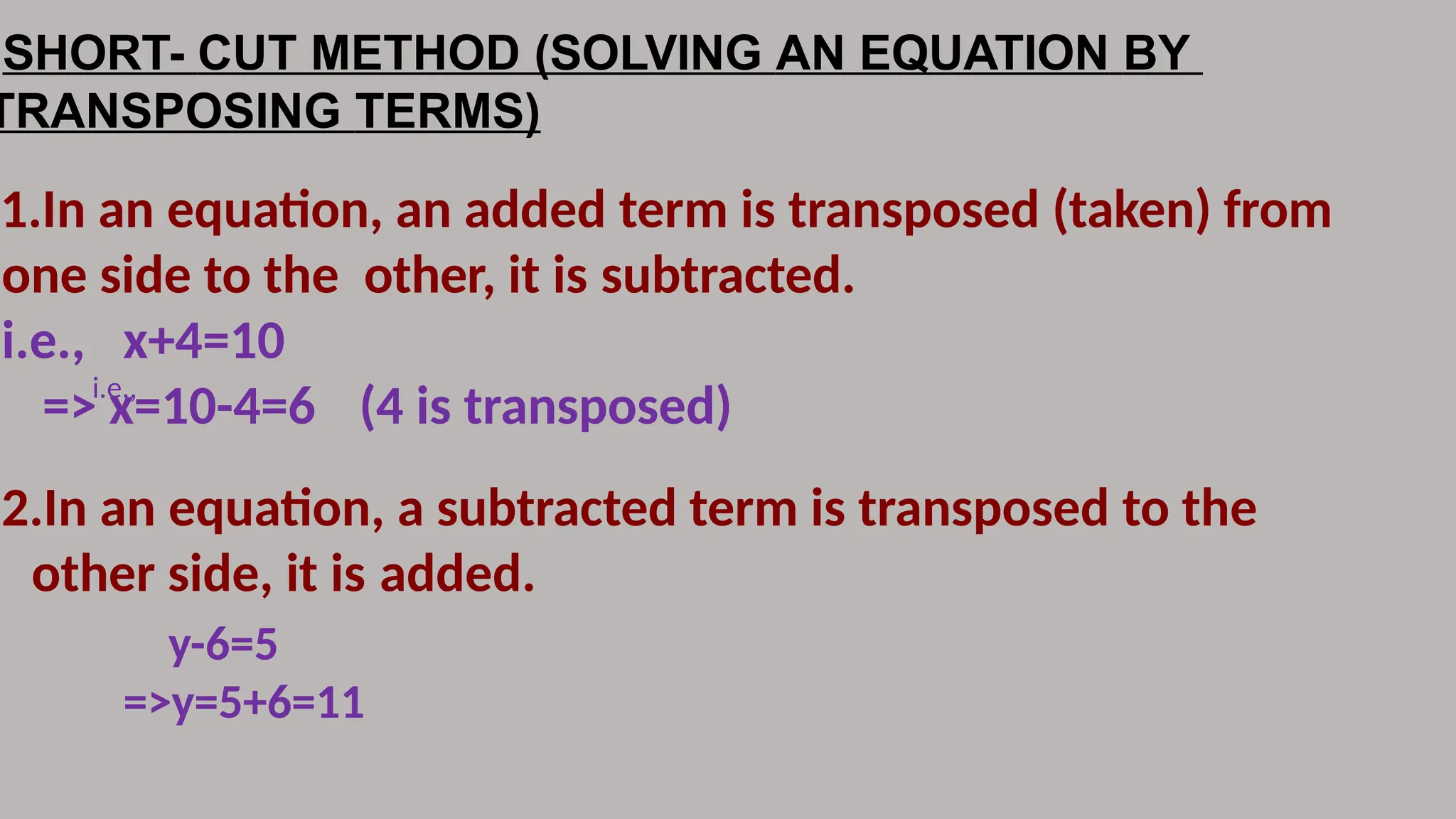

Equations are fundamental to understanding the world around us. They are used in various fields, from physics and engineering to economics and computer science. But what is an equation? An equation is a mathematical statement that asserts the equality of two expressions. These expressions can be simple or complex, involving variables, constants, and operators. Understanding what is an equation and how to solve it is crucial for anyone looking to delve into the world of mathematics and its applications.
Understanding the Basics of Equations
To grasp the concept of what is an equation, it's essential to start with the basics. An equation typically consists of two sides separated by an equals sign (=). The left side of the equation is called the left-hand side (LHS), and the right side is called the right-hand side (RHS). The goal is to find the value of the variable that makes the equation true.
For example, consider the simple equation:
2x + 3 = 7
Here, 2x + 3 is the LHS, and 7 is the RHS. The variable x is what we need to solve for. To find the value of x, we perform operations on both sides of the equation to isolate x.
Types of Equations
Equations come in various forms, each with its own set of rules and methods for solving. Understanding the different types of equations is crucial for determining the appropriate approach to solving them.
Linear Equations
Linear equations are the simplest type of equation. They involve a single variable and are in the form of ax + b = c, where a, b, and c are constants, and x is the variable. The goal is to find the value of x that makes the equation true.
For example:
3x - 5 = 10
To solve for x, we first add 5 to both sides of the equation:
3x - 5 + 5 = 10 + 5
This simplifies to:
3x = 15
Next, we divide both sides by 3:
3x / 3 = 15 / 3
This gives us:
x = 5
📝 Note: Always perform the same operation on both sides of the equation to maintain equality.
Quadratic Equations
Quadratic equations are more complex than linear equations. They involve a variable squared and are in the form of ax² + bx + c = 0, where a, b, and c are constants, and x is the variable. Solving quadratic equations often involves using the quadratic formula:
x = [-b ± √(b² - 4ac)] / (2a)
For example, consider the quadratic equation:
x² - 5x + 6 = 0
Here, a = 1, b = -5, and c = 6. Plugging these values into the quadratic formula gives us:
x = [-(-5) ± √((-5)² - 4(1)(6))] / (2(1))
Simplifying this, we get:
x = [5 ± √(25 - 24)] / 2
x = [5 ± √1] / 2
This results in two solutions:
x = (5 + 1) / 2 = 3
x = (5 - 1) / 2 = 2
Polynomial Equations
Polynomial equations are equations that involve polynomials, which are expressions consisting of variables and coefficients. These equations can be of various degrees, depending on the highest power of the variable. For example, a cubic equation is a polynomial equation of degree 3.
Solving polynomial equations often involves factoring, synthetic division, or using the Rational Root Theorem. For higher-degree polynomials, numerical methods or graphing may be required.
Exponential and Logarithmic Equations
Exponential and logarithmic equations involve exponential or logarithmic functions. These equations are often used in fields such as finance, biology, and physics. Solving these equations typically involves using properties of exponents and logarithms.
For example, consider the exponential equation:
2^x = 8
To solve for x, we take the logarithm of both sides:
log(2^x) = log(8)
Using the property of logarithms that log(a^b) = b * log(a), we get:
x * log(2) = log(8)
Solving for x, we get:
x = log(8) / log(2)
Since 8 = 2^3, we have:
x = log(2^3) / log(2) = 3
Trigonometric Equations
Trigonometric equations involve trigonometric functions such as sine, cosine, and tangent. These equations are often used in fields such as physics, engineering, and astronomy. Solving trigonometric equations typically involves using properties of trigonometric functions and the unit circle.
For example, consider the trigonometric equation:
sin(x) = 0.5
To solve for x, we find the angles whose sine is 0.5. These angles are 30° and 150° (or π/6 and 5π/6 in radians). Since the sine function is periodic with a period of 2π, the solutions are:
x = 30° + 2kπ or x = 150° + 2kπ, where k is an integer.
Solving Systems of Equations
In many real-world problems, we encounter systems of equations, which are sets of two or more equations with the same variables. Solving these systems involves finding the values of the variables that satisfy all the equations simultaneously.
There are several methods for solving systems of equations, including substitution, elimination, and matrix methods. The choice of method depends on the type of equations and the number of variables.
Substitution Method
The substitution method involves solving one equation for one variable and then substituting that expression into the other equations. This method is often used when one of the equations is already solved for one variable.
For example, consider the system of equations:
y = 2x + 1
x + y = 7
We can substitute the expression for y from the first equation into the second equation:
x + (2x + 1) = 7
Simplifying, we get:
3x + 1 = 7
Subtracting 1 from both sides, we get:
3x = 6
Dividing by 3, we get:
x = 2
Substituting x = 2 back into the first equation, we get:
y = 2(2) + 1 = 5
So the solution to the system of equations is x = 2 and y = 5.
Elimination Method
The elimination method involves adding or subtracting the equations to eliminate one of the variables. This method is often used when the coefficients of one of the variables are opposites or can be made opposites by multiplying one of the equations by a constant.
For example, consider the system of equations:
2x + y = 5
x - y = 1
We can add the two equations to eliminate y:
(2x + y) + (x - y) = 5 + 1
Simplifying, we get:
3x = 6
Dividing by 3, we get:
x = 2
Substituting x = 2 back into the first equation, we get:
2(2) + y = 5
Simplifying, we get:
4 + y = 5
Subtracting 4 from both sides, we get:
y = 1
So the solution to the system of equations is x = 2 and y = 1.
Matrix Methods
Matrix methods involve representing the system of equations as a matrix and then using matrix operations to find the solution. This method is often used for systems with three or more variables. The most common matrix method is Gaussian elimination, which involves transforming the matrix into row-echelon form and then back-substituting to find the solution.
For example, consider the system of equations:
2x + y - z = 8
x - y + 2z = 1
3x + 2y + z = 5
We can represent this system as a matrix:
| 2 | 1 | -1 | | | 8 |
|---|---|---|---|---|
| 1 | -1 | 2 | | | 1 |
| 3 | 2 | 1 | | | 5 |
Using Gaussian elimination, we can transform this matrix into row-echelon form and then back-substitute to find the solution. The solution to this system of equations is x = 2, y = 1, and z = -1.
Applications of Equations
Equations have a wide range of applications in various fields. Understanding what is an equation and how to solve it is crucial for solving real-world problems. Here are a few examples of how equations are used in different fields.
Physics
In physics, equations are used to describe the relationships between physical quantities. For example, Newton's laws of motion are expressed as equations that relate force, mass, and acceleration. Solving these equations allows us to predict the motion of objects under various conditions.
For example, consider Newton's second law of motion:
F = ma
where F is the force, m is the mass, and a is the acceleration. Solving this equation for a, we get:
a = F / m
This equation allows us to calculate the acceleration of an object given its mass and the force acting on it.
Engineering
In engineering, equations are used to design and analyze systems. For example, electrical engineers use equations to analyze circuits, and mechanical engineers use equations to design structures. Solving these equations allows engineers to optimize their designs and ensure that they meet the required specifications.
For example, consider Ohm's law in electrical engineering:
V = IR
where V is the voltage, I is the current, and R is the resistance. Solving this equation for I, we get:
I = V / R
This equation allows us to calculate the current in a circuit given the voltage and resistance.
Economics
In economics, equations are used to model economic systems. For example, supply and demand curves are expressed as equations that relate price and quantity. Solving these equations allows economists to predict market behavior and make policy recommendations.
For example, consider the supply and demand equation:
Qd = a - bP
Qs = c + dP
where Qd is the quantity demanded, Qs is the quantity supplied, P is the price, and a, b, c, and d are constants. Solving these equations simultaneously allows us to find the equilibrium price and quantity.
Computer Science
In computer science, equations are used to design algorithms and analyze their performance. For example, recurrence relations are used to describe the time complexity of recursive algorithms. Solving these equations allows computer scientists to optimize their algorithms and ensure that they run efficiently.
For example, consider the recurrence relation for the time complexity of the merge sort algorithm:
T(n) = 2T(n/2) + n
where T(n) is the time complexity, and n is the size of the input. Solving this recurrence relation, we find that the time complexity of merge sort is O(n log n).
Advanced Topics in Equations
As we delve deeper into the world of equations, we encounter more advanced topics that require a deeper understanding of mathematical concepts. These topics include differential equations, partial differential equations, and nonlinear equations.
Differential Equations
Differential equations are equations that involve derivatives. They are used to model dynamic systems, where the rate of change of a quantity is related to the quantity itself. Solving differential equations allows us to predict the behavior of these systems over time.
For example, consider the differential equation for exponential growth:
dy/dt = ky
where y is the quantity, t is the time, and k is the growth rate. Solving this differential equation, we find that the quantity y grows exponentially over time:
y = y0 * e^(kt)
where y0 is the initial quantity.
Partial Differential Equations
Partial differential equations (PDEs) are equations that involve partial derivatives. They are used to model systems that depend on multiple variables. Solving PDEs allows us to predict the behavior of these systems under various conditions.
For example, consider the heat equation, which is a PDE that describes the distribution of heat in a material:
∂u/∂t = k * ∂²u/∂x²
where u is the temperature, t is the time, x is the spatial coordinate, and k is the thermal diffusivity. Solving this PDE allows us to predict the temperature distribution in the material over time.
Nonlinear Equations
Nonlinear equations are equations that are not linear. They involve terms that are not linear in the variables, such as squares, cubes, or products of variables. Solving nonlinear equations often requires numerical methods or graphing.
For example, consider the nonlinear equation:
x³ - 3x + 1 = 0
This equation is not linear because it involves the cube of x. Solving this equation requires numerical methods or graphing. The solutions to this equation are approximately x = -1.879, x = 0.5, and x = 1.379.
📝 Note: Nonlinear equations often have multiple solutions, and finding all the solutions can be challenging.
Understanding what is an equation and how to solve it is a fundamental skill in mathematics and its applications. Equations are used in various fields to model and solve real-world problems. Whether you're a student, a professional, or just someone interested in mathematics, mastering the art of solving equations is essential for success.
From simple linear equations to complex differential equations, the world of equations is vast and fascinating. By understanding the different types of equations and the methods for solving them, you can unlock the power of mathematics to solve problems and make discoveries. So, dive in, explore, and discover the beauty of equations!
Related Terms:
- what is an algebraic expression
- what is an equation example
- equation meaning
- equation definition
- what is an equation editor