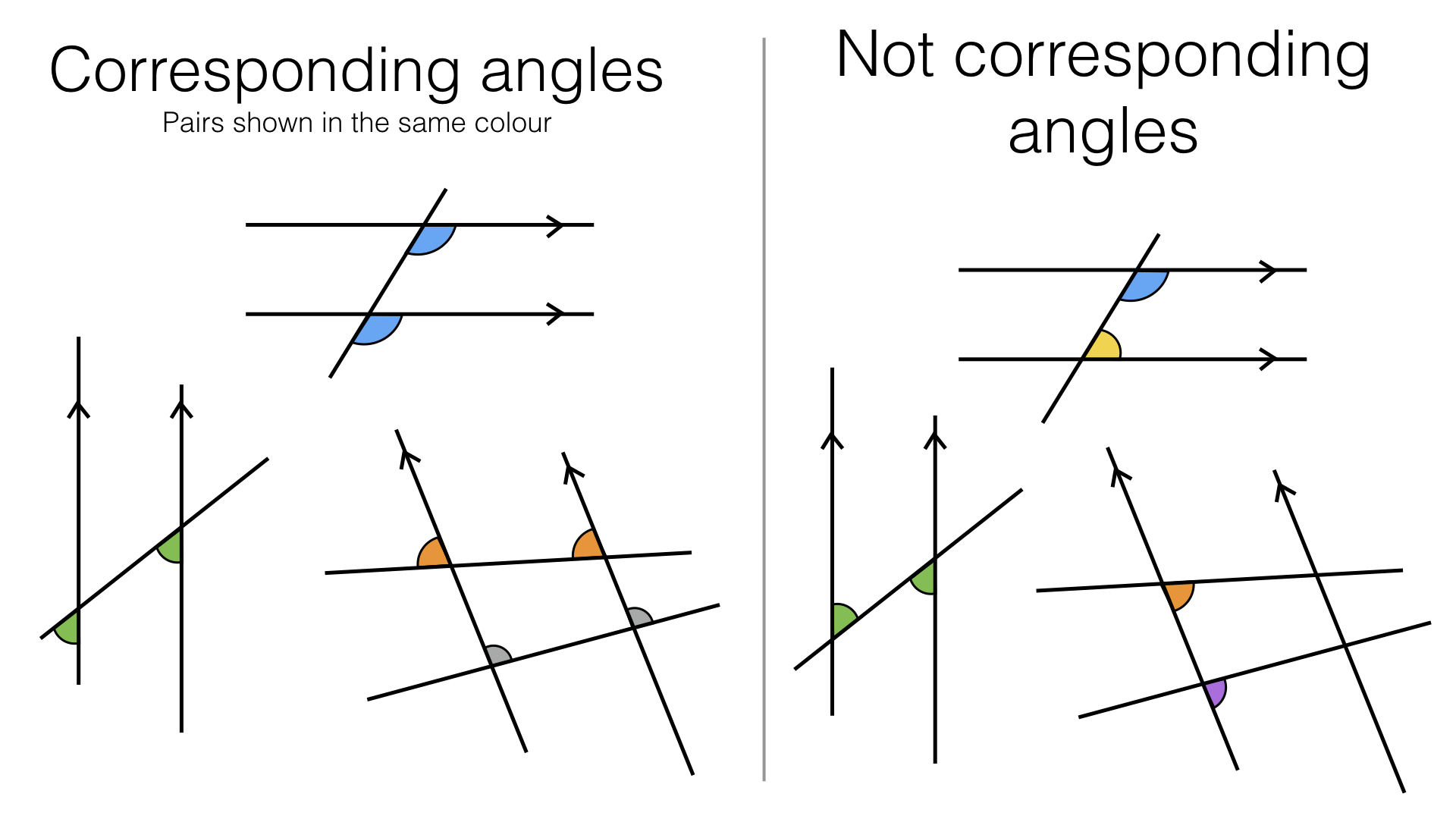

Understanding the concept of angles is fundamental in geometry, and one of the key terms that often comes up is What Are Corresponding Angles. These angles are formed when two lines are intersected by a transversal, creating pairs of angles that occupy the same relative position at each intersection. This concept is crucial for various geometric proofs and real-world applications, such as in architecture, engineering, and navigation.
What Are Corresponding Angles?
Corresponding angles are pairs of angles that are in the same relative position at each intersection where a straight line crosses two others. These angles are formed when a transversal line intersects two or more other lines. The key characteristic of corresponding angles is that they are on the same side of the transversal and in the same relative position at each intersection.
Identifying Corresponding Angles
To identify corresponding angles, follow these steps:
- Draw two lines and a transversal that intersects both lines.
- Label the angles formed at the intersections.
- Identify pairs of angles that are in the same relative position at each intersection and on the same side of the transversal.
For example, consider two parallel lines intersected by a transversal. The angles that are in the same position at each intersection and on the same side of the transversal are corresponding angles.
Properties of Corresponding Angles
Corresponding angles have several important properties:
- Equality: When two lines are parallel and intersected by a transversal, the corresponding angles are equal.
- Position: Corresponding angles are always on the same side of the transversal and in the same relative position at each intersection.
- Measurement: The measure of corresponding angles is the same if the lines are parallel.
These properties make corresponding angles a powerful tool in geometric proofs and constructions.
Applications of Corresponding Angles
Corresponding angles have numerous applications in various fields. Here are a few examples:
- Architecture: Architects use corresponding angles to ensure that structures are aligned correctly and that walls, floors, and ceilings are parallel.
- Engineering: Engineers rely on corresponding angles to design roads, bridges, and other infrastructure where parallel lines and transversals are common.
- Navigation: In navigation, corresponding angles help in determining the direction and alignment of paths and routes.
Understanding corresponding angles is essential for accurate measurements and precise constructions in these fields.
Examples of Corresponding Angles
Let’s look at a few examples to illustrate the concept of corresponding angles:
Consider two parallel lines, L1 and L2, intersected by a transversal T. The angles formed at the intersections are labeled as follows:
| Angle | Position |
|---|---|
| Angle 1 | Top left of L1 |
| Angle 2 | Top right of L2 |
| Angle 3 | Bottom left of L1 |
| Angle 4 | Bottom right of L2 |
In this scenario, Angle 1 and Angle 2 are corresponding angles, as are Angle 3 and Angle 4. These pairs of angles are equal because the lines L1 and L2 are parallel.
📝 Note: When identifying corresponding angles, ensure that the angles are on the same side of the transversal and in the same relative position at each intersection.
Proving Corresponding Angles are Equal
To prove that corresponding angles are equal when two lines are parallel and intersected by a transversal, follow these steps:
- Draw two parallel lines and a transversal intersecting them.
- Label the angles formed at the intersections.
- Use the properties of parallel lines and transversals to show that the corresponding angles are equal.
For example, consider two parallel lines L1 and L2 intersected by a transversal T. The corresponding angles formed are Angle 1 and Angle 2. To prove they are equal:
- Draw a line segment connecting the vertices of Angle 1 and Angle 2.
- Use the fact that the sum of the angles on a straight line is 180 degrees.
- Show that Angle 1 and Angle 2 are supplementary to the same angle, making them equal.
This proof demonstrates that corresponding angles are equal when the lines are parallel.
📝 Note: The proof relies on the properties of parallel lines and transversals, as well as the fact that the sum of the angles on a straight line is 180 degrees.
Real-World Examples of Corresponding Angles
Corresponding angles are not just theoretical concepts; they have practical applications in various real-world scenarios. Here are a few examples:
- Road Intersections: When designing road intersections, engineers use corresponding angles to ensure that the roads are aligned correctly and that vehicles can navigate the intersection safely.
- Building Construction: In building construction, corresponding angles help ensure that walls, floors, and ceilings are parallel and aligned correctly. This is crucial for the structural integrity of the building.
- Surveying: Surveyors use corresponding angles to measure and map out land areas accurately. This is essential for land development, property boundaries, and infrastructure planning.
These examples illustrate how understanding corresponding angles can be applied in practical situations to achieve precise and accurate results.
Corresponding angles are a fundamental concept in geometry with wide-ranging applications. By understanding what corresponding angles are, how to identify them, and their properties, you can apply this knowledge to various fields, from architecture and engineering to navigation and surveying. The concept of corresponding angles is not just theoretical; it has practical implications that make it an essential tool in many professions.
Related Terms:
- what are consecutive angles
- what are alternate exterior angles
- what are corresponding angles definition
- what are vertical angles
- consecutive interior angles
- corresponding angles examples