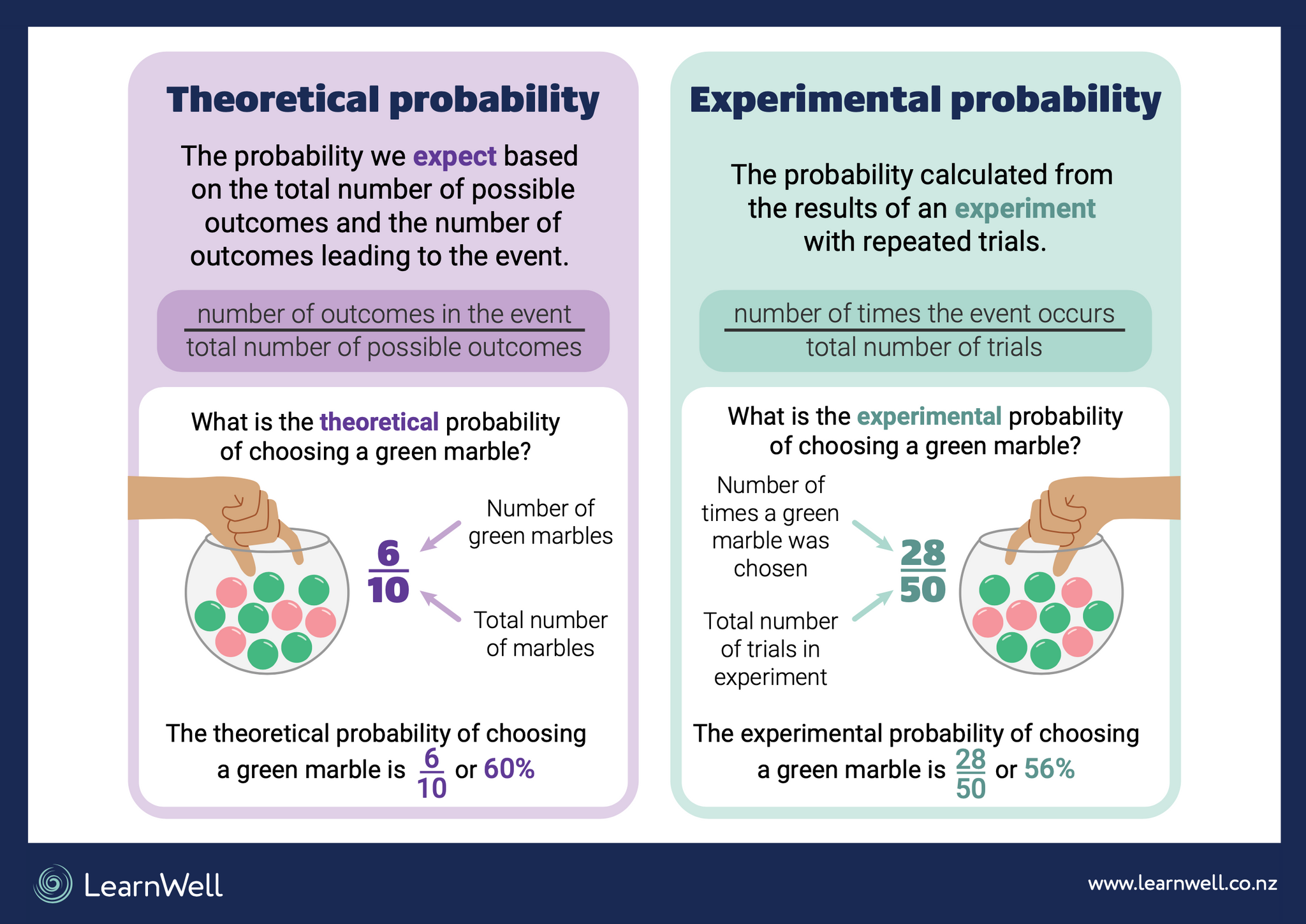

Probability is a fundamental concept in mathematics and statistics, used to quantify the likelihood of events occurring. Understanding the difference between Theoretical Vs Experimental Probability is crucial for anyone delving into the field of statistics or data analysis. This post will explore the distinctions between these two types of probability, their applications, and how they are calculated.
Theoretical Probability
Theoretical probability is based on logical reasoning and mathematical calculations. It assumes that all outcomes are equally likely and uses the total number of possible outcomes to determine the probability of a specific event. The formula for theoretical probability is:
P(A) = Number of favorable outcomes / Total number of possible outcomes
For example, consider the probability of rolling a six on a fair six-sided die. There is only one favorable outcome (rolling a six) out of six possible outcomes (rolling any number from one to six). Therefore, the theoretical probability is:
P(Six) = 1 / 6
Experimental Probability
Experimental probability, on the other hand, is based on actual observations and data collected from experiments or real-world events. It involves conducting trials and recording the frequency of an event occurring. The formula for experimental probability is:
P(A) = Number of times event A occurs / Total number of trials
For instance, if you flip a coin 100 times and it lands on heads 55 times, the experimental probability of flipping heads is:
P(Heads) = 55 / 100 = 0.55
Key Differences Between Theoretical Vs Experimental Probability
Understanding the key differences between Theoretical Vs Experimental Probability is essential for applying the correct type of probability in different scenarios. Here are some of the main differences:
- Calculation Method: Theoretical probability is calculated using mathematical formulas and logical reasoning, while experimental probability is determined through observation and data collection.
- Assumptions: Theoretical probability assumes that all outcomes are equally likely, whereas experimental probability does not make this assumption and relies on actual data.
- Accuracy: Theoretical probability provides an exact value based on mathematical principles, while experimental probability can vary based on the number of trials and the conditions of the experiment.
- Applications: Theoretical probability is often used in scenarios where the outcomes are well-defined and equally likely, such as in games of chance. Experimental probability is used in real-world situations where data collection is feasible, such as in scientific experiments or market research.
Applications of Theoretical Probability
Theoretical probability has numerous applications in various fields. Some of the most common applications include:
- Games of Chance: Theoretical probability is used to calculate the odds of winning in games like poker, roulette, and lottery.
- Quality Control: In manufacturing, theoretical probability helps in determining the likelihood of defects in products.
- Risk Assessment: In finance and insurance, theoretical probability is used to assess the risk of investments and insurance policies.
- Scientific Research: Theoretical probability is used in designing experiments and analyzing data in fields like physics, chemistry, and biology.
Applications of Experimental Probability
Experimental probability is widely used in fields where data collection and observation are crucial. Some of the key applications include:
- Clinical Trials: In medicine, experimental probability is used to determine the effectiveness of new drugs and treatments.
- Market Research: Businesses use experimental probability to analyze consumer behavior and market trends.
- Sports Analytics: In sports, experimental probability helps in predicting outcomes and optimizing strategies.
- Environmental Studies: Experimental probability is used to study the impact of environmental factors on ecosystems and climate.
Calculating Theoretical Probability
To calculate theoretical probability, follow these steps:
- Identify the total number of possible outcomes.
- Determine the number of favorable outcomes.
- Apply the formula: P(A) = Number of favorable outcomes / Total number of possible outcomes.
💡 Note: Ensure that all outcomes are equally likely when calculating theoretical probability.
Calculating Experimental Probability
To calculate experimental probability, follow these steps:
- Conduct a series of trials or experiments.
- Record the number of times the event of interest occurs.
- Apply the formula: P(A) = Number of times event A occurs / Total number of trials.
💡 Note: The accuracy of experimental probability improves with a larger number of trials.
Example: Coin Toss
Let's consider an example of a coin toss to illustrate both Theoretical Vs Experimental Probability.
For a fair coin, the theoretical probability of getting heads is:
P(Heads) = 1 / 2 = 0.5
Now, let's conduct an experiment by flipping the coin 50 times and recording the results. Suppose heads appear 28 times. The experimental probability of getting heads is:
P(Heads) = 28 / 50 = 0.56
As you can see, the experimental probability is close to the theoretical probability but not exactly the same. This discrepancy is due to the random nature of the experiment and the limited number of trials.
Example: Dice Roll
Consider rolling a fair six-sided die. The theoretical probability of rolling an even number (2, 4, or 6) is:
P(Even) = Number of favorable outcomes / Total number of possible outcomes = 3 / 6 = 0.5
Now, let's conduct an experiment by rolling the die 100 times and recording the results. Suppose an even number appears 52 times. The experimental probability of rolling an even number is:
P(Even) = 52 / 100 = 0.52
Again, the experimental probability is close to the theoretical probability but not exactly the same. This example demonstrates how Theoretical Vs Experimental Probability can differ based on the number of trials and the conditions of the experiment.
Example: Card Draw
Consider drawing a card from a standard deck of 52 cards. The theoretical probability of drawing a heart is:
P(Heart) = Number of hearts / Total number of cards = 13 / 52 = 0.25
Now, let's conduct an experiment by drawing a card from the deck 100 times (with replacement) and recording the results. Suppose a heart is drawn 24 times. The experimental probability of drawing a heart is:
P(Heart) = 24 / 100 = 0.24
In this case, the experimental probability is very close to the theoretical probability, illustrating how experimental probability can converge to theoretical probability with a sufficient number of trials.
Comparing Theoretical Vs Experimental Probability
To better understand the differences between Theoretical Vs Experimental Probability, let's compare them side by side:
| Aspect | Theoretical Probability | Experimental Probability |
|---|---|---|
| Calculation Method | Mathematical formulas and logical reasoning | Observation and data collection |
| Assumptions | All outcomes are equally likely | No assumptions about outcome likelihood |
| Accuracy | Exact value based on mathematical principles | Varies based on the number of trials and conditions |
| Applications | Games of chance, quality control, risk assessment | Clinical trials, market research, sports analytics |
This comparison highlights the key differences between Theoretical Vs Experimental Probability and their respective applications.
Understanding the distinction between Theoretical Vs Experimental Probability is crucial for anyone working in fields that involve data analysis and statistical reasoning. While theoretical probability provides a precise and predictable measure of likelihood, experimental probability offers a practical and data-driven approach to understanding real-world events. By grasping the nuances of both types of probability, you can make more informed decisions and draw accurate conclusions from your data.
Related Terms:
- theoretical experimental probability examples
- theoretical vs experimental probability worksheet
- difference between experimental and theoretical
- theoretical vs experimental probability formula
- experimental and theoretical probability pdf
- theoretical vs experimental probability pdf