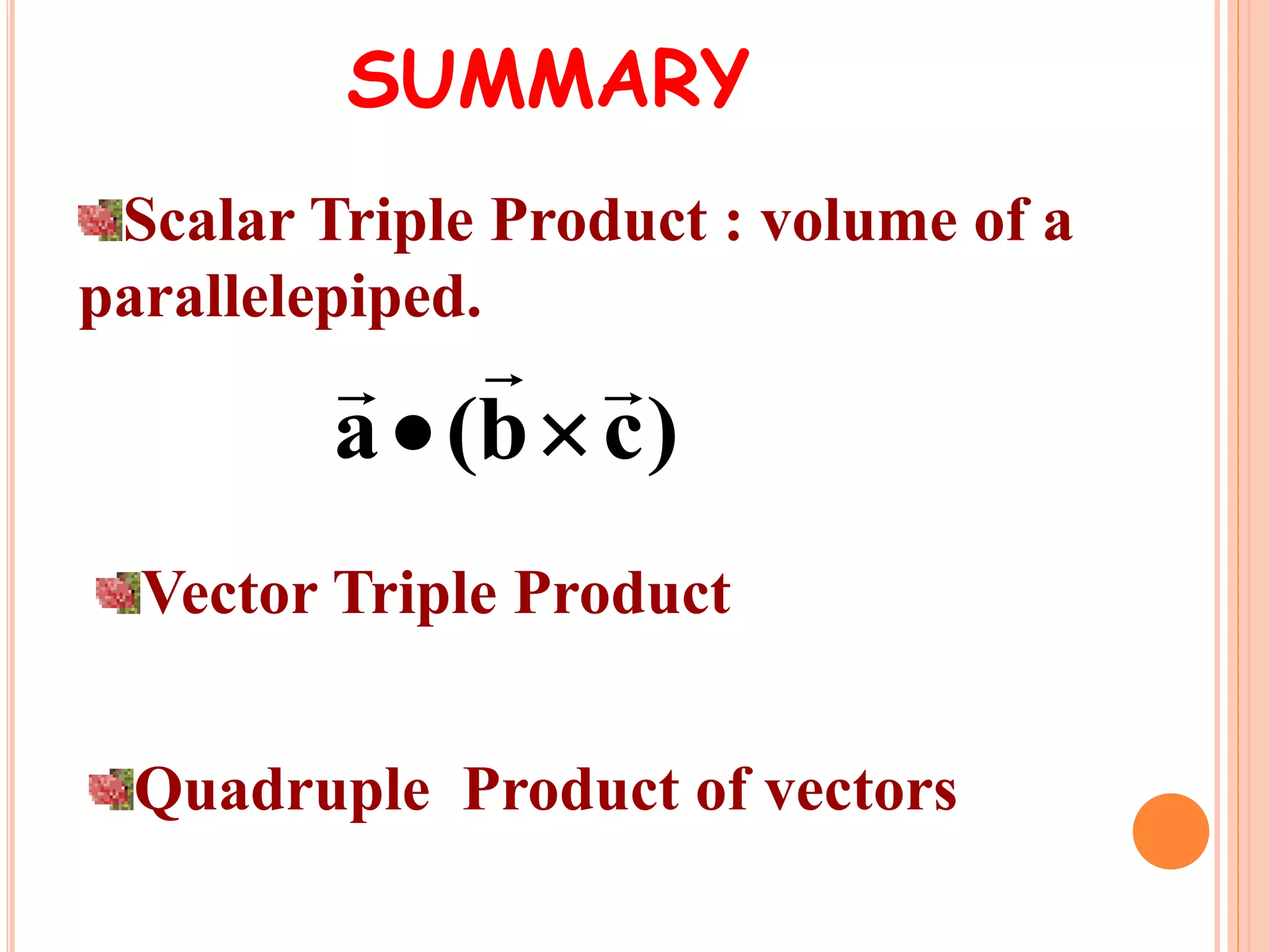

In the realm of vector mathematics, the Scalar Triple Product is a fundamental concept that plays a crucial role in various fields such as physics, engineering, and computer graphics. This product involves three vectors and results in a scalar value, which provides insights into the geometric relationships between the vectors. Understanding the Scalar Triple Product is essential for solving problems related to volumes, areas, and orientations in three-dimensional space.
Understanding the Scalar Triple Product
The Scalar Triple Product of three vectors a, b, and c is defined as the dot product of one vector with the cross product of the other two vectors. Mathematically, it is expressed as:
a · (b × c)
This expression can be interpreted geometrically as the volume of the parallelepiped formed by the three vectors. The magnitude of the Scalar Triple Product gives the volume of this parallelepiped, and its sign indicates the orientation of the vectors.
Geometric Interpretation
The geometric interpretation of the Scalar Triple Product is closely tied to the concept of a parallelepiped. A parallelepiped is a three-dimensional figure formed by six parallelograms. When three vectors a, b, and c are positioned such that they originate from a common point, they define a parallelepiped. The volume of this parallelepiped is given by the absolute value of the Scalar Triple Product of the vectors.
If the vectors a, b, and c are not coplanar, the parallelepiped will have a non-zero volume. If they are coplanar, the volume will be zero, indicating that the Scalar Triple Product is zero.
Mathematical Properties
The Scalar Triple Product has several important mathematical properties that make it a powerful tool in vector analysis:
- Commutativity: The Scalar Triple Product is commutative with respect to cyclic permutations of the vectors. This means that a · (b × c) is equal to b · (c × a) and c · (a × b).
- Anticommutativity: If any two vectors are swapped, the sign of the Scalar Triple Product changes. For example, a · (b × c) is equal to -a · (c × b).
- Linearity: The Scalar Triple Product is linear in each of its arguments. This means that if a, b, and c are vectors and k is a scalar, then k(a · (b × c)) is equal to (ka) · (b × c).
Applications of the Scalar Triple Product
The Scalar Triple Product has numerous applications in various fields. Some of the key areas where it is used include:
- Physics: In classical mechanics, the Scalar Triple Product is used to calculate the torque exerted by a force on a rigid body. It is also used in electromagnetism to determine the magnetic field generated by a current-carrying wire.
- Engineering: In structural engineering, the Scalar Triple Product is used to analyze the stability of structures and to calculate the forces acting on them. It is also used in fluid dynamics to study the flow of fluids through pipes and channels.
- Computer Graphics: In computer graphics, the Scalar Triple Product is used to determine the orientation of objects in three-dimensional space. It is also used in rendering algorithms to calculate the lighting and shading of objects.
Calculating the Scalar Triple Product
To calculate the Scalar Triple Product of three vectors a, b, and c, follow these steps:
- Calculate the cross product of vectors b and c. The cross product is given by the determinant of a matrix formed by the unit vectors i, j, and k and the components of b and c.
- Calculate the dot product of vector a with the result from step 1.
For example, if a = (a1, a2, a3), b = (b1, b2, b3), and c = (c1, c2, c3), the Scalar Triple Product can be calculated using the determinant of a 3x3 matrix:
| a1 | a2 | a3 |
|---|---|---|
| b1 | b2 | b3 |
| c1 | c2 | c3 |
The determinant of this matrix gives the value of the Scalar Triple Product.
💡 Note: The determinant of a 3x3 matrix can be calculated using the rule of Sarrus or by expanding along the first row or column.
Examples of Scalar Triple Product
Let's consider a few examples to illustrate the calculation of the Scalar Triple Product.
Example 1: Calculate the Scalar Triple Product of vectors a = (1, 2, 3), b = (4, 5, 6), and c = (7, 8, 9).
First, calculate the cross product of b and c:
b × c = (5*9 - 6*8, 6*7 - 4*9, 4*8 - 5*7) = (-3, -6, -3)
Next, calculate the dot product of a with the result:
a · (b × c) = 1*(-3) + 2*(-6) + 3*(-3) = -21
Therefore, the Scalar Triple Product of a, b, and c is -21.
Example 2: Calculate the Scalar Triple Product of vectors a = (1, 0, 0), b = (0, 1, 0), and c = (0, 0, 1).
First, calculate the cross product of b and c:
b × c = (1*0 - 0*0, 0*0 - 0*1, 0*1 - 1*0) = (0, 0, 0)
Next, calculate the dot product of a with the result:
a · (b × c) = 1*0 + 0*0 + 0*0 = 0
Therefore, the Scalar Triple Product of a, b, and c is 0, indicating that the vectors are coplanar.
💡 Note: The Scalar Triple Product is zero if and only if the vectors are coplanar.
Scalar Triple Product in Different Coordinate Systems
The Scalar Triple Product can be calculated in different coordinate systems, such as Cartesian, cylindrical, and spherical coordinates. The general approach remains the same, but the components of the vectors and the unit vectors may differ.
In Cartesian coordinates, the Scalar Triple Product is calculated using the determinant of a 3x3 matrix, as shown earlier. In cylindrical and spherical coordinates, the components of the vectors are expressed in terms of the radial, azimuthal, and polar angles, and the unit vectors are different.
For example, in cylindrical coordinates, the unit vectors are e_r, e_φ, and e_z, and the components of a vector a are (a_r, a_φ, a_z). The Scalar Triple Product can be calculated using the determinant of a matrix formed by these components and unit vectors.
In spherical coordinates, the unit vectors are e_r, e_θ, and e_φ, and the components of a vector a are (a_r, a_θ, a_φ). The Scalar Triple Product can be calculated using the determinant of a matrix formed by these components and unit vectors.
💡 Note: The choice of coordinate system depends on the specific problem and the symmetry of the system being studied.
Scalar Triple Product in Physics
The Scalar Triple Product is widely used in physics to solve problems related to forces, torques, and magnetic fields. Some of the key applications include:
- Torque: The torque τ exerted by a force F on a rigid body is given by the cross product of the position vector r and the force vector F. The magnitude of the torque is given by the Scalar Triple Product of r, F, and a unit vector n perpendicular to the plane containing r and F.
- Magnetic Field: The magnetic field B generated by a current-carrying wire is given by the Biot-Savart law, which involves the Scalar Triple Product of the current element Idl, the position vector r, and a unit vector n perpendicular to the plane containing Idl and r.
- Electric Field: The electric field E generated by a charge distribution is given by Coulomb's law, which involves the Scalar Triple Product of the charge element dq, the position vector r, and a unit vector n perpendicular to the plane containing dq and r.
In each of these applications, the Scalar Triple Product provides a convenient way to calculate the magnitude and direction of the resulting vector.
💡 Note: The Scalar Triple Product is a powerful tool in physics for solving problems related to forces, torques, and fields.
Scalar Triple Product in Engineering
The Scalar Triple Product is also widely used in engineering to solve problems related to structures, fluids, and materials. Some of the key applications include:
- Structural Analysis: In structural engineering, the Scalar Triple Product is used to analyze the stability of structures and to calculate the forces acting on them. For example, the Scalar Triple Product can be used to calculate the moment of inertia of a beam or the shear force acting on a truss.
- Fluid Dynamics: In fluid dynamics, the Scalar Triple Product is used to study the flow of fluids through pipes and channels. For example, the Scalar Triple Product can be used to calculate the pressure drop in a pipe or the lift force acting on an airfoil.
- Material Science: In material science, the Scalar Triple Product is used to study the properties of materials and to calculate the stresses and strains acting on them. For example, the Scalar Triple Product can be used to calculate the yield strength of a material or the fracture toughness of a composite.
In each of these applications, the Scalar Triple Product provides a convenient way to calculate the magnitude and direction of the resulting vector.
💡 Note: The Scalar Triple Product is a powerful tool in engineering for solving problems related to structures, fluids, and materials.
Scalar Triple Product in Computer Graphics
The Scalar Triple Product is also used in computer graphics to solve problems related to rendering, animation, and simulation. Some of the key applications include:
- Rendering: In rendering, the Scalar Triple Product is used to calculate the lighting and shading of objects. For example, the Scalar Triple Product can be used to calculate the dot product of the normal vector and the light vector, which determines the intensity of the reflected light.
- Animation: In animation, the Scalar Triple Product is used to calculate the orientation of objects in three-dimensional space. For example, the Scalar Triple Product can be used to calculate the rotation matrix that transforms the object from one orientation to another.
- Simulation: In simulation, the Scalar Triple Product is used to calculate the forces and torques acting on objects. For example, the Scalar Triple Product can be used to calculate the gravitational force acting on a planet or the aerodynamic force acting on an aircraft.
In each of these applications, the Scalar Triple Product provides a convenient way to calculate the magnitude and direction of the resulting vector.
💡 Note: The Scalar Triple Product is a powerful tool in computer graphics for solving problems related to rendering, animation, and simulation.
In conclusion, the Scalar Triple Product is a fundamental concept in vector mathematics that has wide-ranging applications in various fields. It provides a convenient way to calculate the volume of a parallelepiped, the torque exerted by a force, the magnetic field generated by a current, and the orientation of objects in three-dimensional space. Understanding the Scalar Triple Product is essential for solving problems related to volumes, areas, and orientations in three-dimensional space. By mastering this concept, one can gain a deeper understanding of the geometric relationships between vectors and apply it to solve complex problems in physics, engineering, and computer graphics.
Related Terms:
- triple vector product
- scalar triple product example
- scalar triple product proof
- scalar triple product calculator
- scalar triple product definition
- scalar triple product representation