
Geometry is a fascinating branch of mathematics that deals with the properties and relationships of points, lines, surfaces, and solids. Among the various shapes and figures studied in geometry, triangles hold a special place due to their simplicity and the wealth of information they provide. Two types of triangles that often capture the interest of both students and enthusiasts are the right triangle and the equilateral triangle. Understanding these triangles and their properties can lead to a deeper appreciation of geometric principles and their applications in various fields.
Understanding Right Triangles
A right triangle is a triangle that has one angle measuring 90 degrees. This unique property makes right triangles fundamental in many areas of mathematics and science. The sides of a right triangle are named based on their relationship to the right angle:
- Hypotenuse: The side opposite the right angle, which is the longest side.
- Legs (or Catheti): The two sides that form the right angle.
One of the most famous theorems related to right triangles is the Pythagorean theorem, which states that in a right triangle, the square of the length of the hypotenuse (c) is equal to the sum of the squares of the lengths of the other two sides (a and b). Mathematically, this is expressed as:
📝 Note: The Pythagorean theorem is named after the ancient Greek mathematician Pythagoras, although knowledge of the theorem predates him.
a² + b² = c²
This theorem is crucial in solving problems involving right triangles and has numerous applications in fields such as architecture, engineering, and physics.
Understanding Equilateral Triangles
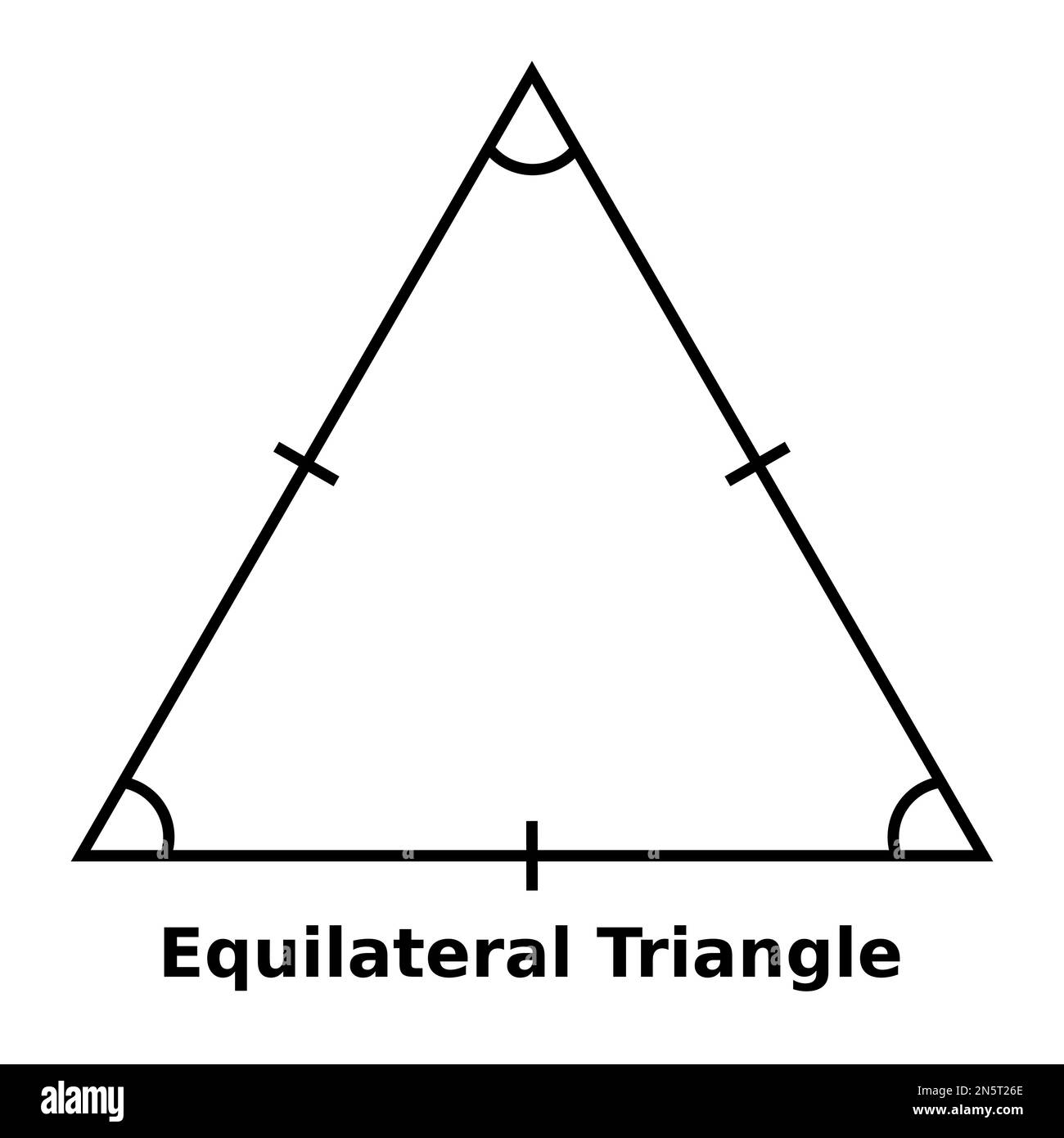
An equilateral triangle is a triangle in which all three sides are of equal length. This property makes the equilateral triangle unique and symmetrical. Each angle in an equilateral triangle measures 60 degrees, making it an equiangular triangle as well. The symmetry and equal sides of an equilateral triangle lead to several interesting properties and applications.
One key property of an equilateral triangle is that it can be divided into two congruent right triangles by drawing an altitude from one vertex to the midpoint of the opposite side. This altitude is also the median and the angle bisector of the triangle. The altitude divides the equilateral triangle into two 30-60-90 right triangles, which have specific side length ratios.
In a 30-60-90 right triangle, the sides are in the ratio 1:√3:2. This means that if the shorter leg (opposite the 30-degree angle) is of length x, the longer leg (opposite the 60-degree angle) is x√3, and the hypotenuse is 2x.
This property is useful in solving problems involving equilateral triangles and right triangles, as it provides a straightforward way to determine the lengths of the sides.
Relationship Between Right Triangles and Equilateral Triangles
While right triangles and equilateral triangles are distinct types of triangles, they are related in several ways. One of the most interesting relationships is that an equilateral triangle can be divided into two congruent right triangles. This division is achieved by drawing an altitude from one vertex to the midpoint of the opposite side, as mentioned earlier.
This relationship is particularly useful in solving problems that involve both right triangles and equilateral triangles. For example, if you need to find the area of an equilateral triangle, you can divide it into two right triangles and use the properties of right triangles to find the area.
Another interesting relationship is that a right triangle can be used to construct an equilateral triangle. This is done by starting with a right triangle and using the properties of the triangle to construct an equilateral triangle. This construction is useful in various geometric proofs and problems.
Applications of Right Triangles and Equilateral Triangles
Right triangles and equilateral triangles have numerous applications in various fields. Some of the most common applications include:
- Architecture and Engineering: Right triangles are used extensively in architecture and engineering to ensure that structures are stable and correctly aligned. The Pythagorean theorem is often used to calculate the lengths of sides in construction projects.
- Navigation: Right triangles are used in navigation to determine distances and directions. For example, the concept of latitude and longitude is based on right triangles.
- Physics: Right triangles are used in physics to analyze forces and vectors. The properties of right triangles are used to solve problems involving motion, energy, and other physical phenomena.
- Computer Graphics: Equilateral triangles are used in computer graphics to create smooth and symmetrical shapes. The properties of equilateral triangles are used to generate 3D models and animations.
- Art and Design: Equilateral triangles are used in art and design to create balanced and harmonious compositions. The symmetry and equal sides of equilateral triangles make them ideal for creating patterns and designs.
In addition to these applications, right triangles and equilateral triangles are used in various mathematical proofs and problems. The properties of these triangles are used to solve problems involving trigonometry, geometry, and calculus.
Constructing a Right Triangle Equilateral Triangle
Constructing a right triangle equilateral triangle involves creating a triangle that is both a right triangle and an equilateral triangle. This is a unique and interesting geometric construction that combines the properties of both types of triangles. Here are the steps to construct a right triangle equilateral triangle:
- Draw a Line Segment: Start by drawing a line segment AB of any length. This will be one side of the right triangle equilateral triangle.
- Construct a Perpendicular Line: At point A, construct a perpendicular line to AB. This line will be one of the legs of the right triangle.
- Draw a Circle: With center at A and radius equal to the length of AB, draw a circle. This circle will intersect the perpendicular line at point C.
- Connect the Points: Connect points A, B, and C to form the right triangle equilateral triangle. Since AB = AC and angle BAC is 90 degrees, triangle ABC is a right triangle. Additionally, since AB = AC = BC, triangle ABC is also an equilateral triangle.
📝 Note: This construction is possible because the properties of right triangles and equilateral triangles allow for the creation of a triangle that satisfies both sets of conditions.
This construction is useful in various geometric problems and proofs. It demonstrates the relationship between right triangles and equilateral triangles and shows how their properties can be combined to create unique geometric figures.
Properties of Right Triangle Equilateral Triangles
A right triangle equilateral triangle is a unique geometric figure that combines the properties of both right triangles and equilateral triangles. Some of the key properties of right triangle equilateral triangles include:
- Equal Sides: All three sides of a right triangle equilateral triangle are of equal length. This property makes it an equilateral triangle.
- Right Angle: One of the angles in a right triangle equilateral triangle is 90 degrees. This property makes it a right triangle.
- Symmetry: Right triangle equilateral triangles are highly symmetrical. This symmetry makes them useful in various geometric constructions and problems.
- Area and Perimeter: The area and perimeter of a right triangle equilateral triangle can be calculated using the properties of both right triangles and equilateral triangles. For example, the area of a right triangle equilateral triangle with side length s is (s²√3)/4, and the perimeter is 3s.
These properties make right triangle equilateral triangles useful in various geometric problems and constructions. They demonstrate the relationship between right triangles and equilateral triangles and show how their properties can be combined to create unique geometric figures.
Solving Problems Involving Right Triangles and Equilateral Triangles
Solving problems involving right triangles and equilateral triangles often requires a combination of geometric principles and algebraic techniques. Here are some steps and strategies for solving problems involving these triangles:
- Identify the Type of Triangle: Determine whether the triangle is a right triangle, an equilateral triangle, or a combination of both. This will help you choose the appropriate geometric principles and formulas.
- Use the Pythagorean Theorem: For right triangles, use the Pythagorean theorem to find the lengths of the sides. This theorem is crucial in solving problems involving right triangles.
- Use the Properties of Equilateral Triangles: For equilateral triangles, use the properties of equal sides and angles to solve problems. The symmetry and equal sides of equilateral triangles make them easier to work with.
- Combine the Properties: For problems involving both right triangles and equilateral triangles, combine the properties of both types of triangles to find the solution. This may involve dividing an equilateral triangle into right triangles or using the properties of right triangles to solve problems involving equilateral triangles.
- Use Algebraic Techniques: In some cases, algebraic techniques may be necessary to solve problems involving right triangles and equilateral triangles. This may involve setting up equations and solving for unknown variables.
📝 Note: Practice is key to becoming proficient in solving problems involving right triangles and equilateral triangles. Work through various problems and examples to develop your skills and understanding.
By following these steps and strategies, you can solve a wide range of problems involving right triangles and equilateral triangles. These problems may involve finding the lengths of sides, calculating areas and perimeters, or solving more complex geometric problems.
Examples of Right Triangle and Equilateral Triangle Problems
Here are some examples of problems involving right triangles and equilateral triangles, along with their solutions:
Example 1: Finding the Length of the Hypotenuse
Problem: In a right triangle, the lengths of the two legs are 3 units and 4 units. Find the length of the hypotenuse.
Solution: Use the Pythagorean theorem to find the length of the hypotenuse. The Pythagorean theorem states that a² + b² = c², where a and b are the lengths of the legs, and c is the length of the hypotenuse.
a² + b² = c²
3² + 4² = c²
9 + 16 = c²
25 = c²
c = √25
c = 5
Therefore, the length of the hypotenuse is 5 units.
Example 2: Finding the Area of an Equilateral Triangle
Problem: Find the area of an equilateral triangle with side length 6 units.
Solution: The area of an equilateral triangle can be calculated using the formula (s²√3)/4, where s is the length of a side.
Area = (6²√3)/4
Area = (36√3)/4
Area = 9√3
Therefore, the area of the equilateral triangle is 9√3 square units.
Example 3: Constructing a Right Triangle Equilateral Triangle
Problem: Construct a right triangle equilateral triangle with side length 5 units.
Solution: Follow the steps outlined earlier to construct a right triangle equilateral triangle. Start by drawing a line segment AB of length 5 units. Construct a perpendicular line at point A and draw a circle with center at A and radius equal to the length of AB. The circle will intersect the perpendicular line at point C. Connect points A, B, and C to form the right triangle equilateral triangle.
By working through these examples, you can develop a better understanding of the properties and applications of right triangles and equilateral triangles. These examples demonstrate the use of geometric principles and algebraic techniques to solve problems involving these triangles.
Advanced Topics in Right Triangles and Equilateral Triangles
For those interested in delving deeper into the world of right triangles and equilateral triangles, there are several advanced topics to explore. These topics build on the fundamental properties and applications of these triangles and provide a more in-depth understanding of their geometric and algebraic properties.
One advanced topic is the study of trigonometric functions and their applications in right triangles. Trigonometric functions, such as sine, cosine, and tangent, are used to analyze the relationships between the angles and sides of right triangles. These functions are crucial in fields such as physics, engineering, and navigation.
Another advanced topic is the study of geometric transformations and their effects on right triangles and equilateral triangles. Geometric transformations, such as rotations, reflections, and translations, can be used to analyze the properties of these triangles and solve more complex geometric problems. For example, rotating an equilateral triangle by 60 degrees results in a new triangle that is congruent to the original triangle.
Additionally, the study of fractals and their relationship to right triangles and equilateral triangles is an interesting advanced topic. Fractals are complex geometric shapes that exhibit self-similarity at different scales. Right triangles and equilateral triangles can be used to construct fractals, such as the Sierpinski triangle, which is a fractal composed of equilateral triangles.
These advanced topics provide a deeper understanding of the properties and applications of right triangles and equilateral triangles. They demonstrate the versatility and complexity of these geometric figures and their role in various fields of study.
In addition to these advanced topics, there are numerous research opportunities in the field of right triangles and equilateral triangles. Researchers can explore new applications of these triangles, develop new geometric constructions, or investigate the properties of these triangles in different mathematical contexts. The study of right triangles and equilateral triangles is a rich and rewarding field of research that offers many opportunities for discovery and innovation.
By exploring these advanced topics and research opportunities, you can deepen your understanding of right triangles and equilateral triangles and contribute to the ongoing development of geometric knowledge.
In the realm of geometry, right triangles and equilateral triangles stand out as fundamental and fascinating shapes. Their unique properties and applications make them essential tools in various fields, from architecture and engineering to physics and computer graphics. Understanding these triangles and their relationships can lead to a deeper appreciation of geometric principles and their practical applications. Whether you are a student, an enthusiast, or a professional, exploring the world of right triangles and equilateral triangles can be a rewarding and enlightening experience. By mastering the properties and applications of these triangles, you can unlock new possibilities in geometry and beyond.
Related Terms:
- right triangle with equal sides
- triangle with all sides equal
- equilateral triangle identification
- triangle with 3 equal angles
- equilateral triangle can't be right
- triangle with three equal sides