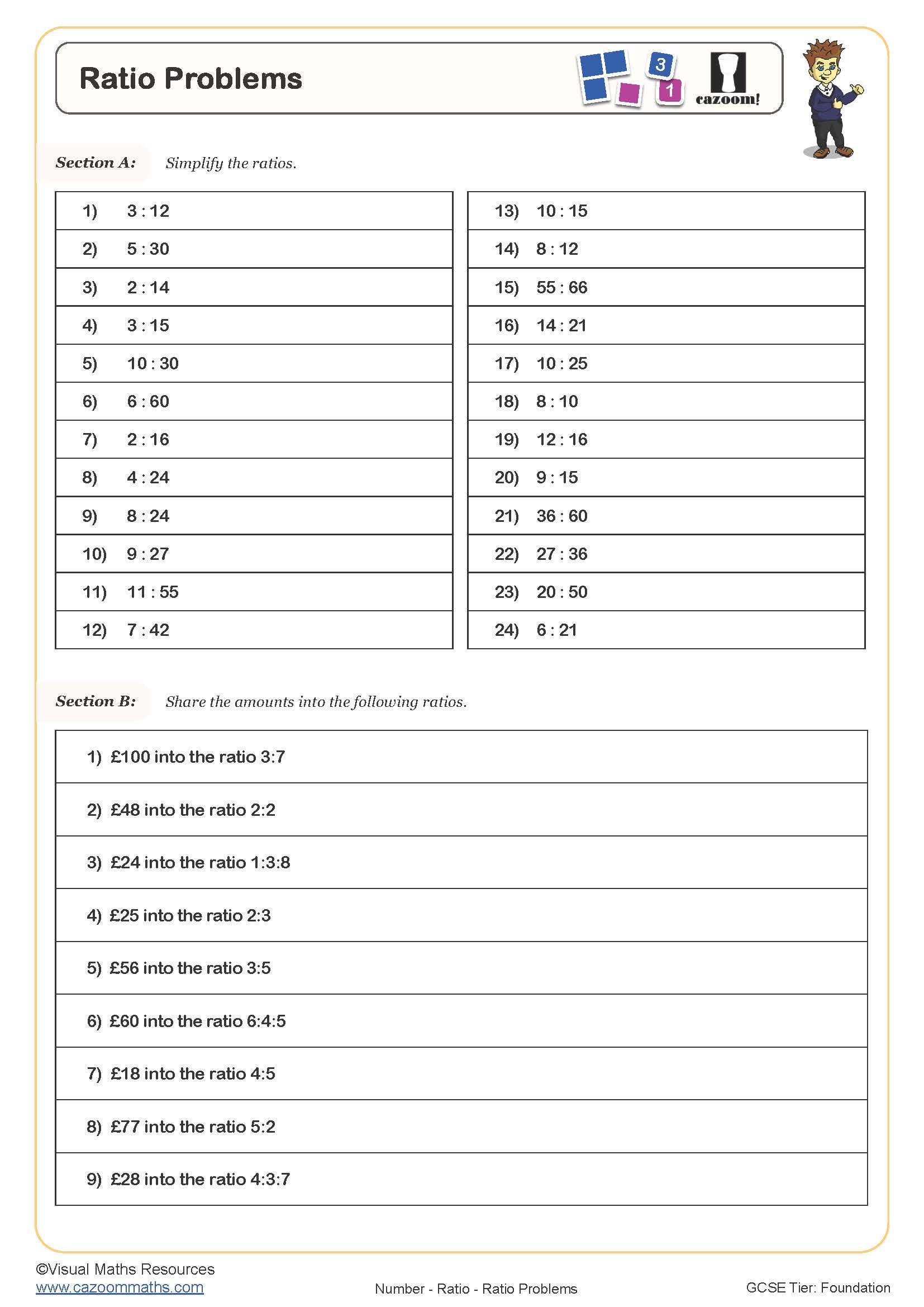

Mathematics is a fundamental subject that forms the basis for many other disciplines. One of the key areas within mathematics is the study of ratios, which are essential for solving a wide range of problems. Ratio word problems are particularly useful in real-world applications, helping students understand how to compare quantities and solve practical issues. This blog post will delve into the intricacies of ratio word problems, providing a comprehensive guide on how to approach and solve them effectively.
Understanding Ratios
Before diving into ratio word problems, it’s crucial to understand what a ratio is. A ratio is a comparison of two quantities. It can be expressed as a fraction, a division, or using the colon (:) symbol. For example, if there are 3 apples and 5 oranges, the ratio of apples to oranges is 3:5.
Types of Ratio Word Problems
Ratio word problems can be categorized into several types, each requiring a different approach to solve. The main types include:
- Part-to-Part Ratios
- Part-to-Whole Ratios
- Comparing Ratios
- Scaling Ratios
Part-to-Part Ratios
Part-to-part ratios compare two different parts of a whole. For example, if a class has 10 boys and 15 girls, the ratio of boys to girls is 10:15, which can be simplified to 2:3.
To solve part-to-part ratio word problems, follow these steps:
- Identify the two quantities being compared.
- Write the ratio in the form of a fraction or using the colon symbol.
- Simplify the ratio if necessary.
💡 Note: Simplifying ratios makes them easier to understand and work with.
Part-to-Whole Ratios
Part-to-whole ratios compare one part of a whole to the entire whole. For instance, if a class has 25 students and 10 of them are boys, the ratio of boys to the total number of students is 10:25, which simplifies to 2:5.
To solve part-to-whole ratio word problems, follow these steps:
- Identify the part and the whole.
- Write the ratio in the form of a fraction or using the colon symbol.
- Simplify the ratio if necessary.
💡 Note: Part-to-whole ratios are often used in percentage calculations.
Comparing Ratios
Comparing ratios involves determining whether two ratios are equivalent. For example, if the ratio of apples to oranges is 3:5 and the ratio of bananas to grapes is 6:10, we need to check if these ratios are equivalent.
To compare ratios, follow these steps:
- Write both ratios in fraction form.
- Cross-multiply to check if the products are equal.
- If the products are equal, the ratios are equivalent.
💡 Note: Cross-multiplication is a quick way to compare ratios.
Scaling Ratios
Scaling ratios involves finding an equivalent ratio by multiplying or dividing both parts by the same number. For example, if the ratio of boys to girls is 2:3, scaling this ratio by 2 gives 4:6.
To scale ratios, follow these steps:
- Identify the scaling factor.
- Multiply or divide both parts of the ratio by the scaling factor.
- Write the new ratio.
💡 Note: Scaling ratios is useful when you need to find equivalent ratios for different quantities.
Solving Ratio Word Problems
Solving ratio word problems requires a systematic approach. Here are some common steps to follow:
- Read the problem carefully to understand what is being compared.
- Identify the quantities involved and write them down.
- Set up the ratio using the appropriate form (fraction, colon, or division).
- Simplify the ratio if necessary.
- Use the ratio to find the missing quantity or to compare different quantities.
Examples of Ratio Word Problems
Let’s look at some examples to illustrate how to solve ratio word problems.
Example 1: Part-to-Part Ratio
In a class, the ratio of boys to girls is 4:5. If there are 20 boys, how many girls are there?
Solution:
- The ratio of boys to girls is 4:5.
- If there are 20 boys, we can set up the ratio as 4⁄5 = 20/x, where x is the number of girls.
- Cross-multiply to solve for x: 4x = 5 * 20.
- 4x = 100.
- x = 25.
Therefore, there are 25 girls in the class.
Example 2: Part-to-Whole Ratio
A recipe calls for 3 cups of flour and 2 cups of sugar. If you want to make half the recipe, how much flour and sugar do you need?
Solution:
- The ratio of flour to the total ingredients is 3:(3+2) = 3:5.
- For half the recipe, we need to scale the ratio by 1⁄2.
- Flour needed = 3 * (1⁄2) = 1.5 cups.
- Sugar needed = 2 * (1⁄2) = 1 cup.
Therefore, you need 1.5 cups of flour and 1 cup of sugar for half the recipe.
Example 3: Comparing Ratios
Compare the ratios 5:7 and 10:14. Are they equivalent?
Solution:
- Write the ratios in fraction form: 5⁄7 and 10⁄14.
- Cross-multiply: 5 * 14 = 70 and 7 * 10 = 70.
- Since 70 = 70, the ratios are equivalent.
Therefore, the ratios 5:7 and 10:14 are equivalent.
Example 4: Scaling Ratios
The ratio of red balls to blue balls is 3:4. If there are 24 red balls, how many blue balls are there?
Solution:
- The ratio of red balls to blue balls is 3:4.
- If there are 24 red balls, we can set up the ratio as 3⁄4 = 24/x, where x is the number of blue balls.
- Cross-multiply to solve for x: 3x = 4 * 24.
- 3x = 96.
- x = 32.
Therefore, there are 32 blue balls.
Common Mistakes to Avoid
When solving ratio word problems, it’s essential to avoid common mistakes that can lead to incorrect answers. Some of these mistakes include:
- Not reading the problem carefully.
- Incorrectly identifying the quantities involved.
- Failing to simplify ratios when necessary.
- Misinterpreting the ratio as a fraction or division.
💡 Note: Double-check your work to ensure accuracy.
Practical Applications of Ratio Word Problems
Ratio word problems have numerous practical applications in various fields. Some of these applications include:
- Cooking and Baking: Adjusting recipe quantities.
- Finance: Calculating interest rates and investment returns.
- Engineering: Designing structures and systems.
- Science: Measuring and comparing quantities.
Understanding how to solve ratio word problems can greatly enhance your problem-solving skills and help you apply mathematical concepts to real-world situations.
Conclusion
Ratio word problems are a fundamental aspect of mathematics that help students understand how to compare quantities and solve practical issues. By following a systematic approach and avoiding common mistakes, you can effectively solve these problems and apply the concepts to various real-world scenarios. Whether you’re adjusting a recipe, calculating interest rates, or designing a structure, understanding ratios is essential for success. Mastering ratio word problems will not only improve your mathematical skills but also enhance your ability to think critically and solve problems efficiently.
Related Terms:
- solving ratios
- ratio word problems 6th grade
- ratio word problems gcse
- ratio word problems pdf
- ratios worksheet
- ratio word problems corbett maths