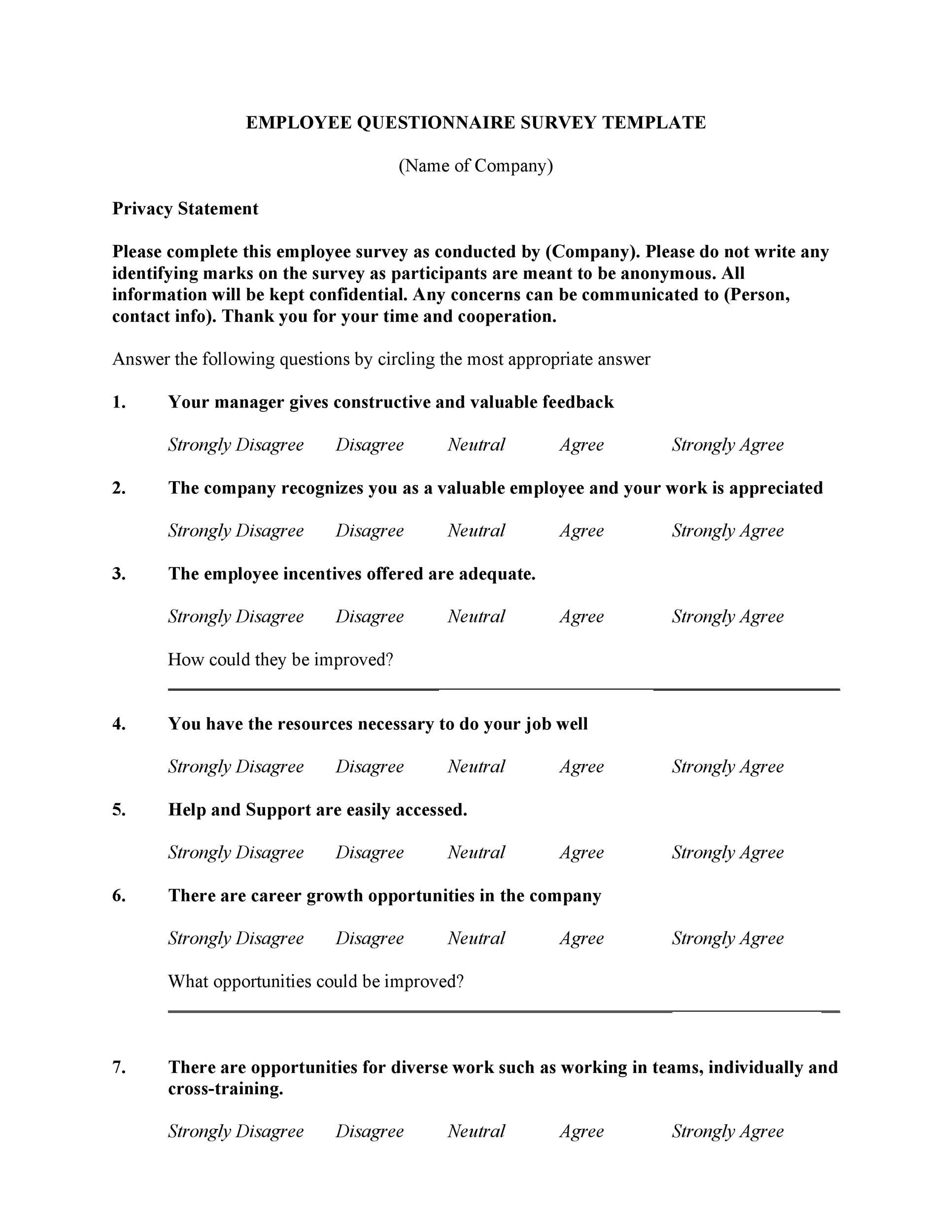

Quantitative questionnaires are essential tools in research and data collection, providing structured methods to gather numerical data that can be statistically analyzed. These questionnaires are designed to measure variables quantitatively, allowing researchers to draw conclusions based on empirical evidence. Understanding the types and examples of quantitative questionnaires can help in designing effective surveys and studies. This post will delve into the various types of quantitative questionnaires, their applications, and provide examples to illustrate their use.
Understanding Quantitative Questionnaires
Quantitative questionnaires are designed to collect data that can be measured and quantified. They typically use closed-ended questions, which offer predefined response options, making the data easier to analyze. These questionnaires are widely used in fields such as market research, social sciences, and healthcare to gather data that can be statistically analyzed.
Types of Quantitative Questionnaires
There are several types of quantitative questionnaires, each serving different purposes and collecting different kinds of data. The most common types include:
- Likert Scale Questionnaires: These questionnaires use a scale to measure attitudes, opinions, or perceptions. Respondents are asked to indicate their level of agreement or disagreement with a statement.
- Multiple Choice Questionnaires: These questionnaires present respondents with a set of predefined options and ask them to choose the one that best fits their response.
- Rating Scale Questionnaires: These questionnaires ask respondents to rate items on a scale, such as satisfaction levels or performance ratings.
- Ranking Questionnaires: These questionnaires ask respondents to rank items in order of preference or importance.
- Demographic Questionnaires: These questionnaires collect information about the characteristics of respondents, such as age, gender, and education level.
Quantitative Questionnaires Examples
To better understand how quantitative questionnaires are used, let's explore some examples of each type.
Likert Scale Questionnaires
Likert scale questionnaires are commonly used in market research and social sciences to measure attitudes and opinions. Here is an example of a Likert scale questionnaire:
Question: How satisfied are you with the customer service provided by our company?
| Strongly Disagree | Disagree | Neutral | Agree | Strongly Agree |
|---|---|---|---|---|
| 1 | 2 | 3 | 4 | 5 |
Respondents select a number from 1 to 5 to indicate their level of satisfaction.
Multiple Choice Questionnaires
Multiple choice questionnaires are straightforward and easy to analyze. Here is an example:
Question: What is your preferred method of communication?
- Phone
- In-person meeting
- Social media
Respondents select one option from the list.
Rating Scale Questionnaires
Rating scale questionnaires are often used to evaluate performance or satisfaction levels. Here is an example:
Question: On a scale of 1 to 10, how would you rate the quality of our product?
| 1 | 2 | 3 | 4 | 5 | 6 | 7 | 8 | 9 | 10 |
|---|
Respondents select a number from 1 to 10 to rate the product.
Ranking Questionnaires
Ranking questionnaires are used to determine the order of preference or importance. Here is an example:
Question: Rank the following features in order of importance to you:
- Price
- Quality
- Customer Service
- Brand Reputation
Respondents rank the features from 1 to 4, with 1 being the most important.
Demographic Questionnaires
Demographic questionnaires collect basic information about respondents. Here is an example:
Question: What is your age?
- Under 18
- 18-24
- 25-34
- 35-44
- 45-54
- 55-64
- 65 or above
Question: What is your gender?
- Male
- Female
- Prefer not to say
Respondents select the appropriate option for each question.
📝 Note: Demographic questionnaires are often included at the beginning or end of a survey to gather background information about the respondents.
Designing Effective Quantitative Questionnaires
Designing effective quantitative questionnaires involves careful planning and consideration of the research objectives. Here are some key steps to follow:
- Define the Research Objectives: Clearly outline what you want to achieve with the questionnaire. This will guide the types of questions you ask and the data you collect.
- Choose the Appropriate Question Types: Select question types that best fit your research objectives. For example, use Likert scales for measuring attitudes and multiple-choice questions for gathering factual information.
- Keep Questions Clear and Concise: Ensure that questions are easy to understand and answer. Avoid jargon and complex language.
- Pilot Test the Questionnaire: Conduct a pilot test with a small group of respondents to identify any issues or ambiguities in the questions. Make necessary adjustments based on the feedback.
- Analyze the Data: Use statistical methods to analyze the data collected. This will help you draw meaningful conclusions and make data-driven decisions.
📝 Note: Always ensure that the questionnaire is user-friendly and that respondents can complete it without difficulty.
Applications of Quantitative Questionnaires
Quantitative questionnaires are used in various fields to gather data and make informed decisions. Some common applications include:
- Market Research: Companies use quantitative questionnaires to understand consumer preferences, market trends, and customer satisfaction.
- Healthcare: Healthcare providers use questionnaires to assess patient outcomes, satisfaction levels, and the effectiveness of treatments.
- Education: Educational institutions use questionnaires to evaluate student performance, teaching effectiveness, and program outcomes.
- Social Sciences: Researchers use questionnaires to study social phenomena, attitudes, and behaviors.
Quantitative questionnaires provide a structured and systematic way to collect data, making them invaluable tools in research and data analysis.
Quantitative questionnaires are versatile tools that can be adapted to various research needs. By understanding the different types and examples of quantitative questionnaires, researchers can design effective surveys that yield valuable insights. Whether used in market research, healthcare, education, or social sciences, quantitative questionnaires play a crucial role in gathering data that can be statistically analyzed and used to make informed decisions.
In summary, quantitative questionnaires are essential for collecting numerical data that can be analyzed to draw meaningful conclusions. By using appropriate question types and following best practices in questionnaire design, researchers can gather reliable and valid data. The examples provided illustrate the versatility of quantitative questionnaires and their applications in various fields. Understanding and utilizing these tools effectively can enhance the quality of research and data analysis, leading to better decision-making and outcomes.
Related Terms:
- examples of a quantitative question
- types of quantitative questionnaire
- sample research questionnaire quantitative
- sample quantitative survey questionnaire
- example of quantitative survey questions
- sample questions in quantitative research