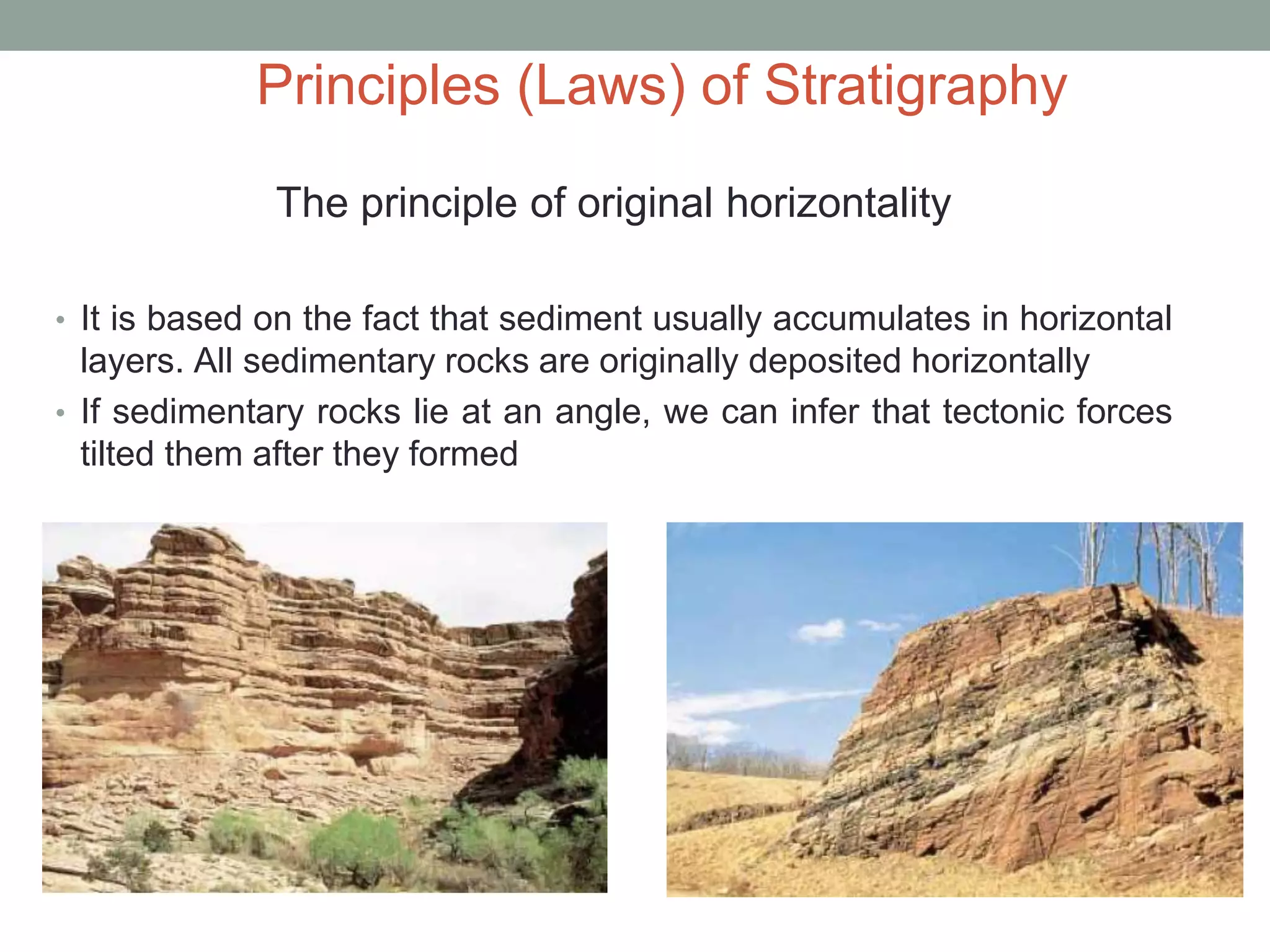

Geology is a fascinating field that delves into the Earth's history, structure, and processes. One of the fundamental principles that guide geologists in understanding the Earth's layers is the Principle of Original Horizontality. This principle states that layers of sediment are originally deposited horizontally under the action of gravity. This foundational concept is crucial for interpreting the geological history of an area and understanding the forces that have shaped the Earth over time.
Understanding the Principle of Original Horizontality
The Principle of Original Horizontality is one of the key principles of stratigraphy, the branch of geology that studies rock layers (strata) and layering (stratification). This principle was first articulated by the Danish geologist Nicolaus Steno in the 17th century. Steno's observations laid the groundwork for modern geology, providing a framework for understanding how sedimentary rocks form and how they can be used to interpret Earth's history.
When sediments are deposited in bodies of water or on land, they settle out in horizontal layers. This is because gravity pulls the sediment particles downwards, and the water or air resistance ensures that they settle in a flat, horizontal manner. Over time, these layers can accumulate to form thick sequences of sedimentary rock. The Principle of Original Horizontality assumes that these layers were originally deposited in a horizontal position, and any deviations from this horizontal orientation are due to subsequent geological processes such as tectonic activity, folding, or faulting.
Importance of the Principle of Original Horizontality
The Principle of Original Horizontality is essential for several reasons:
- Interpreting Geological History: By understanding that sedimentary layers were originally horizontal, geologists can infer the relative ages of different rock layers. Younger layers are deposited on top of older layers, allowing geologists to create a timeline of geological events.
- Identifying Tectonic Activity: Deviations from horizontal layers can indicate tectonic activity. For example, folded or tilted layers suggest that the area has experienced compressional or extensional forces, which can provide insights into the tectonic history of the region.
- Resource Exploration: The principle is also crucial in the exploration for natural resources. Many valuable resources, such as oil, gas, and minerals, are found in sedimentary rocks. Understanding the original horizontal deposition of these rocks helps in predicting where these resources might be located.
Applications of the Principle of Original Horizontality
The Principle of Original Horizontality has numerous applications in various fields of geology and related sciences. Some of the key applications include:
- Stratigraphic Analysis: Geologists use this principle to analyze the sequence of rock layers and determine the relative ages of different strata. This helps in reconstructing the geological history of an area.
- Structural Geology: By identifying deviations from horizontal layers, geologists can map out the structural features of an area, such as folds, faults, and unconformities. This information is crucial for understanding the tectonic forces that have shaped the Earth's crust.
- Paleontology: The principle aids in the study of fossils by providing a framework for understanding the depositional environments in which fossils were preserved. This helps paleontologists reconstruct ancient ecosystems and understand the evolution of life on Earth.
- Environmental Geology: The principle is also applied in environmental studies to understand the depositional history of sediments in areas affected by natural disasters, such as floods and landslides. This information can be used to assess the risk of future events and develop mitigation strategies.
Examples of the Principle of Original Horizontality in Action
To illustrate the Principle of Original Horizontality, let's consider a few examples:
Example 1: The Grand Canyon
The Grand Canyon in Arizona, USA, is a classic example of the Principle of Original Horizontality in action. The canyon exposes nearly 2 billion years of Earth's history through its layered rock formations. The horizontal layers of sedimentary rocks, such as the Coconino Sandstone and the Redwall Limestone, were originally deposited in a horizontal position. The canyon's steep walls and deep gorge are the result of millions of years of erosion by the Colorado River, which has cut through the layers, exposing their original horizontal orientation.
Example 2: The Appalachian Mountains
The Appalachian Mountains in eastern North America provide another example. The sedimentary rocks in this region were originally deposited horizontally in ancient seas. However, tectonic activity during the Paleozoic era caused these layers to be folded and faulted, creating the mountainous terrain we see today. By understanding the Principle of Original Horizontality, geologists can interpret the complex structural features of the Appalachians and reconstruct the tectonic events that shaped the region.
Example 3: Oil and Gas Exploration
In the oil and gas industry, the Principle of Original Horizontality is used to identify potential reservoirs. Sedimentary rocks, such as shales and sandstones, are often deposited in horizontal layers. Over time, these layers can be folded or faulted, creating traps where oil and gas can accumulate. By understanding the original horizontal deposition of these rocks, geologists can predict where these traps might be located and drill exploratory wells to test for the presence of hydrocarbons.
Challenges and Limitations
While the Principle of Original Horizontality is a powerful tool for understanding geological processes, it is not without its challenges and limitations. Some of the key challenges include:
- Complex Tectonic Histories: In regions with complex tectonic histories, the original horizontal layers may have been significantly deformed, making it difficult to interpret the geological record.
- Erosion and Weathering: Erosion and weathering can remove or alter the original horizontal layers, making it challenging to reconstruct the depositional history of an area.
- Diagenesis: Diagenesis, the process by which sediments are transformed into sedimentary rocks, can also alter the original horizontal layers. For example, compaction and cementation can cause the layers to become more compact and less distinct.
Despite these challenges, the Principle of Original Horizontality remains a fundamental concept in geology, providing a framework for interpreting the Earth's history and understanding the processes that shape our planet.
📝 Note: The Principle of Original Horizontality is just one of several key principles in stratigraphy. Other important principles include the Principle of Superposition, the Principle of Cross-Cutting Relationships, and the Principle of Inclusion. Together, these principles provide a comprehensive framework for understanding the Earth's geological history.
To further illustrate the Principle of Original Horizontality, consider the following table, which outlines the key features of horizontal and deformed sedimentary layers:
| Feature | Horizontal Layers | Deformed Layers |
|---|---|---|
| Orientation | Horizontal | Tilted, folded, or faulted |
| Depositional Environment | Quiet, undisturbed | Tectonically active |
| Relative Age | Younger layers on top | Relative age may be obscured |
| Structural Features | None | Folds, faults, unconformities |
By comparing horizontal and deformed layers, geologists can gain insights into the geological processes that have shaped an area over time. This information is crucial for interpreting the Earth's history and understanding the forces that continue to shape our planet.
In conclusion, the Principle of Original Horizontality is a cornerstone of geology, providing a fundamental framework for understanding the Earth’s sedimentary layers and the processes that have shaped them. By applying this principle, geologists can interpret the relative ages of rock layers, identify tectonic activity, and explore for natural resources. Despite its challenges and limitations, the Principle of Original Horizontality remains an essential tool for unraveling the complex history of our planet. Understanding this principle allows us to appreciate the dynamic nature of the Earth and the forces that have shaped its surface over billions of years.
Related Terms:
- law of superposition
- principle of superposition
- cross cutting relationships
- principle of original horizontality definition
- principle of original horizontality example
- principle of cross cutting relationship