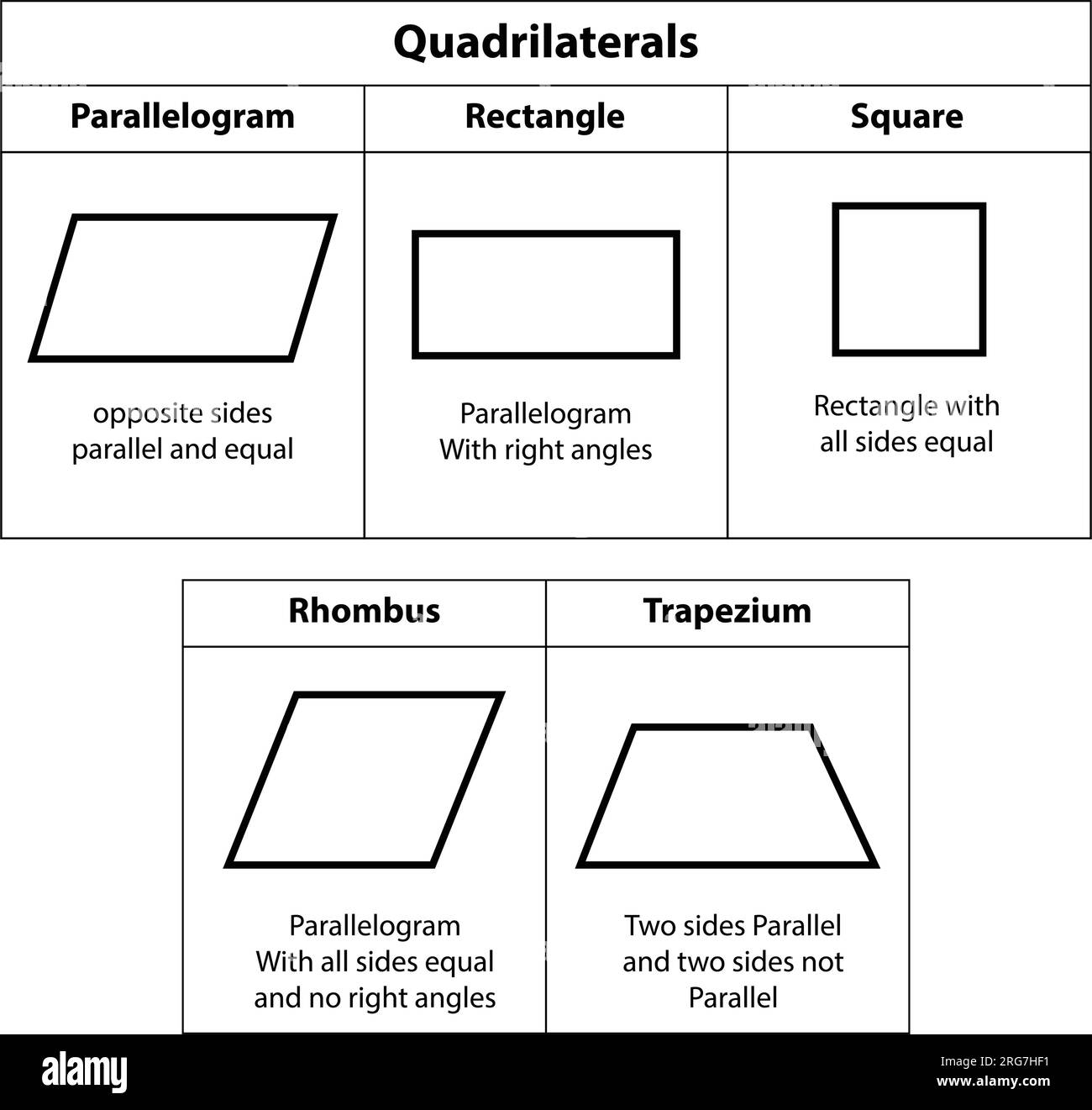

Exploring the world of geometry can be both fascinating and educational, especially when delving into the intricacies of parallel sides shapes. These shapes, characterized by their parallel sides, are fundamental in various fields, from architecture to engineering. Understanding their properties and applications can provide a deeper appreciation for the mathematical principles that govern our world.
Understanding Parallel Sides Shapes
Parallel sides shapes are geometric figures where at least one pair of sides are parallel. The most common examples include parallelograms, rectangles, and trapezoids. Each of these shapes has unique properties that make them useful in different contexts.
Parallelograms
A parallelogram is a quadrilateral with two pairs of parallel sides. The opposite sides are equal in length, and the opposite angles are equal. Parallelograms can be further classified into special types such as rectangles, rhombuses, and squares.
Key properties of parallelograms include:
- Opposite sides are equal and parallel.
- Opposite angles are equal.
- The diagonals bisect each other.
Rectangles
A rectangle is a special type of parallelogram where all angles are right angles (90 degrees). This makes rectangles particularly useful in applications requiring right-angled structures, such as building design and furniture making.
Key properties of rectangles include:
- All angles are 90 degrees.
- Opposite sides are equal and parallel.
- The diagonals are equal in length and bisect each other.
Trapezoids
A trapezoid, also known as a trapezium in some regions, is a quadrilateral with at least one pair of parallel sides. The non-parallel sides are called the legs, and the parallel sides are called the bases. Trapezoids are commonly used in engineering and architecture for their ability to distribute weight evenly.
Key properties of trapezoids include:
- One pair of opposite sides are parallel.
- The sum of the angles on the same side of the parallel sides is 180 degrees.
- The area can be calculated using the formula: Area = (1/2) * (sum of the lengths of the parallel sides) * height.
Applications of Parallel Sides Shapes
Parallel sides shapes are ubiquitous in various fields due to their structural stability and geometric properties. Here are some key applications:
Architecture and Construction
In architecture, parallel sides shapes are essential for creating stable and aesthetically pleasing structures. Rectangles and parallelograms are commonly used in the design of walls, floors, and roofs. Trapezoids are often used in the design of staircases and ramps to ensure smooth transitions between different levels.
Engineering
In engineering, parallel sides shapes are used in the design of bridges, buildings, and machinery. The stability and strength of these shapes make them ideal for load-bearing structures. For example, trapezoidal trusses are used in bridge construction to distribute weight evenly and provide structural support.
Art and Design
In art and design, parallel sides shapes are used to create visually appealing compositions. Artists and designers often use rectangles and parallelograms to create balance and symmetry in their work. Trapezoids can be used to create dynamic and interesting shapes that draw the eye.
Mathematical Properties and Formulas
Understanding the mathematical properties and formulas associated with parallel sides shapes is crucial for solving geometric problems and applying these shapes in practical scenarios.
Area and Perimeter Formulas
Here are the formulas for calculating the area and perimeter of common parallel sides shapes:
| Shape | Area Formula | Perimeter Formula |
|---|---|---|
| Parallelogram | Area = base * height | Perimeter = 2 * (base + side) |
| Rectangle | Area = length * width | Perimeter = 2 * (length + width) |
| Trapezoid | Area = (1/2) * (sum of the lengths of the parallel sides) * height | Perimeter = sum of all sides |
📝 Note: The height in these formulas refers to the perpendicular distance between the parallel sides.
Diagonal Properties
The diagonals of parallel sides shapes have unique properties that can be useful in various geometric proofs and constructions. For example, the diagonals of a parallelogram bisect each other, meaning they intersect at their midpoints. This property is crucial in proving the congruence of triangles and other geometric figures.
Examples and Illustrations
To better understand parallel sides shapes, let's look at some examples and illustrations.

In the above image, we see a parallelogram with opposite sides equal and parallel. The diagonals intersect at their midpoints, illustrating the bisecting property.

This image shows a rectangle with all angles equal to 90 degrees. The diagonals are equal in length and bisect each other, demonstrating the properties of a rectangle.

Here, we have a trapezoid with one pair of parallel sides. The non-parallel sides are the legs, and the parallel sides are the bases. The area can be calculated using the formula provided earlier.
These illustrations help visualize the properties and applications of parallel sides shapes, making it easier to understand their significance in various fields.
Parallel sides shapes are not just theoretical constructs; they have practical applications that make them indispensable in many areas of study and industry. From architecture to engineering, these shapes provide the foundation for stable and efficient structures. Understanding their properties and formulas allows us to apply them effectively in real-world scenarios, ensuring that our designs and constructions are both functional and aesthetically pleasing.
Related Terms:
- picture of parallel sides
- what shapes have parallel sides
- shape with 2 parallel sides
- 2 pairs of parallel sides
- are parallel sides equal
- parallel sides examples