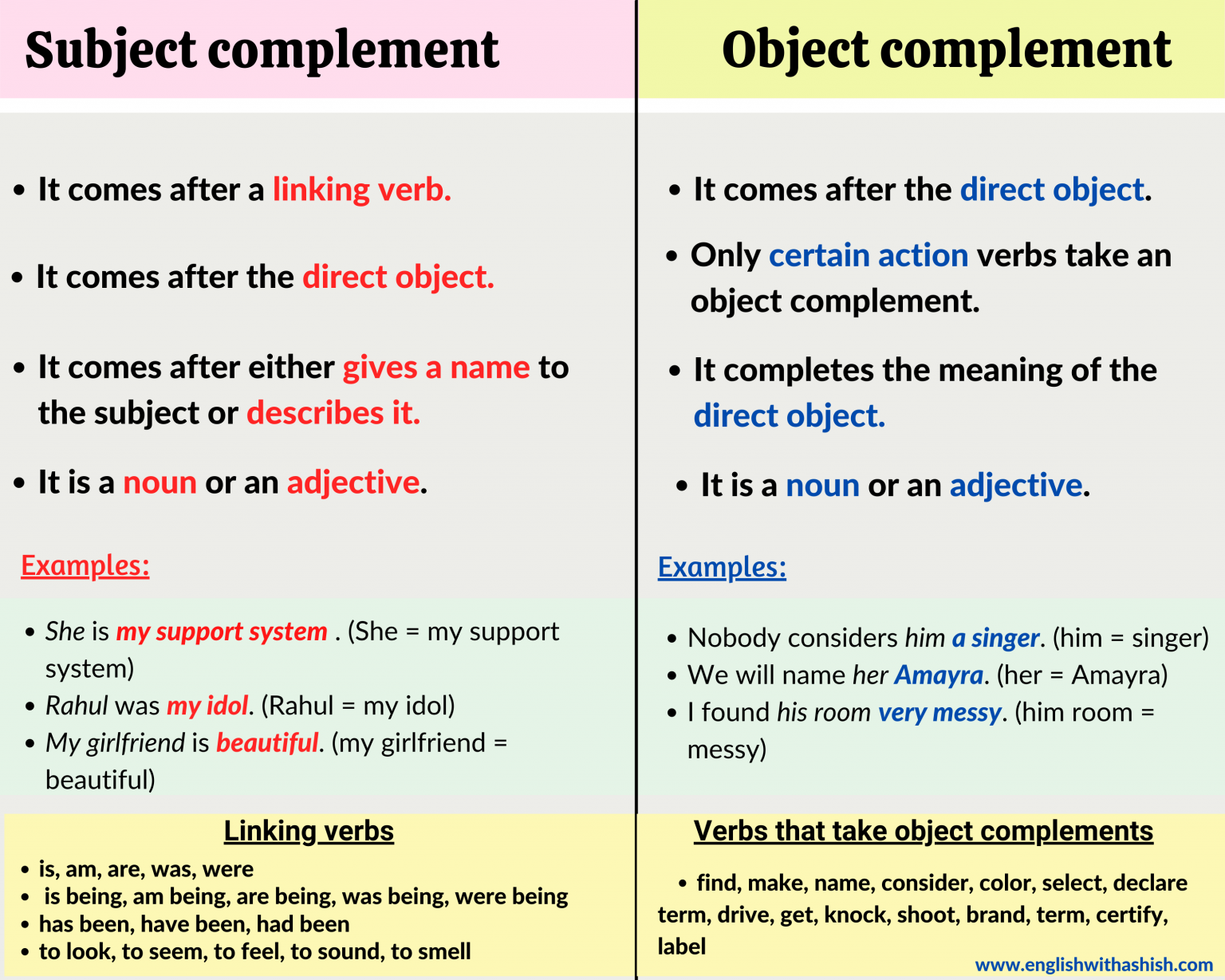

Understanding the intricacies of grammar can be a challenging yet rewarding endeavor. One of the more nuanced aspects of English grammar is the concept of the object of complement. This grammatical structure plays a crucial role in sentence construction and meaning. By delving into the details of the object of complement, we can gain a deeper appreciation for how language functions and how to use it effectively.
What is an Object of Complement?
The object of complement is a grammatical term that refers to a noun or pronoun that follows a direct object and completes the meaning of the sentence. It is often used in sentences where the verb requires both a direct object and a complement to convey a complete thought. For example, in the sentence "She considers him a genius," "him" is the direct object, and "a genius" is the object of complement.
Identifying the Object of Complement
To identify the object of complement in a sentence, follow these steps:
- Identify the verb in the sentence.
- Determine the direct object of the verb.
- Look for a noun or pronoun that follows the direct object and completes the meaning of the sentence.
For example, in the sentence "They elected her president," "her" is the direct object, and "president" is the object of complement.
Types of Complements
Complements can take various forms, each serving a different grammatical function. The most common types of complements include:
- Subject Complements: These complements rename or describe the subject of the sentence. For example, in "She is a doctor," "a doctor" is the subject complement.
- Object Complements: These complements rename or describe the direct object of the sentence. For example, in "They named the baby Lily," "Lily" is the object of complement.
- Predicate Nominatives: These are nouns or pronouns that follow a linking verb and rename the subject. For example, in "He became a teacher," "a teacher" is the predicate nominative.
- Predicate Adjectives: These are adjectives that follow a linking verb and describe the subject. For example, in "She looks happy," "happy" is the predicate adjective.
Examples of Object of Complement in Sentences
To better understand the object of complement, let's look at some examples:
- They appointed him chairman. (Here, "him" is the direct object, and "chairman" is the object of complement.)
- She painted the wall blue. (Here, "the wall" is the direct object, and "blue" is the object of complement.)
- We found the book interesting. (Here, "the book" is the direct object, and "interesting" is the object of complement.)
In each of these examples, the object of complement provides additional information about the direct object, completing the meaning of the sentence.
Common Verbs that Take an Object of Complement
Certain verbs frequently require an object of complement to convey a complete thought. Some of the most common verbs that take an object of complement include:
- Consider
- Elect
- Name
- Appoint
- Paint
- Find
- Make
- Call
- Think
- Believe
For example, in the sentence "They elected her president," the verb "elected" requires both a direct object ("her") and an object of complement ("president") to convey the complete thought.
Grammatical Structures Involving the Object of Complement
The object of complement can appear in various grammatical structures, each with its own nuances. Some common structures include:
- Verb + Direct Object + Object of Complement: This is the most basic structure, where the verb is followed by a direct object and then an object of complement. For example, "They named the baby Lily."
- Verb + Direct Object + Adjective Complement: In this structure, the object of complement is an adjective that describes the direct object. For example, "She found the movie boring."
- Verb + Direct Object + Noun Complement: Here, the object of complement is a noun that renames or describes the direct object. For example, "They appointed him chairman."
Understanding these structures can help in constructing sentences that are grammatically correct and convey the intended meaning clearly.
Practical Applications of the Object of Complement
The object of complement is not just a theoretical concept; it has practical applications in various fields. For example:
- Writing and Editing: Understanding the object of complement can help writers and editors create clear and concise sentences. It ensures that the meaning is conveyed accurately and that the sentence structure is grammatically correct.
- Language Learning: For language learners, grasping the concept of the object of complement is essential for mastering sentence construction and improving overall language proficiency.
- Public Speaking: Effective public speakers use the object of complement to structure their sentences in a way that is easy to understand and remember. This helps in delivering clear and impactful messages.
By mastering the object of complement, individuals can enhance their communication skills and express their thoughts more effectively.
📝 Note: The object of complement is a versatile grammatical tool that can be used in various contexts to enhance clarity and precision in communication.
In addition to its practical applications, the object of complement also plays a crucial role in literary analysis. Writers often use this grammatical structure to create vivid and descriptive sentences that engage readers and convey complex ideas. For example, in the sentence "She described the sunset as breathtaking," the object of complement "breathtaking" adds depth and emotion to the description.
Common Mistakes and How to Avoid Them
While the object of complement is a powerful tool, it is also a common source of grammatical errors. Some of the most frequent mistakes include:
- Misidentifying the Direct Object: It is essential to correctly identify the direct object before determining the object of complement. For example, in the sentence "They found the book interesting," "the book" is the direct object, and "interesting" is the object of complement.
- Using Incorrect Complements: Ensure that the object of complement correctly describes or renames the direct object. For example, in the sentence "She painted the wall blue," "blue" is the correct object of complement because it describes the color of the wall.
- Omitting the Object of Complement: Some verbs require an object of complement to convey a complete thought. Omitting it can result in an incomplete or unclear sentence. For example, in the sentence "They elected her," the sentence is incomplete without the object of complement "president."
To avoid these mistakes, carefully analyze the sentence structure and ensure that the object of complement is correctly identified and used.
📝 Note: Paying attention to sentence structure and verb requirements can help in correctly identifying and using the object of complement.
Advanced Usage of the Object of Complement
For those looking to take their understanding of the object of complement to the next level, there are several advanced techniques and considerations:
- Complex Sentences: The object of complement can be used in complex sentences to create intricate and nuanced meanings. For example, "Although they considered him a genius, his ideas were often overlooked."
- Passive Voice: The object of complement can also appear in passive voice constructions. For example, "He was appointed chairman by the board."
- Relative Clauses: The object of complement can be part of relative clauses to provide additional information. For example, "The book, which they found interesting, was a bestseller."
By exploring these advanced usages, individuals can enhance their grammatical skills and create more sophisticated and nuanced sentences.
In addition to these advanced techniques, it is also important to consider the context in which the object of complement is used. The meaning and impact of the sentence can vary depending on the context, so it is essential to choose the object of complement carefully to convey the intended message effectively.
📝 Note: Advanced usage of the object of complement requires a deep understanding of sentence structure and context. Practice and careful analysis can help in mastering these techniques.
Examples of Object of Complement in Literature
Literature is rich with examples of the object of complement used to create vivid and descriptive sentences. Here are a few notable examples:
- Jane Austen's "Pride and Prejudice": "She considered him a proud and arrogant man." In this sentence, "a proud and arrogant man" is the object of complement that describes the direct object "him."
- F. Scott Fitzgerald's "The Great Gatsby": "He found the party boring." Here, "boring" is the object of complement that describes the direct object "the party."
- Ernest Hemingway's "The Old Man and the Sea": "He considered the fish a worthy opponent." In this sentence, "a worthy opponent" is the object of complement that describes the direct object "the fish."
These examples illustrate how the object of complement can be used to create rich and engaging descriptions that enhance the reader's understanding and enjoyment of the text.
In addition to these examples, the object of complement can also be found in various forms of media, including movies, television shows, and songs. By paying attention to how the object of complement is used in these contexts, individuals can gain a deeper appreciation for its versatility and importance in communication.
📝 Note: The object of complement is a versatile grammatical tool that can be used in various contexts to enhance clarity and precision in communication.
Object of Complement in Different Languages
The concept of the object of complement is not unique to English; it exists in various forms in other languages as well. Understanding how the object of complement functions in different languages can provide insights into the universal principles of grammar and language structure. Here are a few examples:
- Spanish: In Spanish, the object of complement is often introduced by the preposition "a." For example, "Lo consideraron un genio" translates to "They considered him a genius." Here, "un genio" is the object of complement.
- French: In French, the object of complement can be introduced by the preposition "de." For example, "Ils l'ont nommé président" translates to "They named him president." Here, "président" is the object of complement.
- German: In German, the object of complement can be introduced by the preposition "zu." For example, "Sie wählten ihn zum Vorsitzenden" translates to "They elected him chairman." Here, "zum Vorsitzenden" is the object of complement.
By comparing the object of complement in different languages, we can gain a deeper understanding of how grammar functions across linguistic boundaries and how it contributes to effective communication.
In addition to these examples, the object of complement can also be found in various other languages, each with its own unique grammatical rules and structures. By exploring these differences, individuals can gain a broader perspective on the universality of grammar and the importance of the object of complement in language.
📝 Note: The object of complement is a universal grammatical concept that exists in various forms in different languages. Understanding its function in different linguistic contexts can provide valuable insights into the principles of grammar and language structure.
To further illustrate the use of the object of complement in different languages, let's look at a table comparing its usage in English, Spanish, French, and German:
| Language | Sentence | Object of Complement |
|---|---|---|
| English | They considered him a genius. | a genius |
| Spanish | Lo consideraron un genio. | un genio |
| French | Ils l'ont nommé président. | président |
| German | Sie wählten ihn zum Vorsitzenden. | zum Vorsitzenden |
This table highlights the similarities and differences in how the object of complement is used in different languages, providing a clear comparison of its grammatical function and structure.
In conclusion, the object of complement is a fundamental aspect of grammar that plays a crucial role in sentence construction and meaning. By understanding its function and usage, individuals can enhance their communication skills and express their thoughts more effectively. Whether in writing, speaking, or language learning, mastering the object of complement is essential for clear and precise communication.
Related Terms:
- subject complement examples sentences
- difference between object and complement
- subjective complement vs objective
- simple sentences with object complements
- subject complement vs object
- object complement examples sentences