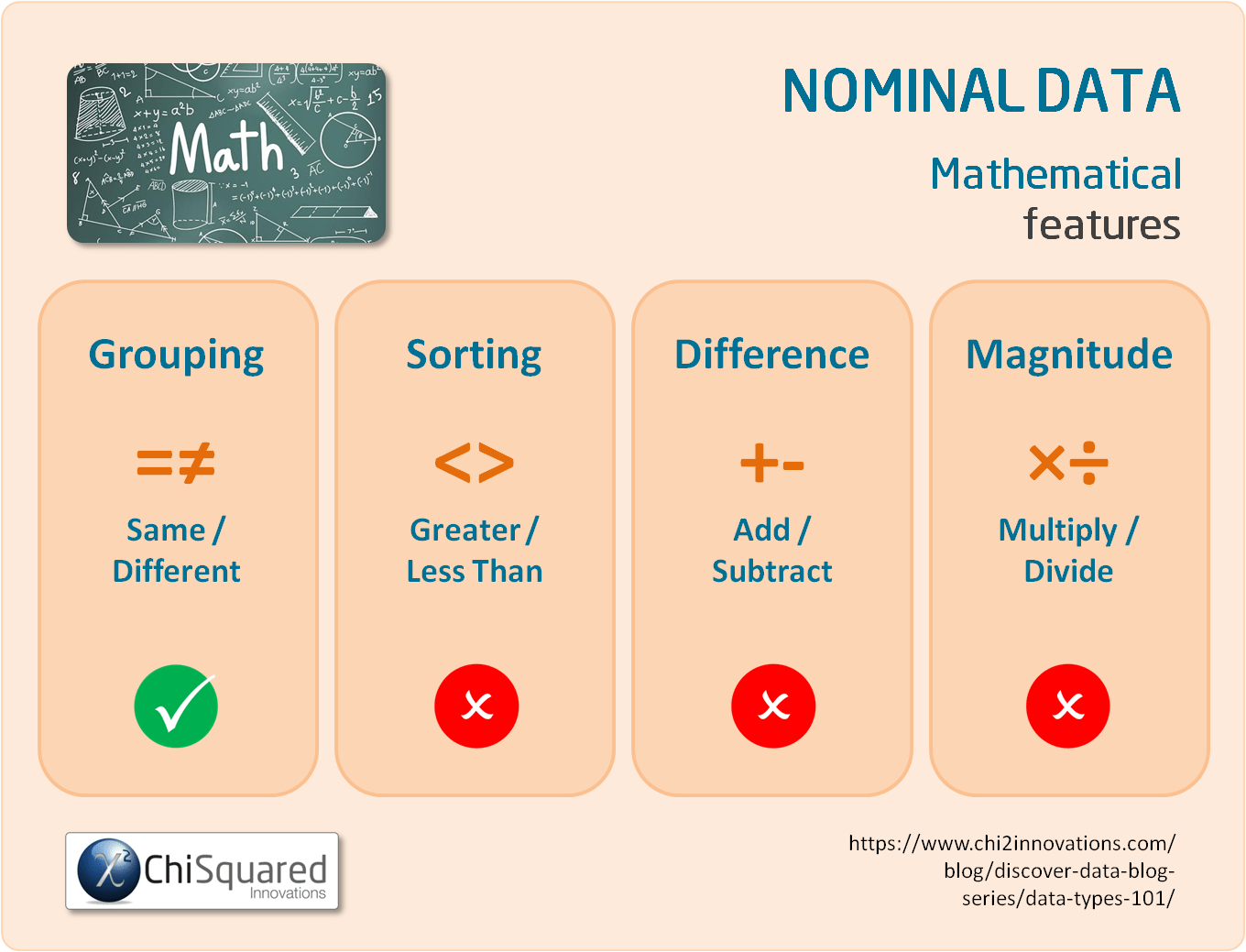

Data analysis is a critical component of modern decision-making processes, and understanding the different types of data is fundamental to effective analysis. One of the most basic types of data is nominal data. Nominal data is categorical data that is used for labeling or naming variables without any quantitative value. This type of data is essential in various fields, including market research, social sciences, and healthcare. In this post, we will delve into the intricacies of nominal data, providing a comprehensive nominal data example to illustrate its applications and significance.
Understanding Nominal Data
Nominal data is characterized by its categorical nature, where each category is distinct and mutually exclusive. Unlike ordinal data, which has a natural ordering, nominal data does not imply any ranking or hierarchy. For instance, gender, race, and marital status are all examples of nominal data. These categories are used to classify individuals without any inherent order.
Characteristics of Nominal Data
To better understand nominal data, let’s explore its key characteristics:
- Categorical Nature: Nominal data consists of categories or labels that describe a characteristic.
- No Quantitative Value: The categories do not have any numerical value or order.
- Mutually Exclusive: Each category is distinct and does not overlap with others.
- Exhaustive: The categories cover all possible outcomes.
Examples of Nominal Data
To provide a clearer picture, let’s consider a few nominal data examples:
- Gender: Male, Female, Non-binary
- Marital Status: Single, Married, Divorced, Widowed
- Blood Type: A, B, AB, O
- Eye Color: Blue, Green, Brown, Hazel
Applications of Nominal Data
Nominal data is widely used in various fields due to its simplicity and effectiveness in categorizing information. Here are some common applications:
- Market Research: Understanding consumer preferences and demographics.
- Healthcare: Classifying patients based on medical conditions or treatments.
- Social Sciences: Analyzing social behaviors and attitudes.
- Education: Categorizing students based on performance or attendance.
Analyzing Nominal Data
Analyzing nominal data involves statistical methods that are suitable for categorical variables. Some common techniques include:
- Frequency Distribution: Counting the number of occurrences of each category.
- Mode: Identifying the most frequently occurring category.
- Chi-Square Test: Determining the relationship between two nominal variables.
Nominal Data Example in Market Research
Let’s consider a nominal data example in the context of market research. Suppose a company wants to understand the preferences of its customers regarding different product features. They conduct a survey asking customers to choose their preferred feature from a list of options. The results might look something like this:
| Feature | Number of Responses |
|---|---|
| Color | 50 |
| Size | 30 |
| Material | 45 |
| Price | 25 |
In this example, the nominal data helps the company identify which feature is most important to their customers. By analyzing the frequency distribution, they can see that "Color" is the most preferred feature, followed by "Material," "Size," and "Price." This information can guide their product development and marketing strategies.
📝 Note: When analyzing nominal data, it's important to ensure that the categories are mutually exclusive and exhaustive to avoid misinterpretation of the results.
Nominal Data Example in Healthcare
Another nominal data example can be found in healthcare settings. Hospitals often categorize patients based on their blood type to ensure proper treatment and blood transfusions. The blood types A, B, AB, and O are nominal data categories. Here is a table showing the distribution of blood types among patients:
| Blood Type | Number of Patients |
|---|---|
| A | 120 |
| B | 80 |
| AB | 40 |
| O | 160 |
This nominal data helps healthcare providers manage blood supplies and ensure that patients receive the correct blood type during transfusions. By understanding the distribution of blood types, hospitals can better prepare for emergencies and optimize their inventory management.
📝 Note: In healthcare, accurate categorization of nominal data is crucial for patient safety and effective treatment.
Nominal Data Example in Education
In the field of education, nominal data is used to categorize students based on various criteria, such as performance levels or attendance. For instance, a school might classify students into different performance categories: Excellent, Good, Fair, and Poor. Here is a table showing the distribution of students across these categories:
| Performance Level | Number of Students |
|---|---|
| Excellent | 60 |
| Good | 80 |
| Fair | 50 |
| Poor | 10 |
This nominal data example helps educators identify areas where students may need additional support and tailor their teaching methods accordingly. By analyzing the distribution of performance levels, schools can implement targeted interventions to improve student outcomes.
📝 Note: Educational institutions can use nominal data to track student progress and make data-driven decisions to enhance learning experiences.
Challenges in Analyzing Nominal Data
While nominal data is straightforward to collect and categorize, there are some challenges associated with its analysis:
- Limited Statistical Methods: Nominal data does not support many advanced statistical techniques that require numerical values.
- Interpretation of Results: The lack of order or hierarchy in nominal data can make it difficult to draw meaningful conclusions.
- Data Quality: Ensuring that the categories are accurately defined and consistently applied is crucial for reliable analysis.
Despite these challenges, nominal data remains a valuable tool in various fields due to its simplicity and effectiveness in categorizing information.
Nominal data is a fundamental type of data that plays a crucial role in various fields, from market research to healthcare and education. By understanding the characteristics and applications of nominal data, professionals can make informed decisions and improve their analytical capabilities. Whether it’s categorizing customer preferences, managing blood supplies, or tracking student performance, nominal data provides valuable insights that drive effective strategies and outcomes.
Related Terms:
- example of nominal level measurement
- nominal data definition and examples
- what does nominal data mean
- how to find nominal data
- ordinal data vs nominal
- nominal type of data