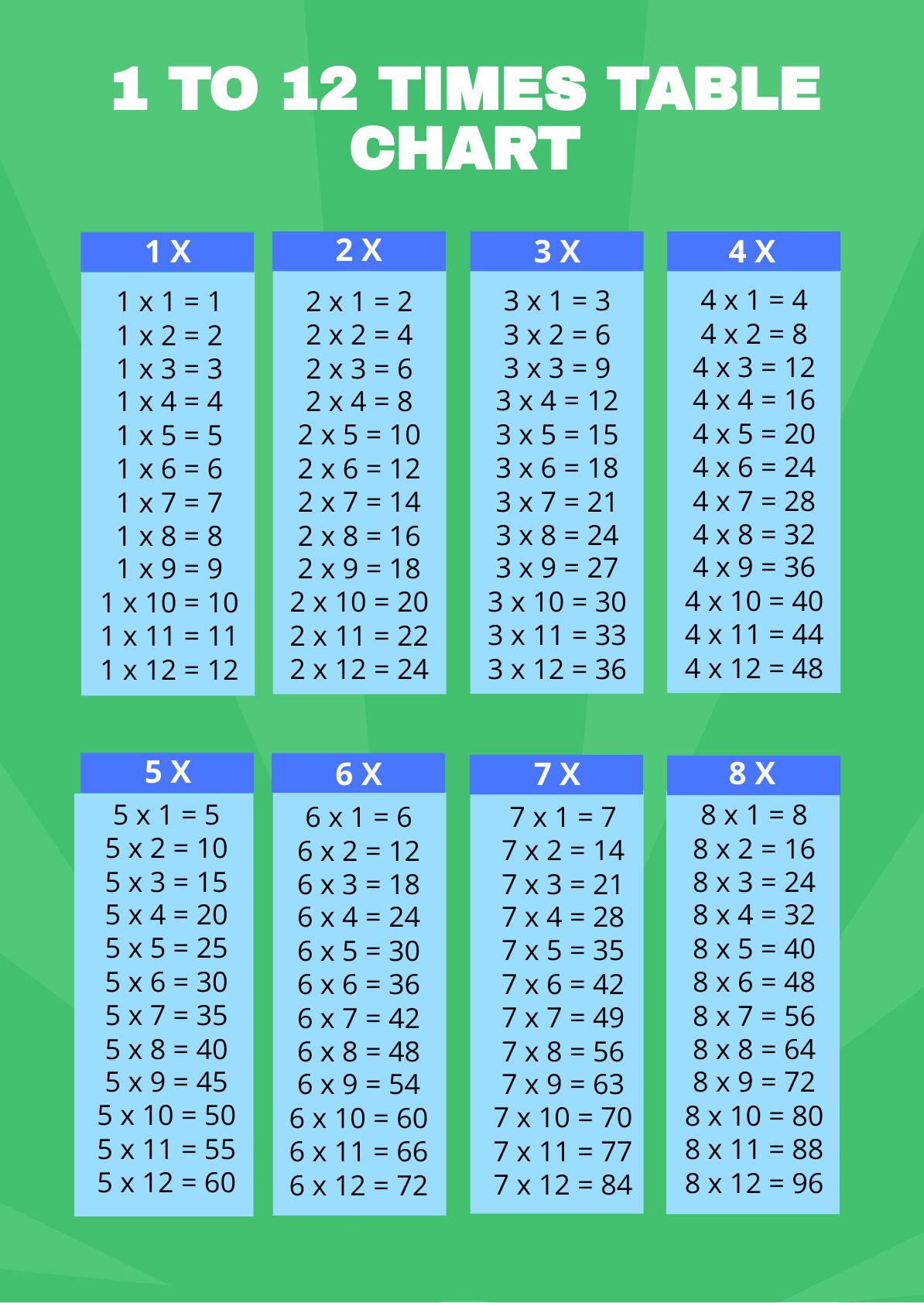

Mastering multiplication is a fundamental skill that lays the groundwork for more advanced mathematical concepts. One of the most effective tools for learning and practicing multiplication is the Multiplication 12 Chart. This chart provides a visual representation of multiplication facts up to 12, making it easier for students to memorize and understand the relationships between numbers. Whether you're a teacher looking for a new teaching method or a parent helping your child with homework, the Multiplication 12 Chart is an invaluable resource.
Understanding the Multiplication 12 Chart
The Multiplication 12 Chart is a grid that displays the products of numbers from 1 to 12. Each row and column represents a number, and the intersection of a row and column shows the product of those two numbers. For example, the intersection of the row for 3 and the column for 4 will show the product 12.
Here is a basic example of what a Multiplication 12 Chart looks like:
| 1 | 2 | 3 | 4 | 5 | 6 | 7 | 8 | 9 | 10 | 11 | 12 | |
|---|---|---|---|---|---|---|---|---|---|---|---|---|
| 1 | 1 | 2 | 3 | 4 | 5 | 6 | 7 | 8 | 9 | 10 | 11 | 12 |
| 2 | 2 | 4 | 6 | 8 | 10 | 12 | 14 | 16 | 18 | 20 | 22 | 24 |
| 3 | 3 | 6 | 9 | 12 | 15 | 18 | 21 | 24 | 27 | 30 | 33 | 36 |
| 4 | 4 | 8 | 12 | 16 | 20 | 24 | 28 | 32 | 36 | 40 | 44 | 48 |
| 5 | 5 | 10 | 15 | 20 | 25 | 30 | 35 | 40 | 45 | 50 | 55 | 60 |
| 6 | 6 | 12 | 18 | 24 | 30 | 36 | 42 | 48 | 54 | 60 | 66 | 72 |
| 7 | 7 | 14 | 21 | 28 | 35 | 42 | 49 | 56 | 63 | 70 | 77 | 84 |
| 8 | 8 | 16 | 24 | 32 | 40 | 48 | 56 | 64 | 72 | 80 | 88 | 96 |
| 9 | 9 | 18 | 27 | 36 | 45 | 54 | 63 | 72 | 81 | 90 | 99 | 108 |
| 10 | 10 | 20 | 30 | 40 | 50 | 60 | 70 | 80 | 90 | 100 | 110 | 120 |
| 11 | 11 | 22 | 33 | 44 | 55 | 66 | 77 | 88 | 99 | 110 | 121 | 132 |
| 12 | 12 | 24 | 36 | 48 | 60 | 72 | 84 | 96 | 108 | 120 | 132 | 144 |
Benefits of Using a Multiplication 12 Chart
The Multiplication 12 Chart offers several benefits for both students and educators. Here are some of the key advantages:
- Visual Learning: The chart provides a visual representation of multiplication facts, making it easier for students to understand and remember.
- Quick Reference: It serves as a quick reference tool for students to check their answers and verify their calculations.
- Pattern Recognition: By observing the chart, students can identify patterns and relationships between numbers, which can enhance their problem-solving skills.
- Confidence Building: Regular practice with the chart can boost students' confidence in their multiplication skills, leading to better performance in math.
- Versatility: The chart can be used in various settings, including classrooms, homeschooling, and tutoring sessions.
How to Use the Multiplication 12 Chart Effectively
To maximize the benefits of the Multiplication 12 Chart, follow these steps:
- Introduction: Introduce the chart to students and explain how it works. Show them how to read the rows and columns to find the products.
- Practice: Encourage students to practice using the chart regularly. They can start by finding the products of simple numbers and gradually move to more complex ones.
- Quizzes: Conduct regular quizzes to test students' knowledge of multiplication facts. Use the chart as a reference during quizzes to help students verify their answers.
- Games: Incorporate games and activities that involve the Multiplication 12 Chart. For example, students can race to find the products of given numbers or create their own multiplication puzzles.
- Review: Periodically review the chart with students to reinforce their understanding and memory of multiplication facts.
📝 Note: It's important to encourage students to use the chart as a learning tool rather than a crutch. The goal is to help them internalize the multiplication facts so they can recall them quickly and accurately.
Creating Your Own Multiplication 12 Chart
While there are many pre-made Multiplication 12 Charts available, creating your own can be a rewarding experience. Here's a simple guide to help you create your own chart:
- Materials: You will need a large sheet of paper, a ruler, and a pencil.
- Draw the Grid: Use the ruler to draw a 13x13 grid on the paper. This will include 12 rows and 12 columns for the numbers 1 through 12, plus an extra row and column for the headers.
- Label the Rows and Columns: Label the top row and the leftmost column with numbers 1 through 12.
- Fill in the Products: Fill in the grid by multiplying the numbers in the rows and columns. For example, the intersection of row 3 and column 4 should contain the number 12.
- Review and Correct: Double-check your chart for any errors and make corrections as needed.
Creating your own Multiplication 12 Chart can help you better understand the relationships between numbers and reinforce your multiplication skills.
📝 Note: If you prefer a digital version, you can use spreadsheet software like Microsoft Excel or Google Sheets to create a Multiplication 12 Chart. This allows for easy editing and customization.
Advanced Techniques with the Multiplication 12 Chart
Once students are comfortable with the basics of the Multiplication 12 Chart, you can introduce more advanced techniques to enhance their learning experience. Here are some ideas:
- Color Coding: Use different colors to highlight patterns and relationships in the chart. For example, you can color-code multiples of 5 or 10 to make them stand out.
- Memory Games: Create memory games where students have to match multiplication facts with their products. This can help reinforce their memory of the facts.
- Real-World Applications: Show students how multiplication is used in real-world situations, such as calculating the total cost of items or determining the area of a rectangle. Use the chart to solve these problems.
- Challenges: Set challenges for students to find specific products or patterns in the chart. For example, ask them to find all the multiples of 7 or to identify the largest product in the chart.
These advanced techniques can make learning multiplication more engaging and help students develop a deeper understanding of the concepts.
📝 Note: Encourage students to explore the chart on their own and discover new patterns and relationships. This can foster a sense of curiosity and excitement about mathematics.
Common Mistakes to Avoid
While using the Multiplication 12 Chart is generally straightforward, there are some common mistakes to avoid:
- Relying Too Much on the Chart: Students should use the chart as a learning tool rather than a crutch. Encourage them to memorize the multiplication facts so they can recall them quickly.
- Ignoring Patterns: The chart is filled with patterns and relationships. Ignoring these can hinder students' understanding of multiplication. Encourage them to observe and identify these patterns.
- Not Practicing Regularly: Regular practice is key to mastering multiplication. Ensure that students use the chart regularly to reinforce their learning.
- Overlooking Errors: Double-check the chart for any errors. Incorrect information can lead to confusion and misconceptions.
By avoiding these mistakes, students can make the most of the Multiplication 12 Chart and develop strong multiplication skills.
📝 Note: Regularly review the chart with students to ensure they are using it correctly and to address any misunderstandings or errors.
Conclusion
The Multiplication 12 Chart is a powerful tool for learning and practicing multiplication. It provides a visual representation of multiplication facts, making it easier for students to understand and remember. By using the chart effectively, students can develop strong multiplication skills, build confidence, and enhance their problem-solving abilities. Whether you’re a teacher, parent, or student, incorporating the Multiplication 12 Chart into your learning routine can lead to significant improvements in mathematical proficiency.
Related Terms:
- 12x12 multiplication chart printable
- full multiplication table 12
- 12 x multiplication table printable
- multiplication table 12 by
- multiplication chart 12 x printable
- 12 multiplication table chart