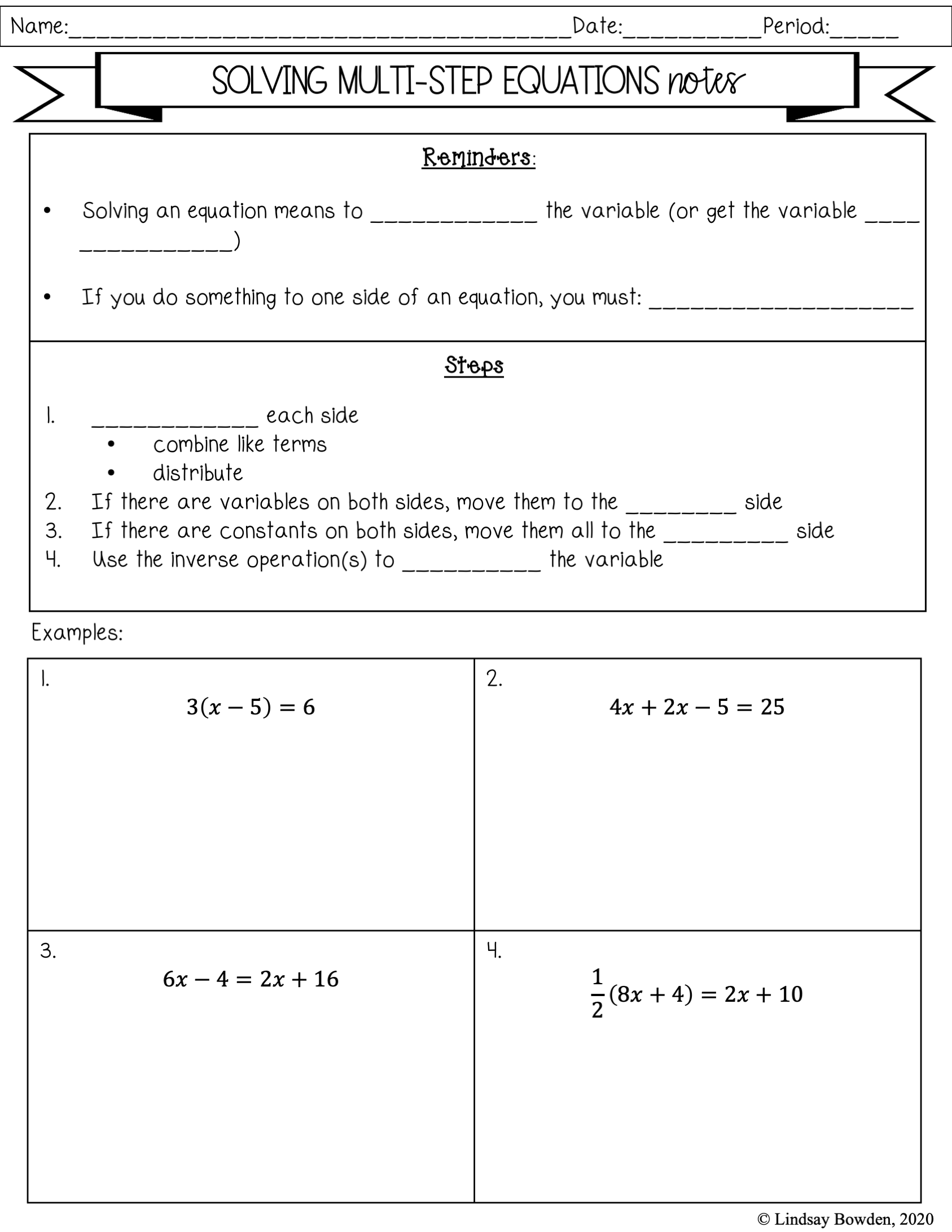

Mastering the art of solving multi step equations is a fundamental skill in algebra that opens the door to more complex mathematical concepts. Whether you're a student preparing for an exam or an educator looking to enhance your teaching methods, understanding the intricacies of multi step equations is crucial. This guide will walk you through the process of solving multi step equations, providing clear examples and step-by-step instructions to help you build a strong foundation.
Understanding Multi Step Equations
Multi step equations are algebraic expressions that require more than one operation to solve. These equations can involve addition, subtraction, multiplication, division, and even exponents. The key to solving multi step equations is to isolate the variable step by step, ensuring that each operation maintains the equation’s balance.
Basic Steps to Solve Multi Step Equations
Solving multi step equations involves a systematic approach. Here are the basic steps:
- Simplify both sides of the equation by combining like terms.
- Isolate the variable term on one side of the equation.
- Isolate the variable by performing the inverse operation.
- Verify the solution by substituting the value back into the original equation.
Example 1: Solving a Simple Multi Step Equation
Let’s start with a simple example:
Solve for x in the equation: 3x + 5 = 20
Step 1: Subtract 5 from both sides to isolate the term with the variable.
3x + 5 - 5 = 20 - 5
3x = 15
Step 2: Divide both sides by 3 to solve for x.
3x / 3 = 15 / 3
x = 5
Step 3: Verify the solution by substituting x = 5 back into the original equation.
3(5) + 5 = 20
15 + 5 = 20
20 = 20
The solution is correct.
💡 Note: Always verify your solution to ensure accuracy.
Example 2: Solving a Multi Step Equation with Fractions
Now, let’s solve an equation that involves fractions:
Solve for y in the equation: 2y/3 + 4 = 10
Step 1: Subtract 4 from both sides to isolate the term with the variable.
2y/3 + 4 - 4 = 10 - 4
2y/3 = 6
Step 2: Multiply both sides by 3⁄2 to solve for y.
(2y/3) * (3⁄2) = 6 * (3⁄2)
y = 9
Step 3: Verify the solution by substituting y = 9 back into the original equation.
2(9)/3 + 4 = 10
18⁄3 + 4 = 10
6 + 4 = 10
10 = 10
The solution is correct.
💡 Note: When dealing with fractions, ensure that you perform the same operation on both sides of the equation to maintain balance.
Example 3: Solving a Multi Step Equation with Decimals
Next, let’s solve an equation that involves decimals:
Solve for z in the equation: 0.5z + 3.2 = 7.8
Step 1: Subtract 3.2 from both sides to isolate the term with the variable.
0.5z + 3.2 - 3.2 = 7.8 - 3.2
0.5z = 4.6
Step 2: Divide both sides by 0.5 to solve for z.
0.5z / 0.5 = 4.6 / 0.5
z = 9.2
Step 3: Verify the solution by substituting z = 9.2 back into the original equation.
0.5(9.2) + 3.2 = 7.8
4.6 + 3.2 = 7.8
7.8 = 7.8
The solution is correct.
💡 Note: Be careful with decimal operations to avoid rounding errors.
Example 4: Solving a Multi Step Equation with Parentheses
Now, let’s solve an equation that involves parentheses:
Solve for x in the equation: 3(x + 2) - 4 = 14
Step 1: Distribute the 3 inside the parentheses.
3x + 6 - 4 = 14
Step 2: Simplify both sides by combining like terms.
3x + 2 = 14
Step 3: Subtract 2 from both sides to isolate the term with the variable.
3x + 2 - 2 = 14 - 2
3x = 12
Step 4: Divide both sides by 3 to solve for x.
3x / 3 = 12 / 3
x = 4
Step 5: Verify the solution by substituting x = 4 back into the original equation.
3(4 + 2) - 4 = 14
3(6) - 4 = 14
18 - 4 = 14
14 = 14
The solution is correct.
💡 Note: Always distribute the operation outside the parentheses before proceeding with other steps.
Example 5: Solving a Multi Step Equation with Exponents
Finally, let’s solve an equation that involves exponents:
Solve for x in the equation: 2x^2 - 5x + 3 = 0
This is a quadratic equation, which requires a different approach. We can use the quadratic formula to solve for x:
x = [-b ± √(b^2 - 4ac)] / (2a)
Where a = 2, b = -5, and c = 3.
Step 1: Calculate the discriminant (b^2 - 4ac).
Discriminant = (-5)^2 - 4(2)(3)
Discriminant = 25 - 24
Discriminant = 1
Step 2: Substitute the values into the quadratic formula.
x = [5 ± √(1)] / (4)
x = [5 ± 1] / (4)
Step 3: Solve for the two possible values of x.
x = (5 + 1) / 4 or x = (5 - 1) / 4
x = 6 / 4 or x = 4 / 4
x = 1.5 or x = 1
Step 4: Verify the solutions by substituting x = 1.5 and x = 1 back into the original equation.
For x = 1.5:
2(1.5)^2 - 5(1.5) + 3 = 0
2(2.25) - 7.5 + 3 = 0
4.5 - 7.5 + 3 = 0
0 = 0
For x = 1:
2(1)^2 - 5(1) + 3 = 0
2 - 5 + 3 = 0
0 = 0
The solutions are correct.
💡 Note: Quadratic equations require the use of the quadratic formula or factoring methods. Ensure you understand the discriminant to determine the nature of the roots.
Common Mistakes to Avoid
When solving multi step equations, it’s easy to make mistakes. Here are some common pitfalls to avoid:
- Forgetting to perform the same operation on both sides: Always ensure that whatever operation you perform on one side of the equation is also performed on the other side.
- Incorrect distribution: When dealing with parentheses, make sure to distribute the operation correctly.
- Rounding errors: Be cautious with decimals and fractions to avoid rounding errors.
- Not verifying the solution: Always substitute the solution back into the original equation to ensure it is correct.
Practice Problems
To reinforce your understanding of multi step equations, try solving the following practice problems:
| Problem | Solution |
|---|---|
| 4x - 7 = 21 | x = 6.5 |
| 3(y + 2) = 15 | y = 3 |
| 2z/5 + 3 = 9 | z = 30 |
| 5x^2 - 3x + 1 = 0 | x = 0.2 or x = 0.6 |
Advanced Topics in Multi Step Equations
As you become more comfortable with solving multi step equations, you can explore more advanced topics such as:
- Systems of equations: Solving multiple equations simultaneously to find the values of multiple variables.
- Inequalities: Solving equations that involve inequalities (e.g., <, >, ≤, ≥).
- Absolute value equations: Solving equations that involve absolute values.
These advanced topics build on the foundational skills you've developed with multi step equations and will further enhance your problem-solving abilities.
Solving multi step equations is a fundamental skill that requires practice and patience. By following the steps outlined in this guide and avoiding common mistakes, you can master the art of solving multi step equations and build a strong foundation for more advanced mathematical concepts. With consistent practice and a clear understanding of the principles, you’ll be well-equipped to tackle any multi step equation that comes your way.
Related Terms:
- multi step equations with distributive
- multi step equations practice
- multi step equations word problems
- multi step equations with fractions
- multi step equation worksheet
- multi step equations video