
In the realm of wireless communication, Medium Access Control (MAC) protocols play a pivotal role in managing how devices share the communication medium efficiently. These protocols are essential for ensuring that data is transmitted reliably and without collisions, especially in environments where multiple devices compete for access to the same channel. This post delves into the intricacies of Medium Access Control, exploring its significance, types, and practical applications.
Understanding Medium Access Control
Medium Access Control, often abbreviated as MAC, is a sublayer of the data link layer in the OSI model. It is responsible for controlling how devices gain access to a shared communication medium, such as a wireless network. The primary goal of MAC protocols is to prevent collisions and ensure fair access to the medium, thereby enhancing the overall performance and reliability of the network.
MAC protocols can be categorized into two main types: contention-based and contention-free. Contention-based protocols allow devices to compete for access to the medium, while contention-free protocols use a scheduling mechanism to allocate time slots to each device. Each type has its own set of advantages and disadvantages, making them suitable for different types of networks and applications.
Contention-Based Medium Access Control Protocols
Contention-based MAC protocols are widely used in wireless networks due to their simplicity and flexibility. These protocols allow devices to contend for access to the medium, with each device deciding when to transmit based on the current state of the network. Some of the most commonly used contention-based MAC protocols include:
- Carrier Sense Multiple Access with Collision Detection (CSMA/CD): This protocol is used in wired Ethernet networks. Devices listen to the medium before transmitting. If the medium is busy, the device waits for a random backoff period before attempting to transmit again.
- Carrier Sense Multiple Access with Collision Avoidance (CSMA/CA): This protocol is used in wireless networks, such as Wi-Fi. Unlike CSMA/CD, CSMA/CA uses a mechanism to avoid collisions rather than detecting them. Devices send a Request to Send (RTS) frame to the receiver, which responds with a Clear to Send (CTS) frame if the medium is clear.
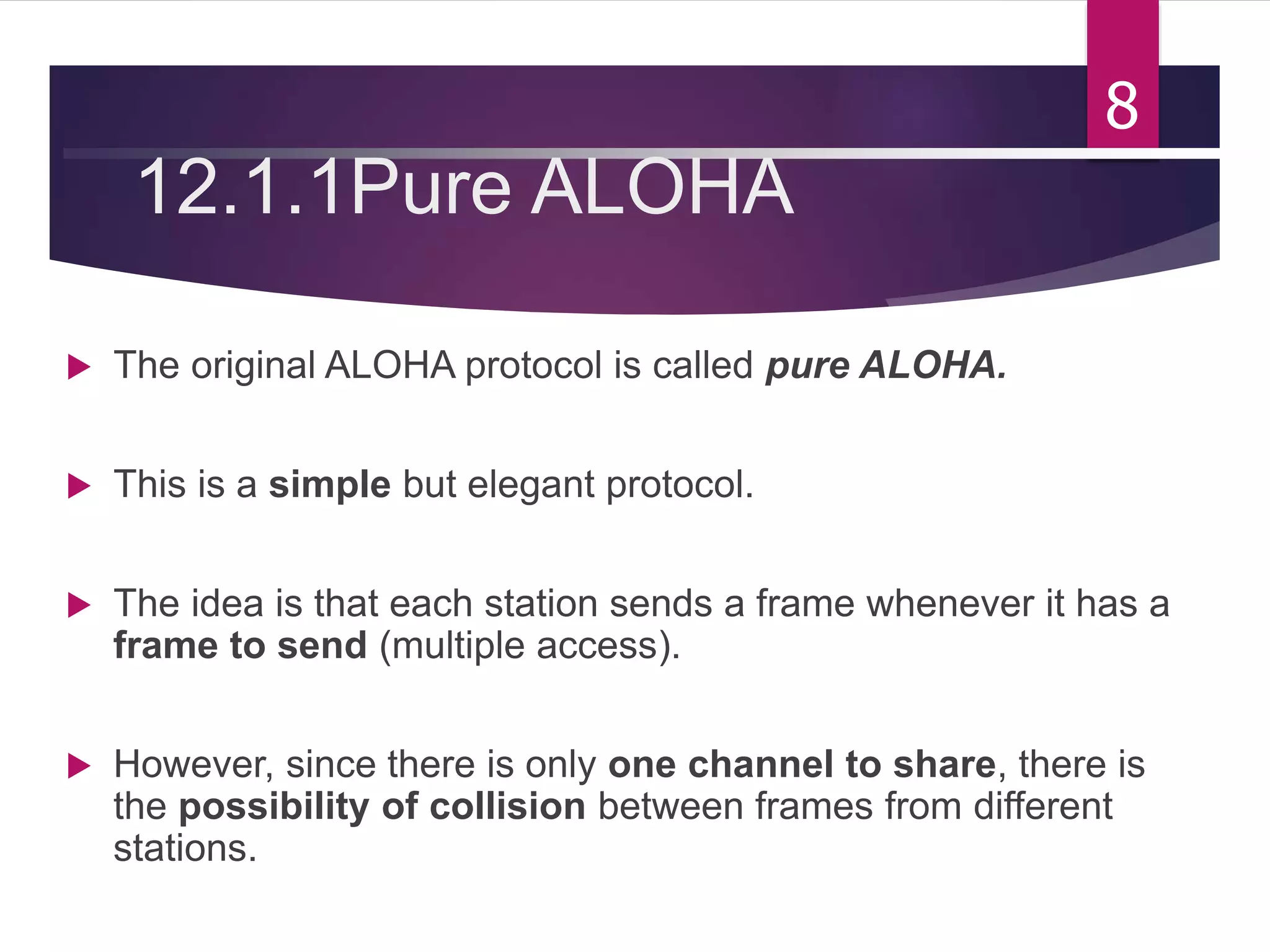
- Aloha Protocol: This is one of the earliest MAC protocols, used in satellite communication. Devices transmit data whenever they have it, without checking if the medium is busy. If a collision occurs, the device waits for a random backoff period before retransmitting.
Contention-Free Medium Access Control Protocols
Contention-free MAC protocols use a scheduling mechanism to allocate time slots to each device, ensuring that collisions are avoided. These protocols are often used in applications where predictable performance is crucial, such as in industrial automation and real-time communication systems. Some of the most commonly used contention-free MAC protocols include:
- Time Division Multiple Access (TDMA): In TDMA, the medium is divided into time slots, and each device is assigned a specific time slot for transmission. This ensures that only one device transmits at a time, eliminating the possibility of collisions.
- Frequency Division Multiple Access (FDMA): In FDMA, the medium is divided into frequency bands, and each device is assigned a specific frequency band for transmission. This allows multiple devices to transmit simultaneously without interfering with each other.
- Code Division Multiple Access (CDMA): In CDMA, each device uses a unique code to spread its signal across the entire frequency band. This allows multiple devices to transmit simultaneously, with each device's signal being distinguished by its unique code.
Practical Applications of Medium Access Control
Medium Access Control protocols are used in a wide range of applications, from wireless local area networks (WLANs) to satellite communication systems. Some of the most common applications include:
- Wireless Local Area Networks (WLANs): WLANs, such as Wi-Fi, use CSMA/CA as their MAC protocol. This allows multiple devices to share the same wireless channel efficiently, ensuring reliable data transmission.
- Cellular Networks: Cellular networks use a combination of TDMA, FDMA, and CDMA to manage access to the wireless medium. This ensures that multiple users can communicate simultaneously without interference.
- Satellite Communication: Satellite communication systems use contention-based protocols like Aloha to manage access to the medium. This is particularly useful in scenarios where devices are widely dispersed and cannot easily coordinate their transmissions.
- Industrial Automation: In industrial automation, contention-free protocols like TDMA are often used to ensure predictable and reliable communication between devices. This is crucial for applications where real-time control is required.
Challenges and Future Directions
While Medium Access Control protocols have significantly improved the efficiency and reliability of wireless communication, they still face several challenges. Some of the key challenges include:
- Scalability: As the number of devices in a network increases, contention-based protocols can become inefficient due to increased collisions. Contention-free protocols, while more efficient, can be complex to implement and manage.
- Interference: Wireless networks are susceptible to interference from other devices and environmental factors. MAC protocols must be robust enough to handle interference and ensure reliable communication.
- Energy Efficiency: In wireless sensor networks and other battery-powered devices, energy efficiency is a critical concern. MAC protocols must be designed to minimize energy consumption while maintaining reliable communication.
To address these challenges, researchers are exploring new MAC protocols and techniques. Some of the future directions in Medium Access Control include:
- Adaptive MAC Protocols: Adaptive MAC protocols can dynamically adjust their parameters based on the current network conditions, improving efficiency and reliability.
- Cognitive Radio: Cognitive radio technology allows devices to sense and adapt to the available spectrum, enabling more efficient use of the wireless medium.
- Machine Learning: Machine learning techniques can be used to optimize MAC protocols, predicting network conditions and adjusting parameters in real-time.
💡 Note: The evolution of Medium Access Control protocols is driven by the need for more efficient, reliable, and scalable wireless communication systems. As technology advances, new protocols and techniques will continue to emerge, addressing the challenges of modern wireless networks.
In conclusion, Medium Access Control protocols are fundamental to the operation of wireless communication systems. They ensure efficient and reliable data transmission by managing how devices access the shared communication medium. Whether contention-based or contention-free, these protocols play a crucial role in a wide range of applications, from wireless local area networks to industrial automation. As the demand for wireless communication continues to grow, the development of advanced MAC protocols will be essential for meeting the challenges of future networks.
Related Terms:
- access control tdm csma cd
- medium access control sub layer
- medium access control ppt
- medium access control protocols
- random access control protocol