
Mathematics is a language of its own, filled with unique symbols, formulas, and Mathematical Terms With Definition that can often seem daunting to those new to the subject. However, understanding these terms is crucial for grasping the fundamentals of mathematics and applying them to real-world problems. This blog post aims to demystify some of the most common mathematical terms, providing clear definitions and examples to help you build a strong foundation in mathematics.
Basic Mathematical Terms With Definition
Before diving into more complex concepts, it's essential to understand the basic Mathematical Terms With Definition that form the backbone of mathematical language.
Numbers
Numbers are the building blocks of mathematics. They can be categorized into several types:
- Natural Numbers: These are the counting numbers starting from 1 (i.e., 1, 2, 3, ...).
- Whole Numbers: These include all natural numbers and zero (i.e., 0, 1, 2, 3, ...).
- Integers: These include all whole numbers and their negatives (i.e., ..., -3, -2, -1, 0, 1, 2, 3, ...).
- Rational Numbers: These are numbers that can be expressed as the quotient or fraction p/q of two integers, with the denominator q not equal to zero (e.g., 1/2, 3/4, 7/8).
- Irrational Numbers: These are numbers that cannot be expressed as a simple fraction, such as √2 or π.
- Real Numbers: These include all rational and irrational numbers.
Operations
Operations are the actions performed on numbers to produce new numbers. The basic operations are:
- Addition: The process of combining two or more numbers to get a sum (e.g., 2 + 3 = 5).
- Subtraction: The process of finding the difference between two numbers (e.g., 5 - 3 = 2).
- Multiplication: The process of finding the product of two or more numbers (e.g., 2 × 3 = 6).
- Division: The process of finding how many times one number is contained within another (e.g., 6 ÷ 3 = 2).
Symbols
Mathematical symbols are used to represent operations, relationships, and other concepts. Some common symbols include:
- =: Equal to
- ≠: Not equal to
- +: Plus (addition)
- -: Minus (subtraction)
- × or •: Multiplication
- ÷ or /: Division
- ( ): Parentheses (used to group numbers or operations)
- [ ]: Brackets (used to group numbers or operations)
- { }: Braces (used to group numbers or operations)
Algebraic Mathematical Terms With Definition
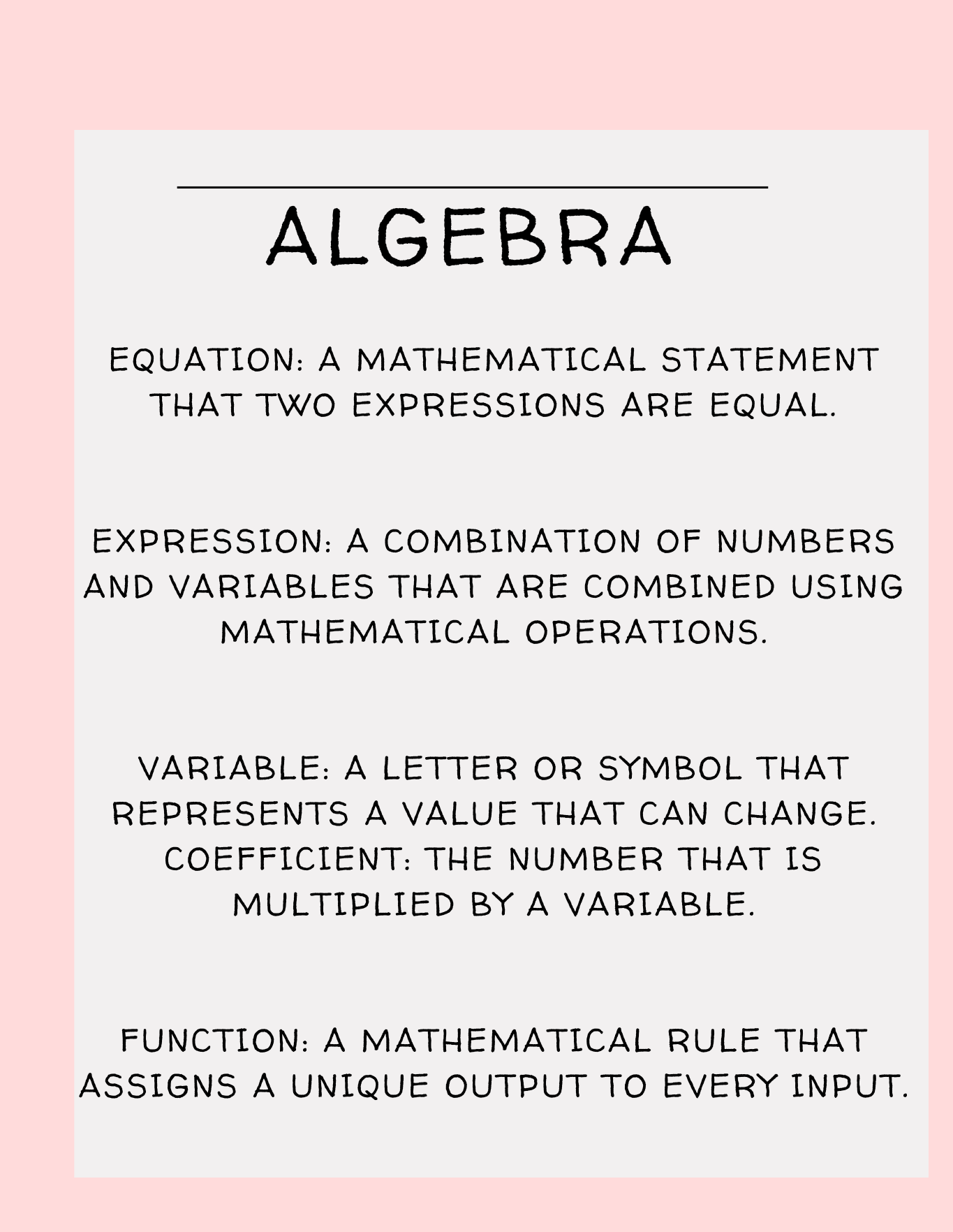
Algebra introduces variables and equations, allowing us to solve problems more abstractly and generally. Here are some key algebraic terms:
Variables
A variable is a symbol, usually a letter, that represents a number or a set of numbers. Variables allow us to generalize mathematical relationships and solve problems with unknown values.
Expressions
An expression is a combination of numbers, variables, and operations. Expressions can be simplified but do not have an equals sign (=). For example:
- 3x + 2
- y - 5
- 2a + 3b - 4
Equations
An equation is a mathematical statement that asserts the equality of two expressions. Equations always have an equals sign (=). For example:
- 3x + 2 = 11
- y - 5 = 10
- 2a + 3b - 4 = 0
Functions
A function is a relation between a set of inputs and a set of permissible outputs with the property that each input is related to exactly one output. Functions are often denoted by f(x), where x is the input (independent variable) and f(x) is the output (dependent variable). For example:
- f(x) = 2x + 3
- g(t) = t^2 - 4t + 4
- h(z) = √z
Geometric Mathematical Terms With Definition
Geometry deals with the properties and relationships of points, lines, surfaces, and solids. Here are some essential geometric terms:
Points, Lines, and Planes
These are the basic building blocks of geometry:
- Point: A precise location in space. It has no size or shape.
- Line: A straight one-dimensional figure with no thickness, extending infinitely in both directions.
- Plane: A flat two-dimensional surface that extends infinitely in all directions.
Angles
An angle is a figure formed by two rays, called the sides of the angle, sharing a common endpoint, called the vertex of the angle. Angles are measured in degrees (°) or radians. Some common types of angles include:
- Acute Angle: An angle that measures less than 90°.
- Right Angle: An angle that measures exactly 90°.
- Obtuse Angle: An angle that measures more than 90° but less than 180°.
- Straight Angle: An angle that measures exactly 180°.
Shapes
Geometry involves studying various shapes, both two-dimensional (2D) and three-dimensional (3D). Some common shapes include:
- Circle: A round shape with all points the same distance from the center.
- Triangle: A three-sided polygon.
- Square: A four-sided polygon with all sides equal and all angles 90°.
- Rectangle: A four-sided polygon with opposite sides equal and all angles 90°.
- Cube: A three-dimensional shape with six square faces.
- Sphere: A three-dimensional shape that is perfectly round, like a ball.
Trigonometric Mathematical Terms With Definition
Trigonometry is the branch of mathematics that deals with the relationships between the sides and angles of triangles. Here are some key trigonometric terms:
Trigonometric Ratios
Trigonometric ratios are used to relate the angles of a right triangle to the lengths of its sides. The three main trigonometric ratios are:
- Sine (sin): The ratio of the length of the opposite side to the length of the hypotenuse (sin θ = opposite/hypotenuse).
- Cosine (cos): The ratio of the length of the adjacent side to the length of the hypotenuse (cos θ = adjacent/hypotenuse).
- Tangent (tan): The ratio of the length of the opposite side to the length of the adjacent side (tan θ = opposite/adjacent).
Trigonometric Functions
Trigonometric functions are functions that relate an angle to the ratios of the sides of a right triangle. The three main trigonometric functions are:
- Sine (sin): sin θ = opposite/hypotenuse
- Cosine (cos): cos θ = adjacent/hypotenuse
- Tangent (tan): tan θ = opposite/adjacent
Trigonometric Identities
Trigonometric identities are equations that are true for all values of the variables involved. Some common trigonometric identities include:
- sin²θ + cos²θ = 1
- tan θ = sin θ / cos θ
- sin(90° - θ) = cos θ
- cos(90° - θ) = sin θ
Calculus Mathematical Terms With Definition
Calculus is the branch of mathematics that deals with rates of change and accumulation of quantities. It is divided into two main branches: differential calculus and integral calculus. Here are some key calculus terms:
Limits
A limit is a value that a function approaches as the input approaches some value. Limits are used to define continuity, derivatives, and integrals. For example:
- lim (x→a) f(x) = L means that as x approaches a, f(x) approaches L.
Derivatives
A derivative is a measure of how a function changes as its input changes. Derivatives are used to find rates of change, slopes of tangents, and extrema (maxima and minima) of functions. For example:
- If f(x) = x², then f'(x) = 2x.
Integrals
An integral is a measure of the accumulation of quantities. Integrals are used to find areas under curves, volumes of solids, and solutions to differential equations. For example:
- ∫(x²) dx = (1/3)x³ + C, where C is the constant of integration.
Fundamental Theorem of Calculus
The Fundamental Theorem of Calculus establishes the relationship between differentiation and integration. It consists of two parts:
- First Fundamental Theorem: If f is continuous on [a, b] and F(x) = ∫ from a to x of f(t) dt, then F'(x) = f(x).
- Second Fundamental Theorem: If f is continuous on [a, b], then ∫ from a to b of f(x) dx = F(b) - F(a), where F is any antiderivative of f.
Probability and Statistics Mathematical Terms With Definition
Probability and statistics deal with the collection, analysis, interpretation, presentation, and organization of data. Here are some key terms in probability and statistics:
Probability
Probability is a measure of the likelihood that an event will occur. Probability values range from 0 to 1, where 0 indicates impossibility and 1 indicates certainty. For example:
- P(A) = 0.5 means that the probability of event A occurring is 50%.
Random Variable
A random variable is a variable whose possible values are outcomes of a random phenomenon. Random variables can be discrete or continuous. For example:
- Let X be the number of heads in two coin tosses. X is a discrete random variable with possible values 0, 1, or 2.
Distribution
A distribution is a function that shows the possible values of a random variable and their corresponding probabilities. Distributions can be discrete or continuous. For example:
- The binomial distribution describes the number of successes in a fixed number of independent Bernoulli trials.
Mean, Median, and Mode
Mean, median, and mode are measures of central tendency, which describe the center or typical value of a dataset. For example:
- Mean: The average value of a dataset (sum of all values divided by the number of values).
- Median: The middle value of a dataset when ordered from smallest to largest.
- Mode: The most frequently occurring value in a dataset.
Standard Deviation
Standard deviation is a measure of the amount of variation or dispersion in a set of values. A low standard deviation indicates that the values tend to be close to the mean, while a high standard deviation indicates that the values are spread out over a wider range. For example:
- If the standard deviation of a dataset is 0, then all the values in the dataset are the same.
Correlation
Correlation is a statistical measure that expresses the extent to which two variables are linearly related. Correlation values range from -1 to 1, where -1 indicates a perfect negative linear relationship, 0 indicates no linear relationship, and 1 indicates a perfect positive linear relationship. For example:
- If the correlation between two variables X and Y is 0.8, then there is a strong positive linear relationship between X and Y.
Hypothesis Testing
Hypothesis testing is a statistical method used to make inferences or draw conclusions about a population based on sample data. It involves formulating a null hypothesis (H0) and an alternative hypothesis (H1), and then using sample data to determine whether to reject the null hypothesis. For example:
- H0: μ = 0 (the population mean is equal to 0)
- H1: μ ≠ 0 (the population mean is not equal to 0)
💡 Note: Hypothesis testing is a fundamental concept in statistics, used to make decisions based on sample data.
Mathematical Symbols and Notations
Mathematics uses a wide range of symbols and notations to represent concepts, operations, and relationships. Here is a table of some common mathematical symbols and their meanings:
| Symbol | Name | Meaning |
|---|---|---|
| + | Plus | Addition |
| - | Minus | Subtraction |
| × or • | Times | Multiplication |
| ÷ or / | Divided by | Division |
| = | Equals | Equality |
| ≠ | Not equal to | Inequality |
| ≤ | Less than or equal to | Inequality |
| ≥ | Greater than or equal to | Inequality |
| < | Less than | Inequality |
| > | Greater than | Inequality |
| √ | Square root | The non-negative number whose square is the given number |
| ∑ | Sigma | Summation |
| ∫ | Integral | Integration |
| ∂ | Partial derivative | Derivative with respect to one variable while others are held constant |
| ∞ | Infinity | Endlessness |
| π | Pi | The ratio of the circumference of a circle to its diameter |
| e | Euler's number | The base of the natural logarithm |
Understanding these symbols and notations is crucial for reading and writing mathematical expressions and equations.
Mathematics is a vast and complex field, but with a solid understanding of these Mathematical Terms With Definition, you’ll be well on your way to mastering the subject. Whether you’re a student, a professional, or simply someone with a curiosity for numbers, taking the time to learn and appreciate these terms will enrich your mathematical journey.
Related Terms:
- term in a sentence math
- definition for term in math
- what does a term mean
- meaning of term in math
- mathematical terms and definitions
- term meaning in mathematics