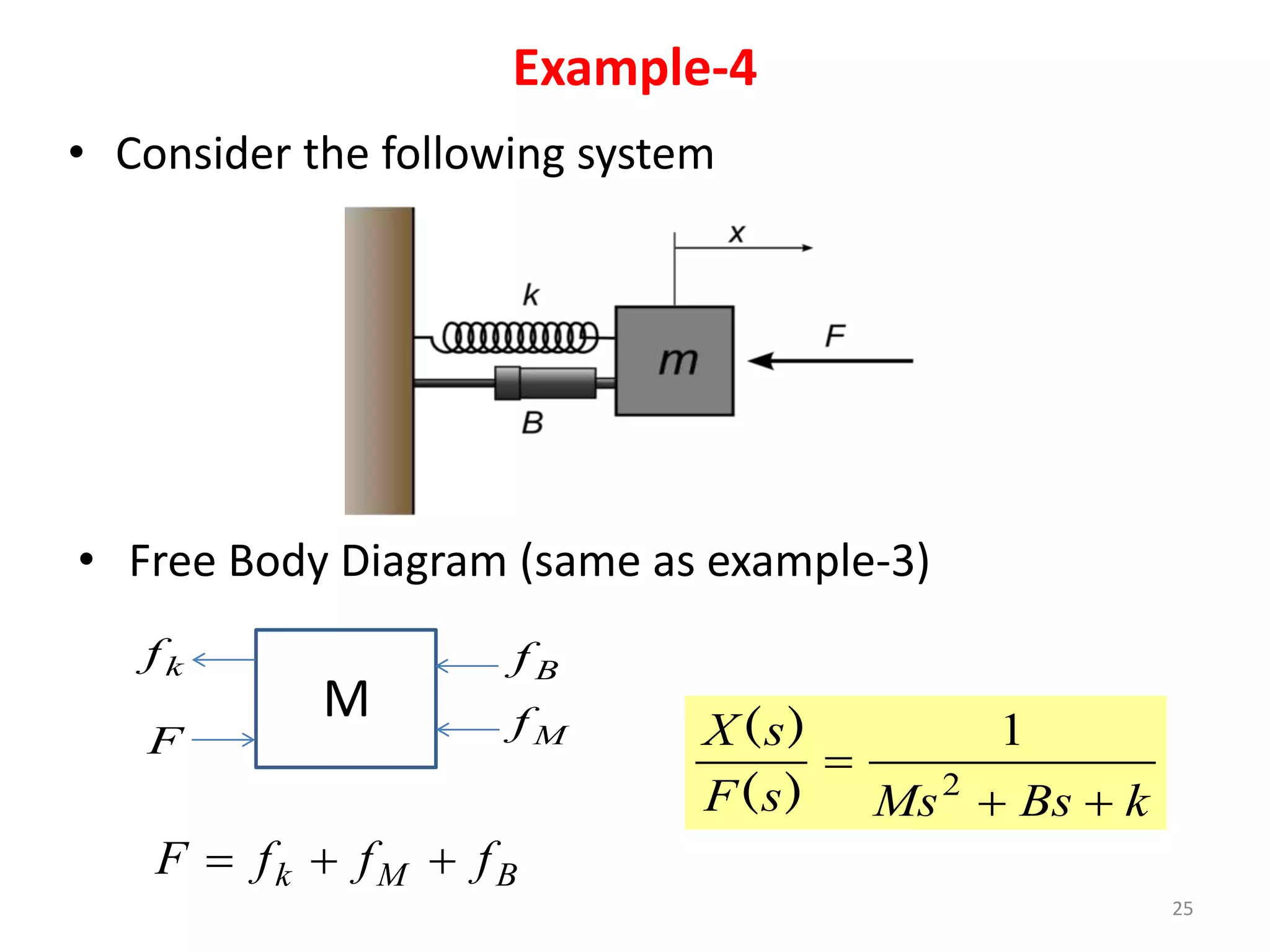

The study of mechanical systems is a fundamental aspect of engineering, and one of the most basic yet crucial models is the Mass Spring Damper System. This system is used to understand the behavior of oscillatory systems, which are prevalent in various engineering applications, from automotive suspensions to seismic isolation systems. By analyzing the dynamics of a mass attached to a spring and a damper, engineers can predict and control the system's response to external forces, ensuring stability and performance.
Understanding the Basics of a Mass Spring Damper System
A Mass Spring Damper System consists of three primary components:
- Mass (m): The object whose motion is being studied.
- Spring (k): The elastic element that provides a restoring force proportional to the displacement.
- Damper (c): The dissipative element that provides a damping force proportional to the velocity.
The behavior of the system can be described by Newton's second law of motion, which states that the sum of the forces acting on the mass is equal to the mass times the acceleration. For a Mass Spring Damper System, the equation of motion is given by:
m * d²x/dt² + c * dx/dt + k * x = F(t)
Where:
- x is the displacement of the mass from its equilibrium position.
- F(t) is the external force applied to the system.
Types of Mass Spring Damper Systems
Mass Spring Damper Systems can be categorized based on the nature of the damping:
- Underdamped System: The system oscillates with decreasing amplitude over time. This is the most common scenario in practical applications.
- Critically Damped System: The system returns to its equilibrium position as quickly as possible without oscillating. This is often desired in control systems.
- Overdamped System: The system returns to its equilibrium position slowly without oscillating. This is less efficient but can be useful in certain applications.
- Undamped System: The system oscillates indefinitely with constant amplitude. This is a theoretical scenario and not practical in real-world applications due to the presence of some form of damping.
Analyzing the Response of a Mass Spring Damper System
The response of a Mass Spring Damper System to an external force can be analyzed using various methods, including:
- Time Domain Analysis: This involves solving the differential equation to find the displacement, velocity, and acceleration as functions of time.
- Frequency Domain Analysis: This involves transforming the time-domain equation into the frequency domain using techniques like the Fourier Transform or Laplace Transform.
- Transfer Function Analysis: This involves finding the transfer function of the system, which relates the input force to the output displacement in the frequency domain.
For an underdamped system, the response to an initial displacement can be described by:
x(t) = A * e^(-ζωn * t) * cos(ωd * t + φ)
Where:
- A is the amplitude of the oscillation.
- ζ is the damping ratio.
- ωn is the natural frequency of the system.
- ωd is the damped natural frequency.
- φ is the phase angle.
Applications of Mass Spring Damper Systems
The principles of Mass Spring Damper Systems are applied in a wide range of engineering disciplines. Some of the key applications include:
- Automotive Suspensions: The suspension system in vehicles acts as a Mass Spring Damper System to absorb shocks and provide a smooth ride.
- Seismic Isolation: Buildings and bridges are equipped with seismic isolators that act as Mass Spring Damper Systems to protect against earthquakes.
- Vibration Control: Machinery and equipment often use dampers to control vibrations and prevent damage.
- Control Systems: In control engineering, Mass Spring Damper Systems are used to design controllers that ensure stable and efficient operation.
Design Considerations for Mass Spring Damper Systems
When designing a Mass Spring Damper System, several factors need to be considered to ensure optimal performance:
- Natural Frequency: The natural frequency of the system should be chosen to avoid resonance with external forces.
- Damping Ratio: The damping ratio should be selected to achieve the desired response characteristics, such as quick settling time or minimal overshoot.
- Material Properties: The materials used for the mass, spring, and damper should be chosen based on their mechanical properties and durability.
- Environmental Factors: The system should be designed to withstand environmental conditions such as temperature, humidity, and corrosion.
Additionally, the system should be analyzed for different operating conditions and loads to ensure robustness and reliability.
🔍 Note: It is crucial to perform experimental validation to verify the theoretical predictions and ensure the system meets the required performance criteria.
Experimental Setup for Mass Spring Damper Systems
To study the behavior of a Mass Spring Damper System experimentally, a typical setup includes:
- A mass attached to a spring and a damper.
- A means to apply an external force, such as a shaker or an impact hammer.
- Sensors to measure displacement, velocity, and acceleration.
- A data acquisition system to record the measurements.
The experimental data can be used to validate the theoretical model and refine the design parameters. The setup should be carefully calibrated to ensure accurate measurements and reliable results.
🔍 Note: Ensure that the sensors are properly calibrated and the data acquisition system is configured correctly to capture the dynamic response of the system.
Advanced Topics in Mass Spring Damper Systems
For more complex systems, advanced topics in Mass Spring Damper Systems include:
- Nonlinear Systems: Systems where the spring or damper characteristics are nonlinear, requiring more sophisticated analysis techniques.
- Multi-Degree-of-Freedom Systems: Systems with multiple masses and springs, leading to coupled equations of motion.
- Active Control: Systems where active control mechanisms, such as actuators and sensors, are used to modify the system's response in real-time.
- Parametric Excitation: Systems where the parameters of the system, such as the mass or stiffness, vary with time, leading to complex dynamic behavior.
These advanced topics require a deeper understanding of dynamics and control theory, as well as specialized tools and techniques for analysis and design.
For example, a multi-degree-of-freedom system can be represented by a matrix equation:
[M] * {d²x/dt²} + [C] * {dx/dt} + [K] * {x} = {F(t)}
Where:
- [M], [C], and [K] are the mass, damping, and stiffness matrices, respectively.
- {x} is the vector of displacements.
- {F(t)} is the vector of external forces.
This matrix equation can be solved using numerical methods to find the dynamic response of the system.
🔍 Note: Advanced topics often require the use of specialized software tools for simulation and analysis, such as MATLAB or ANSYS.
Case Studies in Mass Spring Damper Systems
To illustrate the practical application of Mass Spring Damper Systems, consider the following case studies:
- Automotive Suspension Design: A car manufacturer designs a suspension system to provide a comfortable ride and good handling. The system is modeled as a Mass Spring Damper System with multiple degrees of freedom, and the parameters are optimized to achieve the desired performance characteristics.
- Seismic Isolation of Buildings: An engineering firm designs a seismic isolation system for a high-rise building. The system consists of multiple Mass Spring Damper Systems arranged in a grid pattern to absorb seismic waves and protect the building from damage.
- Vibration Control in Machinery: A manufacturing company installs dampers on a machine to control vibrations and prevent damage to the equipment. The Mass Spring Damper System is designed to absorb the vibrations at the machine's operating frequency, ensuring smooth operation.
These case studies demonstrate the versatility and importance of Mass Spring Damper Systems in various engineering applications.
For example, the seismic isolation system for a building can be designed using the following parameters:
| Parameter | Value |
|---|---|
| Mass of the building (m) | 500,000 kg |
| Stiffness of the isolators (k) | 500 kN/m |
| Damping coefficient (c) | 100 kN·s/m |
| Natural frequency (ωn) | 0.7 Hz |
| Damping ratio (ζ) | 0.1 |
These parameters are chosen to ensure that the building's natural frequency is well below the frequency of seismic waves, providing effective isolation and protection.
🔍 Note: The design of Mass Spring Damper Systems for real-world applications often involves iterative testing and refinement to achieve the desired performance.
In conclusion, the Mass Spring Damper System is a fundamental model in engineering that provides insights into the behavior of oscillatory systems. By understanding the dynamics of this system, engineers can design and optimize a wide range of applications, from automotive suspensions to seismic isolation systems. The principles of Mass Spring Damper Systems are essential for ensuring stability, performance, and reliability in various engineering disciplines. The study of this system involves both theoretical analysis and experimental validation, allowing engineers to develop robust and efficient solutions for real-world problems.
Related Terms:
- what is mass damper
- mass spring damper simulink
- spring mass damping system
- mass spring damper transfer function
- mass damper system equation
- mass spring damper system matlab