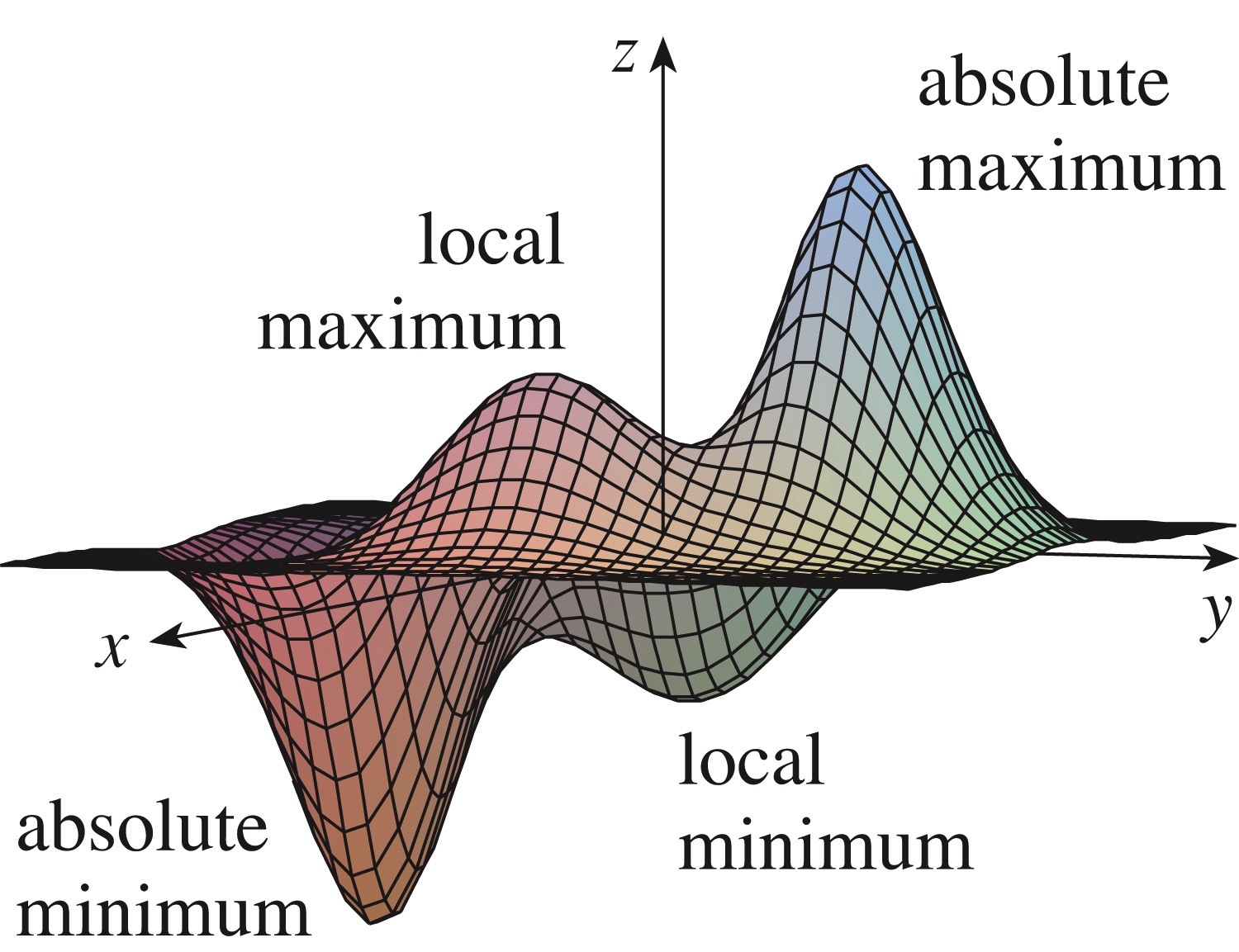

Understanding the concepts of local maximum and absolute maximum is crucial in various fields of mathematics, particularly in calculus and optimization. These concepts help in identifying the highest points within a given function or dataset, which is essential for making informed decisions in fields such as economics, engineering, and data science. This blog post will delve into the definitions, differences, and applications of local maximum and absolute maximum, providing a comprehensive guide for readers.
Understanding Local Maximum
A local maximum is a point within a function where the function value is higher than the values at nearby points. In other words, it is the highest point within a small neighborhood of the function. This concept is particularly important in calculus, where it is used to analyze the behavior of functions and to find critical points.
To identify a local maximum, one must first find the derivative of the function and set it equal to zero. The points where the derivative is zero are called critical points. These critical points can then be tested to determine if they are local maxima, local minima, or points of inflection.
For example, consider the function f(x) = x2 - 4x + 3. The derivative of this function is f'(x) = 2x - 4. Setting the derivative equal to zero gives 2x - 4 = 0, which simplifies to x = 2. To determine if this point is a local maximum, we can use the second derivative test. The second derivative of the function is f''(x) = 2. Since the second derivative is positive, the point x = 2 is a local minimum, not a local maximum.
Understanding Absolute Maximum
An absolute maximum, also known as a global maximum, is the highest point of a function over its entire domain. Unlike a local maximum, which is only the highest point within a small neighborhood, an absolute maximum is the highest point across the entire range of the function. This concept is crucial in optimization problems, where the goal is to find the best possible outcome within a given set of constraints.
To find the absolute maximum of a function, one must consider the function's behavior over its entire domain. This often involves evaluating the function at critical points, endpoints, and any points where the function is discontinuous. The highest value obtained from these evaluations is the absolute maximum.
For example, consider the function f(x) = sin(x) over the interval [0, 2π]. The derivative of this function is f'(x) = cos(x). Setting the derivative equal to zero gives cos(x) = 0, which has solutions at x = π/2 and x = 3π/2. Evaluating the function at these points and at the endpoints of the interval gives f(π/2) = 1, f(3π/2) = -1, f(0) = 0, and f(2π) = 0. The highest value is 1, so the absolute maximum of the function over the interval [0, 2π] is 1.
Differences Between Local Maximum and Absolute Maximum
While both local maximum and absolute maximum refer to the highest points of a function, there are key differences between the two concepts. Understanding these differences is essential for accurately analyzing and optimizing functions.
- Scope: A local maximum is the highest point within a small neighborhood of the function, while an absolute maximum is the highest point over the entire domain of the function.
- Number of Occurrences: A function can have multiple local maxima, but it can only have one absolute maximum.
- Identification: Local maxima are identified by analyzing the function's behavior within small neighborhoods, while absolute maxima are identified by evaluating the function over its entire domain.
For example, consider the function f(x) = sin(x) over the interval [0, 4π]. This function has multiple local maxima, including x = π/2, x = 5π/2, and x = 9π/2. However, the absolute maximum of the function over this interval is 1, which occurs at x = π/2 and x = 5π/2.
Applications of Local Maximum and Absolute Maximum
The concepts of local maximum and absolute maximum have numerous applications in various fields. Understanding these concepts is essential for solving optimization problems, making informed decisions, and analyzing data.
In economics, for example, local maxima and absolute maxima are used to analyze supply and demand curves, cost functions, and revenue functions. By identifying the local and absolute maxima of these functions, economists can determine the optimal price and quantity for maximizing profits or minimizing costs.
In engineering, local maxima and absolute maxima are used to design and optimize systems. For example, in structural engineering, the local and absolute maxima of stress and strain functions are used to ensure that structures are safe and stable. In electrical engineering, the local and absolute maxima of voltage and current functions are used to design efficient and reliable circuits.
In data science, local maxima and absolute maxima are used to analyze and interpret data. For example, in machine learning, the local and absolute maxima of loss functions are used to train models and improve their performance. In statistics, the local and absolute maxima of probability distributions are used to make inferences and predictions.
Finding Local Maximum Absolute Maximum
Finding the local maximum absolute maximum of a function involves several steps. Here is a detailed guide to help you identify these critical points:
Step 1: Find the Derivative
The first step in finding the local maximum absolute maximum is to find the derivative of the function. The derivative represents the rate of change of the function and is essential for identifying critical points.
For example, consider the function f(x) = x3 - 3x2 + 3. The derivative of this function is f'(x) = 3x2 - 6x.
Step 2: Find Critical Points
The next step is to find the critical points of the function. Critical points are the points where the derivative is zero or undefined. These points are potential candidates for local maxima, local minima, or points of inflection.
For the function f(x) = x3 - 3x2 + 3, setting the derivative equal to zero gives 3x2 - 6x = 0, which simplifies to x(x - 2) = 0. The solutions are x = 0 and x = 2.
Step 3: Test Critical Points
Once the critical points are identified, the next step is to test them to determine if they are local maxima, local minima, or points of inflection. This can be done using the second derivative test or the first derivative test.
For the function f(x) = x3 - 3x2 + 3, the second derivative is f''(x) = 6x - 6. Evaluating the second derivative at the critical points gives f''(0) = -6 and f''(2) = 6. Since the second derivative is negative at x = 0, this point is a local maximum. Since the second derivative is positive at x = 2, this point is a local minimum.
Step 4: Evaluate the Function at Endpoints
To find the absolute maximum, it is necessary to evaluate the function at the endpoints of its domain. This step is crucial for functions with a closed interval domain.
For example, consider the function f(x) = x3 - 3x2 + 3 over the interval [0, 3]. Evaluating the function at the endpoints gives f(0) = 3 and f(3) = 3. The highest value is 3, so the absolute maximum of the function over this interval is 3.
Step 5: Compare Values
The final step is to compare the values of the function at the critical points and endpoints to determine the absolute maximum. The highest value obtained from these evaluations is the absolute maximum.
For the function f(x) = x3 - 3x2 + 3 over the interval [0, 3], the values at the critical points and endpoints are f(0) = 3, f(2) = -1, and f(3) = 3. The highest value is 3, so the absolute maximum of the function over this interval is 3.
📝 Note: When evaluating the function at endpoints, ensure that the endpoints are within the domain of the function. If the domain is open, the endpoints may not be included in the evaluation.
Examples of Local Maximum Absolute Maximum
To further illustrate the concepts of local maximum and absolute maximum, let's consider a few examples:
Example 1: Quadratic Function
Consider the quadratic function f(x) = -x2 + 4x + 5. The derivative of this function is f'(x) = -2x + 4. Setting the derivative equal to zero gives -2x + 4 = 0, which simplifies to x = 2. Evaluating the function at this point gives f(2) = 9. Since the function is a downward-opening parabola, this point is the absolute maximum of the function.
Example 2: Cubic Function
Consider the cubic function f(x) = x3 - 3x2 + 3 over the interval [0, 3]. The derivative of this function is f'(x) = 3x2 - 6x. Setting the derivative equal to zero gives 3x2 - 6x = 0, which simplifies to x(x - 2) = 0. The solutions are x = 0 and x = 2. Evaluating the function at these points and at the endpoints gives f(0) = 3, f(2) = -1, and f(3) = 3. The highest value is 3, so the absolute maximum of the function over this interval is 3.
Example 3: Trigonometric Function
Consider the trigonometric function f(x) = sin(x) over the interval [0, 2π]. The derivative of this function is f'(x) = cos(x). Setting the derivative equal to zero gives cos(x) = 0, which has solutions at x = π/2 and x = 3π/2. Evaluating the function at these points and at the endpoints gives f(π/2) = 1, f(3π/2) = -1, f(0) = 0, and f(2π) = 0. The highest value is 1, so the absolute maximum of the function over the interval [0, 2π] is 1.
Common Mistakes to Avoid
When identifying local maximum absolute maximum, it is essential to avoid common mistakes that can lead to incorrect results. Here are some pitfalls to watch out for:
- Ignoring Endpoints: When evaluating the function over a closed interval, it is crucial to include the endpoints in the evaluation. Ignoring endpoints can lead to missing the absolute maximum.
- Incorrect Derivative: Ensure that the derivative is calculated correctly. An incorrect derivative can lead to incorrect critical points and, ultimately, incorrect local and absolute maxima.
- Misinterpreting Critical Points: Not all critical points are local maxima or minima. It is essential to test critical points using the second derivative test or the first derivative test to determine their nature.
- Overlooking Discontinuities: Functions with discontinuities can have local maxima or minima at the points of discontinuity. Ensure that these points are included in the evaluation.
By avoiding these common mistakes, you can accurately identify the local maximum absolute maximum of a function and make informed decisions based on your analysis.
In summary, understanding the concepts of local maximum and absolute maximum is crucial for analyzing and optimizing functions. By following the steps outlined in this blog post, you can accurately identify these critical points and apply them to various fields, including economics, engineering, and data science. Whether you are a student, a professional, or an enthusiast, mastering these concepts will enhance your analytical skills and enable you to make informed decisions.
Related Terms:
- absolute maxima vs local
- relative and absolute maximum minimum
- what is a local maximum
- local maximum on a graph
- local vs absolute extrema
- local maxima and minima