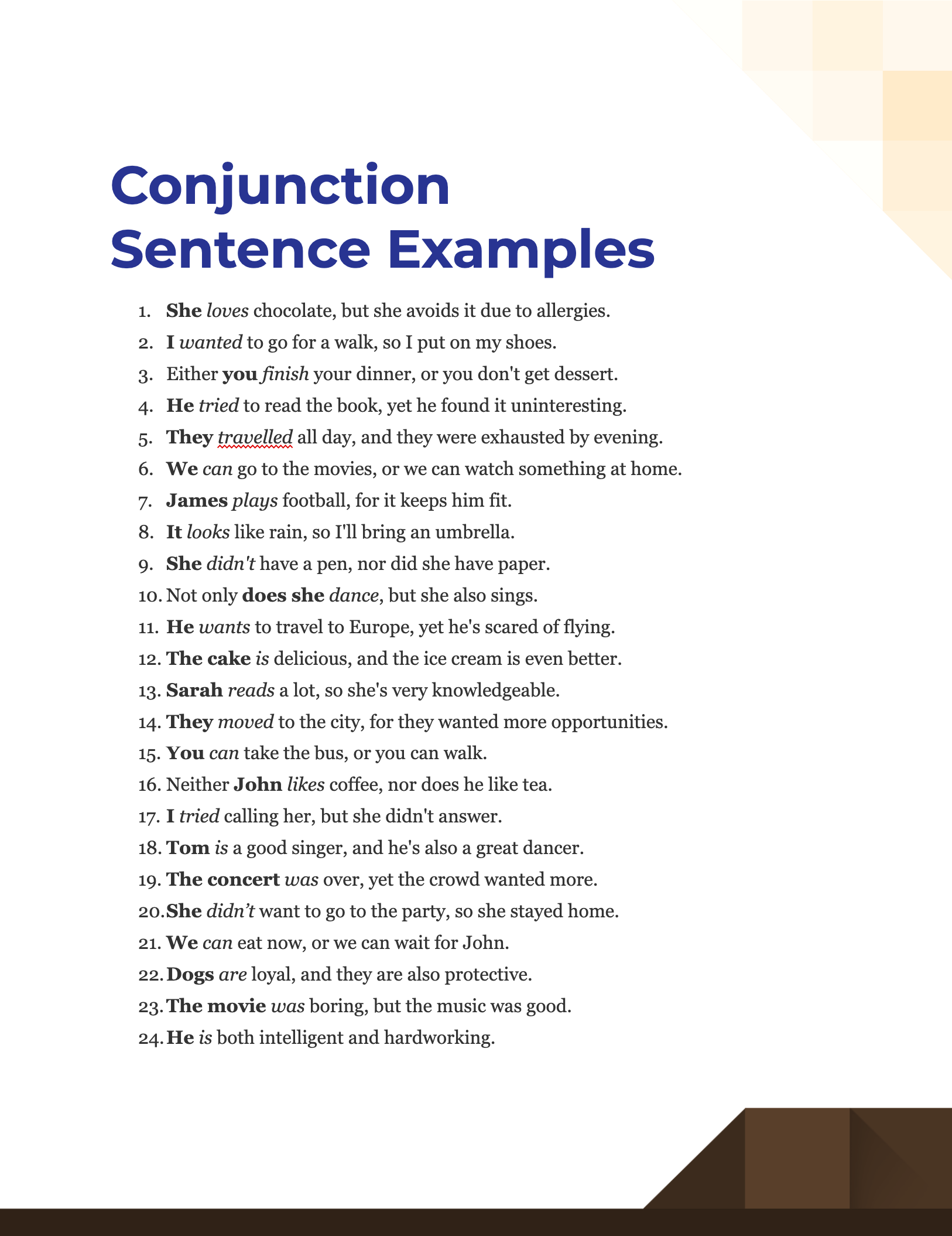

Understanding the intricacies of grammar can often be a challenging task, especially when it comes to conjunctions. One of the most fundamental questions that arise is whether a specific word is a conjunction. This question is crucial for both native speakers and language learners alike, as it helps in constructing grammatically correct sentences. In this post, we will delve into the concept of conjunctions, explore examples, and determine whether certain words are indeed conjunctions.
What is a Conjunction?
A conjunction is a part of speech that connects words, phrases, or clauses. It serves as a bridge between different elements of a sentence, helping to create a coherent and meaningful structure. Conjunctions can be categorized into several types, including coordinating, subordinating, and correlative conjunctions.
Types of Conjunctions
Conjunctions can be broadly classified into three main types:
- Coordinating Conjunctions: These conjunctions connect words, phrases, or clauses of equal importance. The most common coordinating conjunctions are for, and, nor, but, or, yet, so (often remembered by the acronym FANBOYS).
- Subordinating Conjunctions: These conjunctions introduce a subordinate clause and connect it to a main clause. Examples include because, although, while, if, unless, and since.
- Correlative Conjunctions: These conjunctions work in pairs to connect words, phrases, or clauses. Common pairs include either…or, neither…nor, not only…but also, and both…and.
Is So A Conjunction?
One of the most frequently asked questions is whether the word “so” is a conjunction. The answer is yes, “so” can indeed be a conjunction. It is a coordinating conjunction that is used to connect two independent clauses, indicating a result or consequence. For example:
“I studied hard, so I passed the exam.”
In this sentence, “so” connects two independent clauses: “I studied hard” and “I passed the exam.” It shows the result of the first clause leading to the second.
Examples of “So” as a Conjunction
To further illustrate how “so” functions as a conjunction, let’s look at a few more examples:
- “It was raining heavily, so we stayed indoors.”
- “She worked overtime, so she finished the project on time.”
- “He was feeling unwell, so he went to the doctor.”
In each of these examples, “so” connects two clauses and shows the relationship between them, indicating a cause-and-effect scenario.
Other Uses of “So”
While “so” is commonly used as a conjunction, it can also function as an adverb or an adjective. Understanding these different uses is essential for mastering the word’s versatility.
- Adverb: When used as an adverb, “so” means “to such an extent” or “in this way.” For example, “She sings so beautifully.”
- Adjective: When used as an adjective, “so” means “in the same way” or “to the same degree.” For example, “I am so happy to see you.”
Common Misconceptions
There are several misconceptions surrounding the use of “so” as a conjunction. One common mistake is confusing “so” with “because.” While both words can indicate a cause-and-effect relationship, they are used differently in sentences. “So” connects two independent clauses, whereas “because” introduces a subordinate clause. For example:
“I stayed home because it was raining.”
In this sentence, “because” introduces the subordinate clause “it was raining,” which explains why the main clause “I stayed home” occurred.
Practical Tips for Using “So” as a Conjunction
To effectively use “so” as a conjunction, keep the following tips in mind:
- Ensure that “so” connects two independent clauses. Each clause should be able to stand alone as a complete sentence.
- Avoid using “so” to connect a dependent clause to an independent clause. Use subordinating conjunctions like “because” or “since” for this purpose.
- Be mindful of the context. “So” should clearly indicate a result or consequence. If the relationship between the clauses is not cause-and-effect, consider using a different conjunction.
💡 Note: Remember that "so" can also be used informally to mean "therefore" or "thus." In formal writing, it is often better to use more precise conjunctions to avoid ambiguity.
Conclusion
Understanding whether “so” is a conjunction is just the beginning of mastering the English language. Conjunctions play a crucial role in connecting words, phrases, and clauses, and “so” is a versatile word that can serve multiple functions. By recognizing the different uses of “so” and applying it correctly in sentences, you can enhance your writing and communication skills. Whether you are a native speaker or a language learner, grasping the nuances of conjunctions will help you construct clear and coherent sentences, making your language more effective and expressive.
Related Terms:
- so conjunction meaning
- is then a conjunction
- conjunction so examples
- is so a subordinating conjunction
- using so as a conjunction
- is nor a conjunction