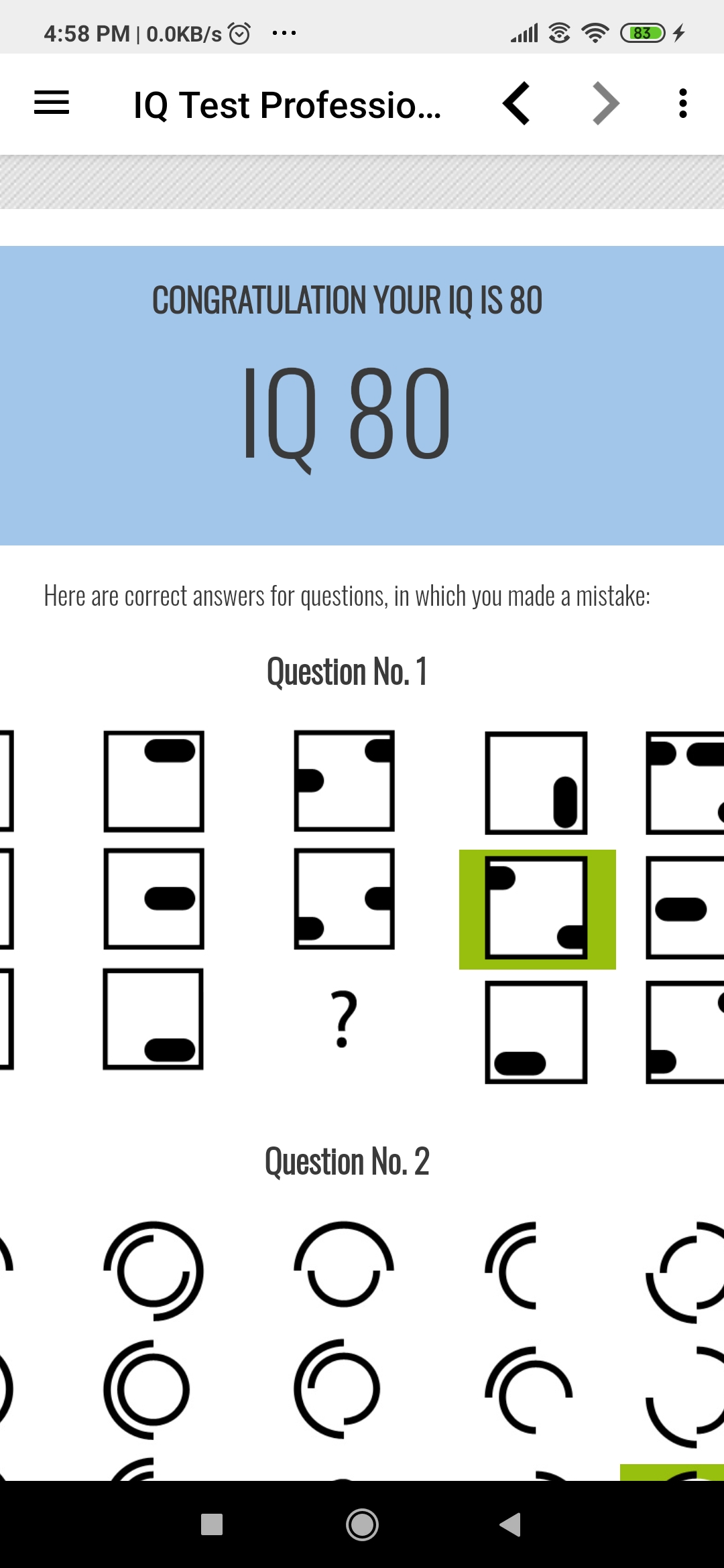

IQ tests are a common method used to measure an individual's cognitive abilities and problem-solving skills. These tests often include a variety of IQ test question examples that challenge different aspects of intelligence, such as logical reasoning, pattern recognition, and verbal comprehension. Understanding the types of questions found in IQ tests can help individuals prepare and improve their performance. This blog post will delve into the various types of IQ test question examples, providing insights into what to expect and how to approach them.
Understanding IQ Tests
IQ tests are designed to assess a person’s intellectual abilities relative to their age group. The term “IQ” stands for Intelligence Quotient, which is a score derived from standardized tests. These tests are used in various settings, including educational institutions, employment screening, and psychological evaluations. The questions in IQ tests are carefully crafted to measure different cognitive functions, ensuring a comprehensive assessment of a person’s intellectual capabilities.
Types of IQ Test Question Examples
IQ tests encompass a wide range of question types, each targeting specific cognitive skills. Here are some of the most common types of IQ test question examples:
Verbal Reasoning Questions
Verbal reasoning questions assess an individual’s ability to understand and analyze written information. These questions often involve:
- Reading comprehension passages followed by questions.
- Analogies where you must identify the relationship between pairs of words.
- Synonyms and antonyms to test vocabulary knowledge.
Example: “Choose the word that is most similar in meaning to ‘serene’:
- A) Chaotic
- B) Calm
- C) Exciting
- D) Busy
The correct answer is B) Calm.
Logical Reasoning Questions
Logical reasoning questions evaluate an individual’s ability to think logically and solve problems. These questions often involve:
- Pattern recognition and sequence completion.
- Deductive reasoning problems.
- Spatial reasoning tasks.
Example: “What number comes next in the sequence: 2, 4, 8, 16, …
- A) 24
- B) 32
- C) 48
- D) 64
The correct answer is B) 32.
Mathematical Reasoning Questions
Mathematical reasoning questions assess an individual’s ability to solve mathematical problems. These questions often involve:
- Arithmetic operations.
- Algebraic equations.
- Geometric problems.
Example: “If x + 3 = 7, what is the value of x?
- A) 2
- B) 3
- C) 4
- D) 5
The correct answer is C) 4.
Spatial Reasoning Questions
Spatial reasoning questions evaluate an individual’s ability to visualize and manipulate objects in space. These questions often involve:
- Identifying shapes and patterns.
- Rotating and flipping objects.
- Assembling puzzles.
Example: “Which of the following shapes can be formed by folding a piece of paper?
- A) A cube
- B) A sphere
- C) A cylinder
- D) A cone
The correct answer is A) A cube.
Memory and Attention Questions
Memory and attention questions assess an individual’s ability to remember information and focus on tasks. These questions often involve:
- Recalling sequences of numbers or letters.
- Identifying patterns in a series of items.
- Matching items based on specific criteria.
Example: “Remember the following sequence of letters: A, B, C, D, E. What is the fifth letter in the sequence?
- A) A
- B) B
- C) C
- D) E
The correct answer is D) E.
Preparing for IQ Tests
Preparing for IQ tests can significantly improve your performance. Here are some strategies to help you get ready:
Practice Regularly
Regular practice with IQ test question examples can help you become familiar with the types of questions and improve your problem-solving skills. There are numerous online resources and practice tests available that can simulate the actual test environment.
Focus on Weak Areas
Identify your weak areas and focus on improving them. For example, if you struggle with mathematical reasoning, spend more time practicing math problems. Similarly, if verbal reasoning is a challenge, work on expanding your vocabulary and reading comprehension skills.
Time Management
IQ tests are often timed, so it’s essential to manage your time effectively. Practice solving questions within the given time limits to build your speed and accuracy. This will help you stay calm and focused during the actual test.
Stay Calm and Confident
Maintaining a calm and confident demeanor is crucial for performing well on IQ tests. Take deep breaths, stay focused, and avoid rushing through questions. Remember that it’s okay to skip difficult questions and come back to them later.
📝 Note: While preparing for IQ tests, it's important to take breaks and avoid burnout. Regular practice and a positive mindset will help you achieve better results.
Common Mistakes to Avoid
When taking IQ tests, it’s easy to make mistakes that can affect your score. Here are some common pitfalls to avoid:
Rushing Through Questions
Rushing through questions can lead to careless errors and missed opportunities to earn points. Take your time to read each question carefully and think through the answers before selecting your response.
Overthinking
Overthinking can also be detrimental. Some questions are designed to be straightforward, and overanalyzing them can lead to incorrect answers. Trust your instincts and move on if you’re unsure.
Ignoring Instructions
Always read the instructions carefully. Ignoring them can result in incorrect answers or missed questions. Make sure you understand what is being asked before attempting to solve the problem.
Not Reviewing Answers
If time permits, review your answers before submitting the test. This can help you catch any mistakes or change answers if you realize you made an error.
📝 Note: Avoid guessing unless you are sure. Guessing can sometimes lead to incorrect answers, especially if you are unsure about the question.
Interpreting IQ Test Results
Understanding your IQ test results is essential for interpreting your cognitive abilities. IQ scores are typically reported on a scale with a mean of 100 and a standard deviation of 15. Here is a breakdown of what different IQ ranges generally indicate:
| IQ Range | Classification |
|---|---|
| 130 and above | Very Superior |
| 120-129 | Superior |
| 110-119 | High Average |
| 90-109 | Average |
| 80-89 | Low Average |
| 70-79 | Borderline |
| Below 70 | Extremely Low |
It's important to note that IQ scores are just one measure of intelligence and do not fully capture an individual's abilities or potential. Other factors, such as emotional intelligence, creativity, and practical skills, also play a significant role in overall intelligence and success.
📝 Note: IQ scores can vary depending on the specific test and the conditions under which it is administered. It's essential to consider the context and limitations of IQ tests when interpreting results.
Conclusion
IQ tests are valuable tools for assessing cognitive abilities and problem-solving skills. Understanding the various types of IQ test question examples and preparing effectively can help individuals perform better on these tests. By practicing regularly, focusing on weak areas, managing time effectively, and staying calm and confident, you can improve your performance and gain a better understanding of your cognitive strengths and weaknesses. Remember that IQ scores are just one aspect of intelligence, and other factors also contribute to overall success and well-being.
Related Terms:
- sample of iq test questions
- iq test word questions
- sample iq tests with answers
- examples of iq tests
- iq tests questions and answers
- standard iq test questions