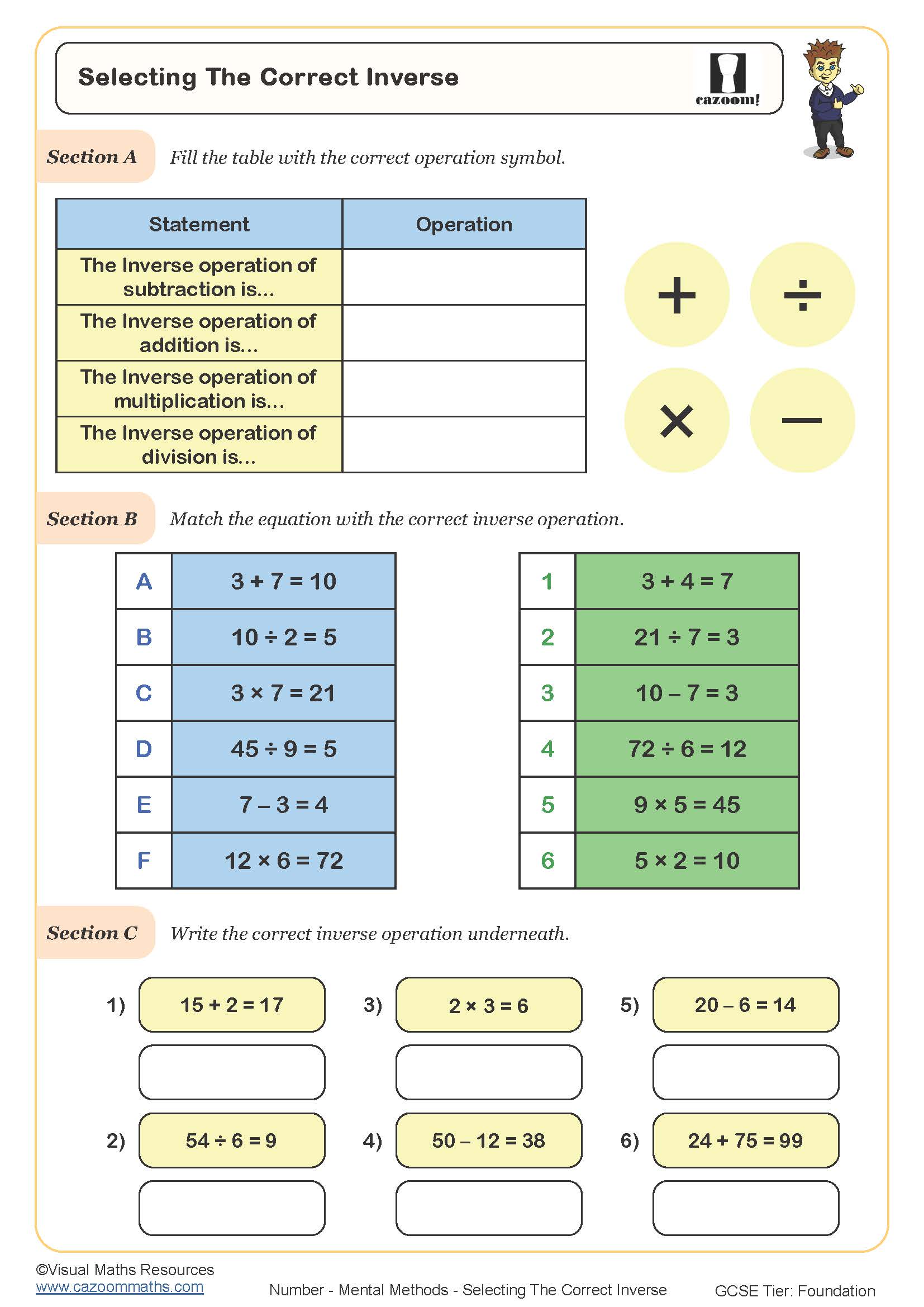

Mathematics is a language that transcends cultures and time, providing a universal framework for understanding the world around us. One of the fundamental concepts in mathematics is the Inverse Operation Definition. This concept is crucial for solving equations, understanding functions, and grasping the broader principles of mathematical operations. In this post, we will delve into the Inverse Operation Definition, its applications, and its significance in various mathematical contexts.
Understanding Inverse Operations
An inverse operation is a mathematical operation that reverses the effect of another operation. For example, addition and subtraction are inverse operations because adding a number and then subtracting the same number returns you to the original value. Similarly, multiplication and division are inverse operations. Understanding these relationships is essential for solving equations and simplifying expressions.
Basic Inverse Operations
Let’s start with the basic inverse operations:
- Addition and Subtraction: If you add a number to another number, you can reverse this operation by subtracting the same number.
- Multiplication and Division: If you multiply a number by another number, you can reverse this operation by dividing by the same number.
- Exponentiation and Logarithms: If you raise a number to a power, you can reverse this operation by taking the logarithm of the result.
Inverse Operation Definition in Algebra
In algebra, the Inverse Operation Definition is used to solve equations. For example, consider the equation:
x + 3 = 7
To solve for x, you apply the inverse operation of addition, which is subtraction:
x + 3 - 3 = 7 - 3
This simplifies to:
x = 4
Similarly, for the equation:
2x = 8
You apply the inverse operation of multiplication, which is division:
x = 8 / 2
This simplifies to:
x = 4
Inverse Operations in Functions
In the context of functions, the Inverse Operation Definition is used to find the inverse of a function. If a function f takes an input x and produces an output y, the inverse function f-1 takes the output y and produces the original input x.
For example, consider the function:
f(x) = 2x + 3
To find the inverse function, you solve for x in terms of y:
y = 2x + 3
Subtract 3 from both sides:
y - 3 = 2x
Divide by 2:
x = (y - 3) / 2
Therefore, the inverse function is:
f-1(y) = (y - 3) / 2
Inverse Operations in Geometry
In geometry, the Inverse Operation Definition is used to understand transformations such as rotations, reflections, and translations. For example, if you rotate a shape by 90 degrees clockwise, the inverse operation would be to rotate it by 90 degrees counterclockwise to return it to its original position.
Similarly, if you reflect a shape over a line, the inverse operation is to reflect it over the same line again to return it to its original position.
Inverse Operations in Calculus
In calculus, the Inverse Operation Definition is used to understand derivatives and integrals. The derivative of a function is the rate at which the function is changing at a specific point, and the integral is the accumulation of quantities. These operations are inverses of each other, meaning that the integral of a derivative returns the original function, and the derivative of an integral also returns the original function.
For example, consider the function:
f(x) = x2
The derivative of f(x) is:
f’(x) = 2x
The integral of f’(x) is:
∫2x dx = x2 + C
Where C is the constant of integration. This shows that the integral of the derivative returns the original function.
Applications of Inverse Operations
The Inverse Operation Definition has numerous applications in various fields, including:
- Engineering: Inverse operations are used to solve problems related to forces, velocities, and accelerations.
- Physics: Inverse operations are used to understand the relationships between variables such as energy, momentum, and time.
- Computer Science: Inverse operations are used in algorithms for sorting, searching, and data compression.
- Economics: Inverse operations are used to model supply and demand, cost functions, and revenue functions.
Importance of Inverse Operations in Problem-Solving
The Inverse Operation Definition is a powerful tool for problem-solving. By understanding how to reverse mathematical operations, you can simplify complex problems and find solutions more efficiently. This concept is fundamental in various mathematical disciplines and is essential for students and professionals alike.
💡 Note: Understanding inverse operations is not just about memorizing formulas; it's about grasping the underlying principles that govern mathematical relationships.
Examples of Inverse Operations
Let’s look at some examples to illustrate the Inverse Operation Definition in action:
Example 1: Solving for x in the equation 3x + 5 = 17
Step 1: Subtract 5 from both sides:
3x + 5 - 5 = 17 - 5
Step 2: Simplify:
3x = 12
Step 3: Divide by 3:
x = 12 / 3
Step 4: Simplify:
x = 4
Example 2: Finding the inverse of the function f(x) = 3x - 2
Step 1: Set y = f(x):
y = 3x - 2
Step 2: Add 2 to both sides:
y + 2 = 3x
Step 3: Divide by 3:
x = (y + 2) / 3
Step 4: Write the inverse function:
f-1(y) = (y + 2) / 3
Inverse Operations in Real-World Scenarios
Inverse operations are not just theoretical concepts; they have practical applications in real-world scenarios. For example, in finance, understanding inverse operations can help in calculating interest rates, loan payments, and investment returns. In engineering, inverse operations are used to design structures, optimize processes, and solve complex problems.
Consider a scenario where you need to calculate the original price of an item after a discount. If the discounted price is 80</em> and the discount rate is <em>20%</em>, you can use inverse operations to find the original price.</p> <p>Step 1: Express the discount as a decimal:</p> <p><em>20% = 0.20</em></p> <p>Step 2: Calculate the original price:</p> <p><em>Original Price = Discounted Price / (1 - Discount Rate)</em></p> <p><em>Original Price = 80 / (1 - 0.20)
Original Price = 80 / 0.80</em></p> <p><em>Original Price = 100
Inverse Operations in Data Analysis
In data analysis, inverse operations are used to transform data and extract meaningful insights. For example, if you have a dataset with logarithmic values, you can use the inverse operation of logarithms (exponentiation) to transform the data back to its original scale.
Consider a dataset with logarithmic values:
log(x) = y
To transform the data back to its original scale, you use the inverse operation:
x = ey
Where e is the base of the natural logarithm.
Inverse Operations in Cryptography
In cryptography, inverse operations are used to encrypt and decrypt data. For example, the RSA algorithm uses the concept of modular arithmetic and its inverse to secure data. The encryption process involves multiplying two large prime numbers, and the decryption process involves finding the modular inverse of the product.
Consider the RSA encryption process:
c = me mod n
Where c is the ciphertext, m is the plaintext, e is the public exponent, and n is the modulus.
The decryption process involves finding the modular inverse of e:
m = cd mod n
Where d is the private exponent, which is the modular inverse of e.
Inverse Operations in Signal Processing
In signal processing, inverse operations are used to filter and analyze signals. For example, the Fourier transform is used to convert a time-domain signal into a frequency-domain signal, and the inverse Fourier transform is used to convert it back. These operations are inverses of each other and are essential for signal analysis and processing.
Consider a signal x(t) in the time domain. The Fourier transform converts it to the frequency domain:
X(f) = ∫x(t)e-j2πft dt
The inverse Fourier transform converts it back to the time domain:
x(t) = ∫X(f)ej2πft df
Inverse Operations in Machine Learning
In machine learning, inverse operations are used in various algorithms and models. For example, in neural networks, the backpropagation algorithm uses the chain rule of calculus, which involves inverse operations, to update the weights of the network. This process is crucial for training the network to make accurate predictions.
Consider a neural network with a loss function L. The backpropagation algorithm involves computing the gradient of the loss function with respect to the weights:
∇wL = ∂L/∂w
This gradient is used to update the weights using an optimization algorithm such as gradient descent:
w = w - η∇wL
Where η is the learning rate.
Inverse Operations in Statistics
In statistics, inverse operations are used to transform data and perform hypothesis testing. For example, the z-score is used to standardize data, and the inverse z-score is used to transform the data back to its original scale. These operations are essential for comparing data from different distributions and performing statistical tests.
Consider a dataset with a mean μ and standard deviation σ. The z-score transforms the data to a standard normal distribution:
z = (x - μ) / σ
The inverse z-score transforms the data back to its original scale:
x = zσ + μ
Inverse Operations in Linear Algebra
In linear algebra, inverse operations are used to solve systems of linear equations and find the inverse of a matrix. For example, the inverse of a matrix A is a matrix A-1 such that:
A-1A = I
Where I is the identity matrix. The inverse of a matrix is used to solve systems of linear equations of the form:
Ax = b
The solution is given by:
x = A-1b
Consider a system of linear equations:
| 2x + 3y = 5 | 4x - y = 2 |
|---|
This system can be represented as a matrix equation:
Ax = b
Where:
A = [2 3; 4 -1]
x = [x; y]
b = [5; 2]
The inverse of A is:
A-1 = [1/10 3/10; 2/5 -1/5]
The solution is:
x = A-1b = [1/10 3/10; 2/5 -1/5] [5; 2] = [1; 1]
💡 Note: The inverse of a matrix exists only if the matrix is square and invertible. If the matrix is not invertible, the system of equations may have no solution or infinitely many solutions.
Inverse operations are a fundamental concept in mathematics with wide-ranging applications. Understanding the Inverse Operation Definition is crucial for solving equations, understanding functions, and grasping the broader principles of mathematical operations. Whether you are a student, a professional, or simply someone interested in mathematics, mastering inverse operations will enhance your problem-solving skills and deepen your understanding of the subject.
Related Terms:
- list of inverse operations
- how to explain inverse operations
- inverse operations rules
- examples of inverse operations
- what is inverse operations
- how to use inverse operations