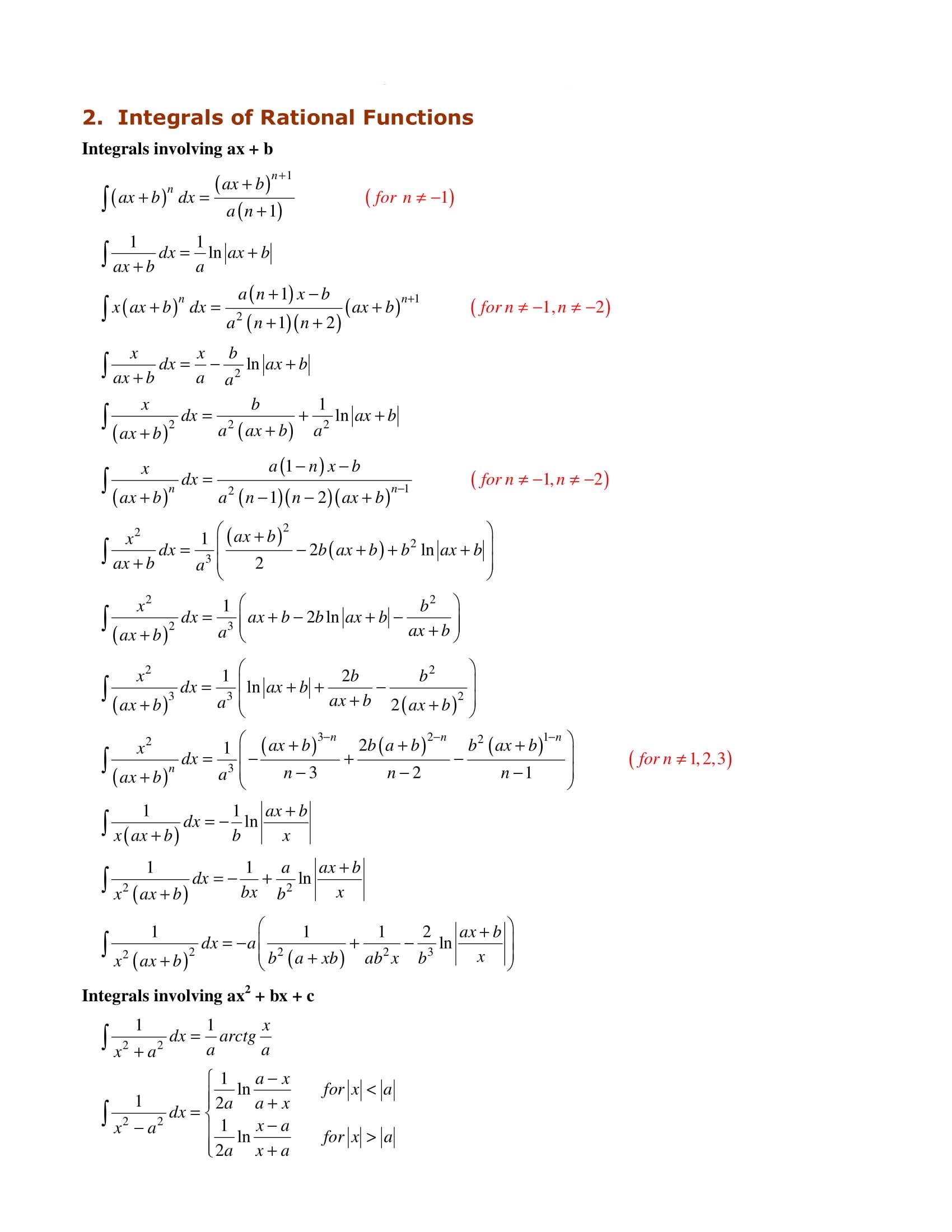

Calculus is a fundamental branch of mathematics that deals with rates of change and accumulation of quantities. One of the key concepts in calculus is the integral, which is used to find areas under curves, volumes of solids, and solutions to differential equations. Among the various integrals studied, the integral of e^(3x) is particularly interesting due to its applications in fields such as physics, engineering, and economics. This post will delve into the integral of e^(3x), its derivation, and its significance in various applications.
Understanding the Integral of e^(3x)
The integral of e^(3x) is a fundamental concept in calculus that involves finding the antiderivative of the function e^(3x). The antiderivative of a function is another function whose derivative is the original function. For e^(3x), the integral can be derived using the substitution method or by recognizing a pattern in the derivatives of exponential functions.
Derivation of the Integral of e^(3x)
To find the integral of e^(3x), we start by recognizing that the derivative of e^(3x) with respect to x is 3e^(3x). This can be written as:
d/dx [e^(3x)] = 3e^(3x)
To find the antiderivative, we need to reverse this process. We can use the substitution method, where we let u = 3x. Then, du = 3dx, and dx = du/3. Substituting these into the integral, we get:
∫e^(3x) dx = ∫(1⁄3)e^u du
Now, we can integrate with respect to u:
∫(1⁄3)e^u du = (1⁄3)e^u + C
Substituting back u = 3x, we get:
∫e^(3x) dx = (1⁄3)e^(3x) + C
Therefore, the integral of e^(3x) is (1⁄3)e^(3x) + C, where C is the constant of integration.
Applications of the Integral of e^(3x)
The integral of e^(3x) has numerous applications in various fields. Some of the key areas where this integral is used include:
- Physics: In physics, exponential functions are often used to model phenomena such as radioactive decay, population growth, and heat transfer. The integral of e^(3x) can be used to find the total amount of a substance that has decayed over time or the total heat transferred in a system.
- Engineering: In engineering, exponential functions are used to model systems that exhibit exponential growth or decay. The integral of e^(3x) can be used to find the total output of a system over time or the total energy consumed by a process.
- Economics: In economics, exponential functions are used to model economic growth, inflation, and interest rates. The integral of e^(3x) can be used to find the total value of an investment over time or the total cost of inflation over a period.
Examples of the Integral of e^(3x)
To illustrate the use of the integral of e^(3x), let’s consider a few examples:
Example 1: Finding the Area Under a Curve
Suppose we want to find the area under the curve of the function f(x) = e^(3x) from x = 0 to x = 1. We can use the integral of e^(3x) to find this area:
Area = ∫ from 0 to 1 e^(3x) dx
Using the integral we derived earlier, we get:
Area = [(1⁄3)e^(3x)] from 0 to 1
Evaluating this at the bounds, we get:
Area = (1⁄3)e^3 - (1⁄3)e^0 = (1⁄3)(e^3 - 1)
Therefore, the area under the curve is (1⁄3)(e^3 - 1).
Example 2: Solving a Differential Equation
Consider the differential equation dy/dx = e^(3x). To find the solution, we need to integrate both sides with respect to x:
∫dy/dx dx = ∫e^(3x) dx
Integrating both sides, we get:
y = (1⁄3)e^(3x) + C
Therefore, the solution to the differential equation is y = (1⁄3)e^(3x) + C, where C is the constant of integration.
Example 3: Modeling Population Growth
Suppose a population grows exponentially according to the function P(t) = e^(3t), where t is the time in years. To find the total population growth over a period of 5 years, we can use the integral of e^(3t):
Total Growth = ∫ from 0 to 5 e^(3t) dt
Using the integral we derived earlier, we get:
Total Growth = [(1⁄3)e^(3t)] from 0 to 5
Evaluating this at the bounds, we get:
Total Growth = (1⁄3)e^(15) - (1⁄3)e^0 = (1⁄3)(e^(15) - 1)
Therefore, the total population growth over 5 years is (1⁄3)(e^(15) - 1).
Importance of the Integral of e^(3x) in Mathematics
The integral of e^(3x) is not only important in its applications but also in the theoretical framework of calculus. It serves as a fundamental example of how to find the antiderivative of an exponential function and demonstrates the power of integration techniques such as substitution. Understanding the integral of e^(3x) is crucial for students and professionals in mathematics, as it lays the groundwork for more complex integrals and differential equations.
Table of Common Integrals
| Function | Integral |
|---|---|
| e^(ax) | (1/a)e^(ax) + C |
| e^(3x) | (1⁄3)e^(3x) + C |
| e^(-x) | -e^(-x) + C |
| e^(2x) | (1⁄2)e^(2x) + C |
📝 Note: The table above lists some common integrals of exponential functions. These integrals are fundamental in calculus and are used extensively in various applications.
In conclusion, the integral of e^(3x) is a crucial concept in calculus with wide-ranging applications in physics, engineering, economics, and mathematics. By understanding how to derive and use this integral, students and professionals can solve complex problems and gain deeper insights into the behavior of exponential functions. The integral of e^(3x) serves as a cornerstone in the study of calculus and continues to be a valuable tool in various scientific and engineering disciplines.
Related Terms:
- integral of e power x
- how to integrate e 3x
- e 3x antiderivative
- e raise to x integral
- integral of e x 4
- e power minus x integration