
In the realm of digital electronics, the Half Adder Circuit stands as a fundamental building block, essential for understanding more complex digital systems. This circuit is designed to perform basic arithmetic operations, specifically addition, and is a cornerstone in the design of larger digital circuits such as full adders, arithmetic logic units (ALUs), and even entire processors. Understanding the Half Adder Circuit provides a foundational knowledge that is crucial for anyone delving into the world of digital electronics and computer engineering.
Understanding the Half Adder Circuit
A Half Adder Circuit is a combinational logic circuit that adds two single-bit binary numbers. It produces two outputs: the sum and the carry. The sum is the result of the addition of the two input bits, while the carry is generated when the sum exceeds one bit (i.e., when both input bits are 1). The circuit can be implemented using basic logic gates such as AND, OR, and XOR gates.
Components of a Half Adder Circuit
The Half Adder Circuit consists of two primary components:
- XOR Gate: This gate is used to compute the sum of the two input bits. The XOR gate outputs 1 when the input bits are different and 0 when they are the same.
- AND Gate: This gate is used to compute the carry. The AND gate outputs 1 only when both input bits are 1, indicating that a carry is needed.
Truth Table for a Half Adder Circuit
The behavior of a Half Adder Circuit can be understood through its truth table, which lists all possible input combinations and their corresponding outputs. The truth table for a Half Adder Circuit is as follows:
| A | B | Sum (A ⊕ B) | Carry (A · B) |
|---|---|---|---|
| 0 | 0 | 0 | 0 |
| 0 | 1 | 1 | 0 |
| 1 | 0 | 1 | 0 |
| 1 | 1 | 0 | 1 |
In this table, A and B are the input bits, Sum (A ⊕ B) is the output of the XOR gate, and Carry (A · B) is the output of the AND gate.
Implementation of a Half Adder Circuit
To implement a Half Adder Circuit, you need to connect the XOR and AND gates as described. Here is a step-by-step guide to building a Half Adder Circuit:
- Connect the Inputs: Connect the two input bits, A and B, to the inputs of both the XOR gate and the AND gate.
- XOR Gate Output: The output of the XOR gate will be the sum of the two input bits. Connect this output to the sum line.
- AND Gate Output: The output of the AND gate will be the carry. Connect this output to the carry line.
💡 Note: Ensure that the logic gates are properly powered and connected to avoid any short circuits or incorrect outputs.
Applications of a Half Adder Circuit
The Half Adder Circuit is not just a theoretical concept; it has practical applications in various digital systems. Some of the key applications include:
- Full Adder Circuits: The Half Adder Circuit is a building block for more complex circuits like the Full Adder, which can add three input bits (two data bits and one carry bit).
- Arithmetic Logic Units (ALUs): ALUs in processors use Half Adder Circuits to perform arithmetic operations such as addition and subtraction.
- Binary Counters: Half Adder Circuits are used in binary counters to increment the count by one.
- Error Detection: In digital communication systems, Half Adder Circuits can be used for error detection and correction.
Designing a Half Adder Circuit Using Logic Gates
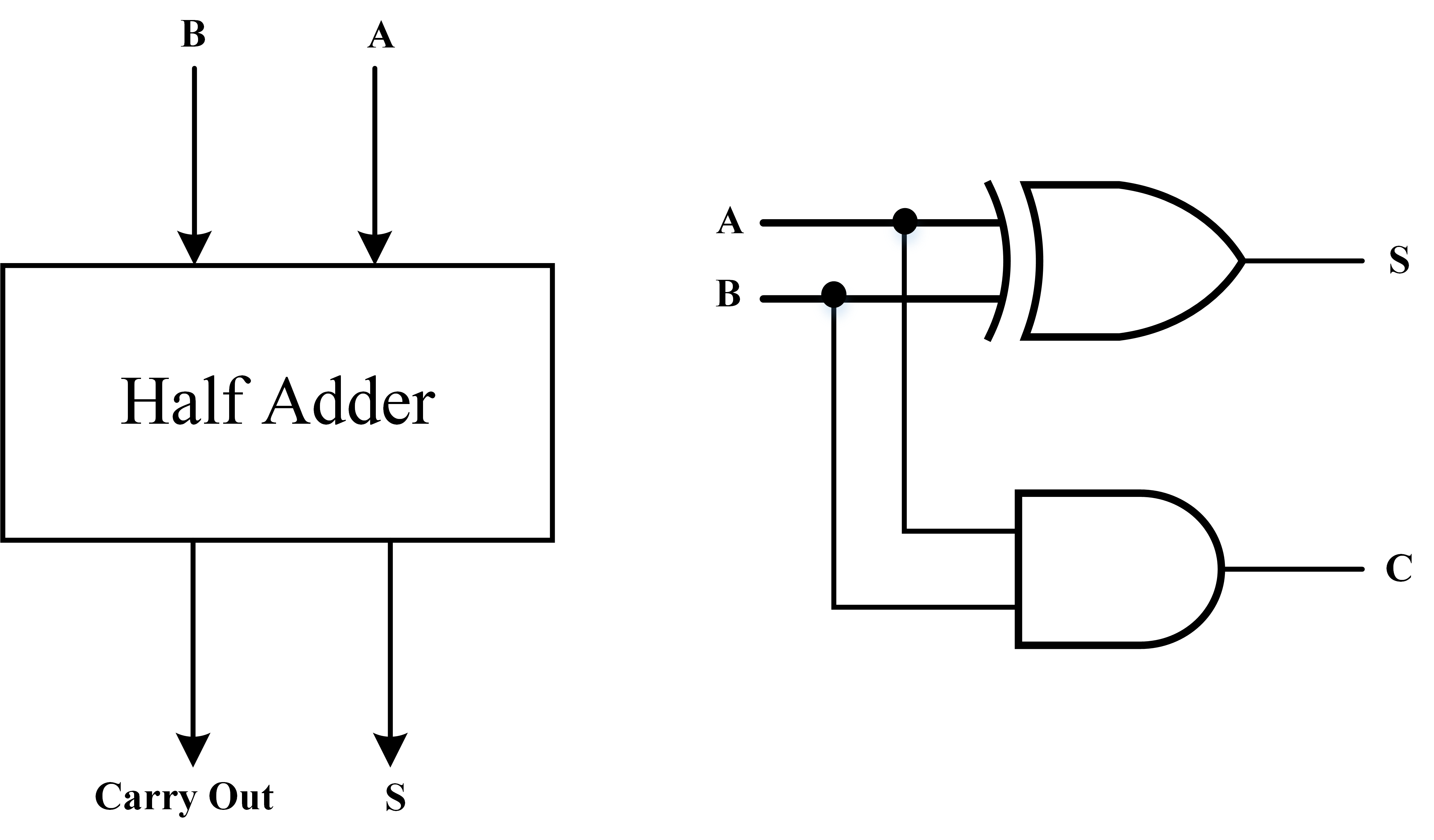
Let's delve into the design of a Half Adder Circuit using basic logic gates. The circuit diagram below illustrates the connections:

In this diagram:
- The XOR gate takes inputs A and B and produces the sum.
- The AND gate takes inputs A and B and produces the carry.
This simple design showcases the elegance and efficiency of digital circuits. By understanding this basic structure, one can appreciate the complexity and power of modern digital systems.
Expanding the Half Adder Circuit
While the Half Adder Circuit is limited to adding two single-bit numbers, it can be expanded to handle multi-bit addition. This is achieved by cascading multiple Half Adder Circuits and Full Adder Circuits. Here’s how you can expand a Half Adder Circuit to handle multi-bit addition:
- Cascade Half Adders: Connect multiple Half Adder Circuits in series, where the carry output of one Half Adder Circuit becomes the carry input of the next.
- Use Full Adders: For more efficient multi-bit addition, use Full Adder Circuits, which can handle three inputs (two data bits and one carry bit).
- Propagate Carry: Ensure that the carry is propagated correctly through the chain of adders to get the correct sum.
This expansion allows for the addition of binary numbers of any length, making it a crucial concept in digital arithmetic.
In conclusion, the Half Adder Circuit is a fundamental component in digital electronics, serving as the backbone for more complex arithmetic operations. Its simplicity and efficiency make it an essential tool for engineers and students alike. By understanding the Half Adder Circuit, one gains a deeper appreciation for the intricacies of digital systems and the principles that govern their operation. This foundational knowledge is invaluable for anyone looking to delve into the world of digital electronics and computer engineering.
Related Terms:
- half subtractor circuit diagram
- half adder circuit diagram
- half adder boolean expression
- half adder
- half subtractor circuit
- full adder