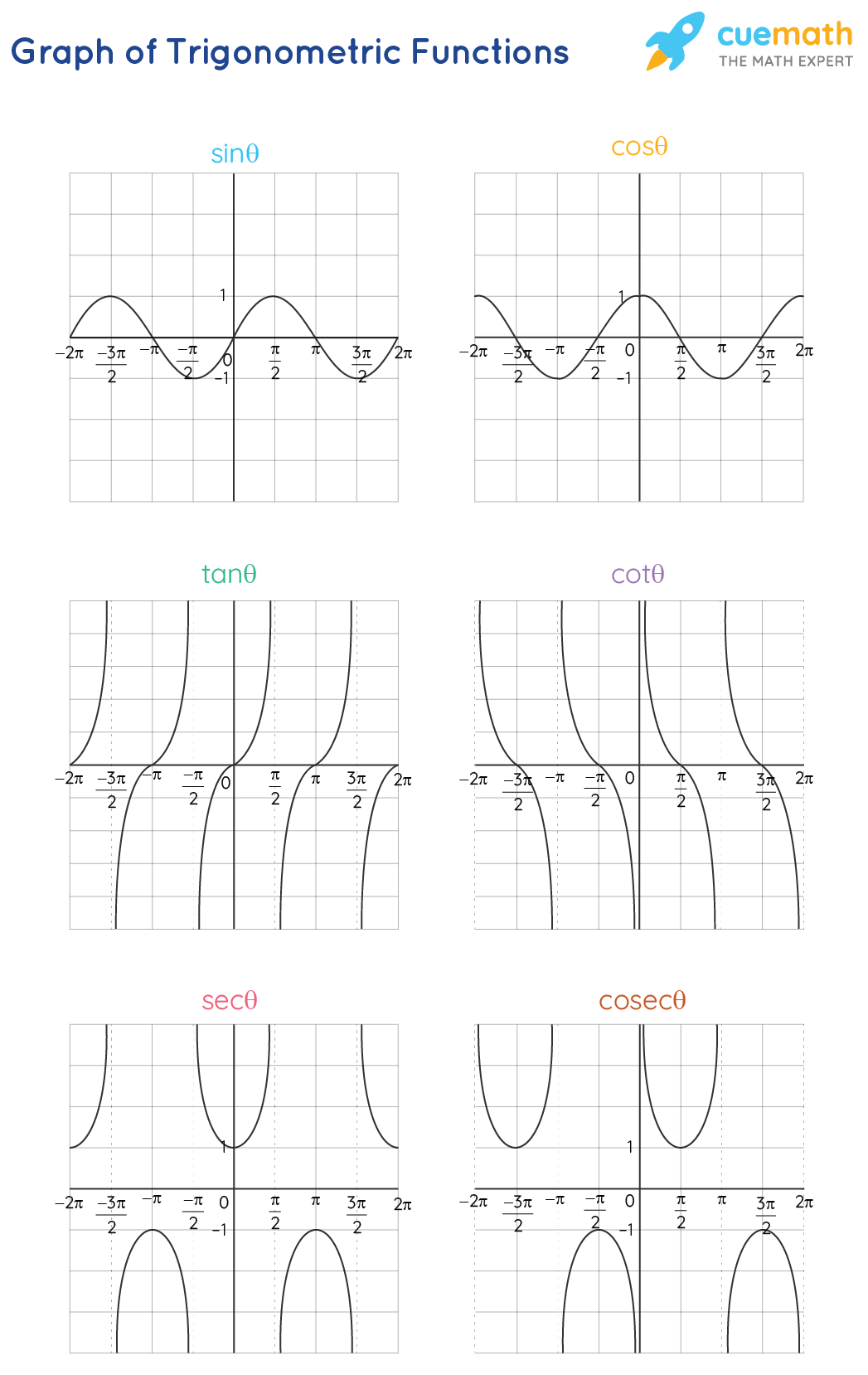

Understanding trigonometric functions is fundamental in mathematics, and one of the best ways to grasp these concepts is through Graphing Trigonometric Functions. This process not only helps in visualizing the behavior of these functions but also aids in solving complex problems in physics, engineering, and other scientific fields. In this post, we will delve into the intricacies of graphing trigonometric functions, exploring their properties, transformations, and applications.
Understanding Trigonometric Functions
Trigonometric functions are mathematical functions that relate the angles of a triangle to the lengths of its sides. The primary trigonometric functions are sine (sin), cosine (cos), and tangent (tan). These functions are periodic, meaning their values repeat at regular intervals. Understanding these functions is crucial for Graphing Trigonometric Functions accurately.
Basic Trigonometric Functions
Let’s start with the basic trigonometric functions and their graphs:
- Sine Function (sin): The sine function is defined as the ratio of the opposite side to the hypotenuse in a right-angled triangle. Its graph is a smooth, periodic wave that oscillates between -1 and 1.
- Cosine Function (cos): The cosine function is defined as the ratio of the adjacent side to the hypotenuse. Its graph is also a smooth, periodic wave but starts at 1 instead of 0.
- Tangent Function (tan): The tangent function is defined as the ratio of the opposite side to the adjacent side. Its graph has vertical asymptotes and repeats every π units.
Graphing the Sine Function
To graph the sine function, we start with the basic equation y = sin(x). The graph of this function is a sine wave that repeats every 2π units. Here are the steps to graph the sine function:
- Draw the x-axis and y-axis.
- Mark the points where the sine function equals 0, 1, and -1.
- Connect these points with a smooth, periodic wave.
📝 Note: The sine function is symmetric about the origin, meaning sin(-x) = -sin(x).
Graphing the Cosine Function
The cosine function, y = cos(x), is similar to the sine function but starts at 1 when x = 0. Here are the steps to graph the cosine function:
- Draw the x-axis and y-axis.
- Mark the points where the cosine function equals 1, 0, and -1.
- Connect these points with a smooth, periodic wave.
📝 Note: The cosine function is symmetric about the y-axis, meaning cos(-x) = cos(x).
Graphing the Tangent Function
The tangent function, y = tan(x), has vertical asymptotes at x = (2n+1)π/2, where n is an integer. Here are the steps to graph the tangent function:
- Draw the x-axis and y-axis.
- Mark the vertical asymptotes at x = (2n+1)π/2.
- Draw the tangent wave, ensuring it approaches infinity near the asymptotes.
📝 Note: The tangent function is periodic with a period of π, meaning tan(x + π) = tan(x).
Transformations of Trigonometric Functions
Understanding how to transform trigonometric functions is essential for Graphing Trigonometric Functions accurately. The primary transformations include amplitude, period, phase shift, and vertical shift.
Amplitude
The amplitude of a trigonometric function is the maximum distance from the x-axis to the peak or trough of the wave. For a function y = A sin(x), the amplitude is |A|. Increasing the amplitude stretches the graph vertically, while decreasing it compresses it.
Period
The period of a trigonometric function is the distance over which the function completes one full cycle. For a function y = sin(Bx), the period is 2π/|B|. Increasing B compresses the graph horizontally, while decreasing it stretches it.
Phase Shift
The phase shift of a trigonometric function is the horizontal displacement of the graph. For a function y = sin(x - C), the phase shift is C. A positive phase shift moves the graph to the right, while a negative shift moves it to the left.
Vertical Shift
The vertical shift of a trigonometric function is the vertical displacement of the graph. For a function y = sin(x) + D, the vertical shift is D. A positive vertical shift moves the graph up, while a negative shift moves it down.
Graphing Trigonometric Functions with Transformations
Let’s consider an example to illustrate how to graph a trigonometric function with transformations. Suppose we have the function y = 2 sin(3x - π/2) + 1.
Here are the steps to graph this function:
- Identify the amplitude: A = 2.
- Identify the period: B = 3, so the period is 2π/3.
- Identify the phase shift: C = π/2, so the phase shift is π/2 to the right.
- Identify the vertical shift: D = 1, so the vertical shift is 1 unit up.
Using these transformations, we can graph the function y = 2 sin(3x - π/2) + 1. The graph will have an amplitude of 2, a period of 2π/3, a phase shift of π/2 to the right, and a vertical shift of 1 unit up.
Applications of Graphing Trigonometric Functions
Graphing Trigonometric Functions has numerous applications in various fields. Here are a few examples:
- Physics: Trigonometric functions are used to describe wave motion, such as sound waves and light waves. Graphing these functions helps in understanding their behavior and properties.
- Engineering: In electrical engineering, trigonometric functions are used to analyze alternating current (AC) circuits. Graphing these functions helps in designing and troubleshooting electrical systems.
- Computer Graphics: Trigonometric functions are used to create smooth curves and animations. Graphing these functions helps in designing visually appealing graphics and animations.
Common Mistakes to Avoid
When Graphing Trigonometric Functions, it’s essential to avoid common mistakes that can lead to incorrect graphs. Here are a few tips to keep in mind:
- Ensure you correctly identify the amplitude, period, phase shift, and vertical shift.
- Double-check the signs of the transformations to avoid graphing the function incorrectly.
- Use graphing tools or software to verify your graphs, especially for complex functions.
📝 Note: Always label your axes and include relevant details about the function being graphed.
Practice Problems
To reinforce your understanding of Graphing Trigonometric Functions, try solving the following practice problems:
- Graph the function y = 3 cos(2x + π/4) - 2.
- Graph the function y = -2 sin(4x - π/3) + 3.
- Graph the function y = tan(2x - π/2).
For each problem, identify the amplitude, period, phase shift, and vertical shift, and use these transformations to graph the function accurately.
Graphing Trigonometric Functions Using Technology
In today’s digital age, technology plays a crucial role in Graphing Trigonometric Functions. Various tools and software can help you create accurate and visually appealing graphs. Here are a few popular options:
- Graphing Calculators: Devices like the TI-84 Plus CE allow you to input trigonometric functions and view their graphs instantly.
- Online Graphing Tools: Websites like Desmos and GeoGebra offer interactive graphing tools that can plot trigonometric functions and allow you to adjust parameters in real-time.
- Computer Algebra Systems: Software like Mathematica and MATLAB provide powerful tools for graphing and analyzing trigonometric functions.
Using these tools can save time and reduce errors, making it easier to focus on understanding the underlying concepts.
Graphing Trigonometric Functions in Real-World Scenarios
To truly master Graphing Trigonometric Functions, it’s essential to apply these skills to real-world scenarios. Here are a few examples:
- Tidal Patterns: The height of the tide at a given location can be modeled using a trigonometric function. Graphing this function helps in predicting tidal patterns and planning coastal activities.
- Seasonal Variations: The amount of daylight in a day varies throughout the year and can be modeled using a trigonometric function. Graphing this function helps in understanding seasonal changes and planning agricultural activities.
- Sound Waves: The amplitude and frequency of sound waves can be modeled using trigonometric functions. Graphing these functions helps in designing audio equipment and analyzing sound patterns.
By applying Graphing Trigonometric Functions to real-world scenarios, you can gain a deeper understanding of these concepts and their practical applications.
Advanced Topics in Graphing Trigonometric Functions
For those looking to delve deeper into Graphing Trigonometric Functions, there are several advanced topics to explore:
- Inverse Trigonometric Functions: These functions, such as arcsin, arccos, and arctan, are the inverses of the basic trigonometric functions. Graphing these functions requires understanding their domains and ranges.
- Trigonometric Identities: These are equations that relate trigonometric functions to each other. Understanding and applying these identities can simplify complex trigonometric expressions and graphs.
- Complex Numbers and Trigonometry: Trigonometric functions can be extended to complex numbers, leading to fascinating applications in fields like signal processing and quantum mechanics.
Exploring these advanced topics can provide a deeper understanding of trigonometry and its applications.
Graphing Trigonometric Functions is a fundamental skill in mathematics that has wide-ranging applications. By understanding the basic trigonometric functions, their transformations, and real-world applications, you can master the art of graphing these functions accurately. Whether you’re a student, engineer, or scientist, Graphing Trigonometric Functions is a valuable skill that will serve you well in your academic and professional pursuits.
Related Terms:
- graphing trigonometric functions ppt
- graphing trigonometric functions pdf
- graphing trigonometric functions practice
- graphing trigonometric functions formula
- sine graph
- graphing trigonometric functions calculator