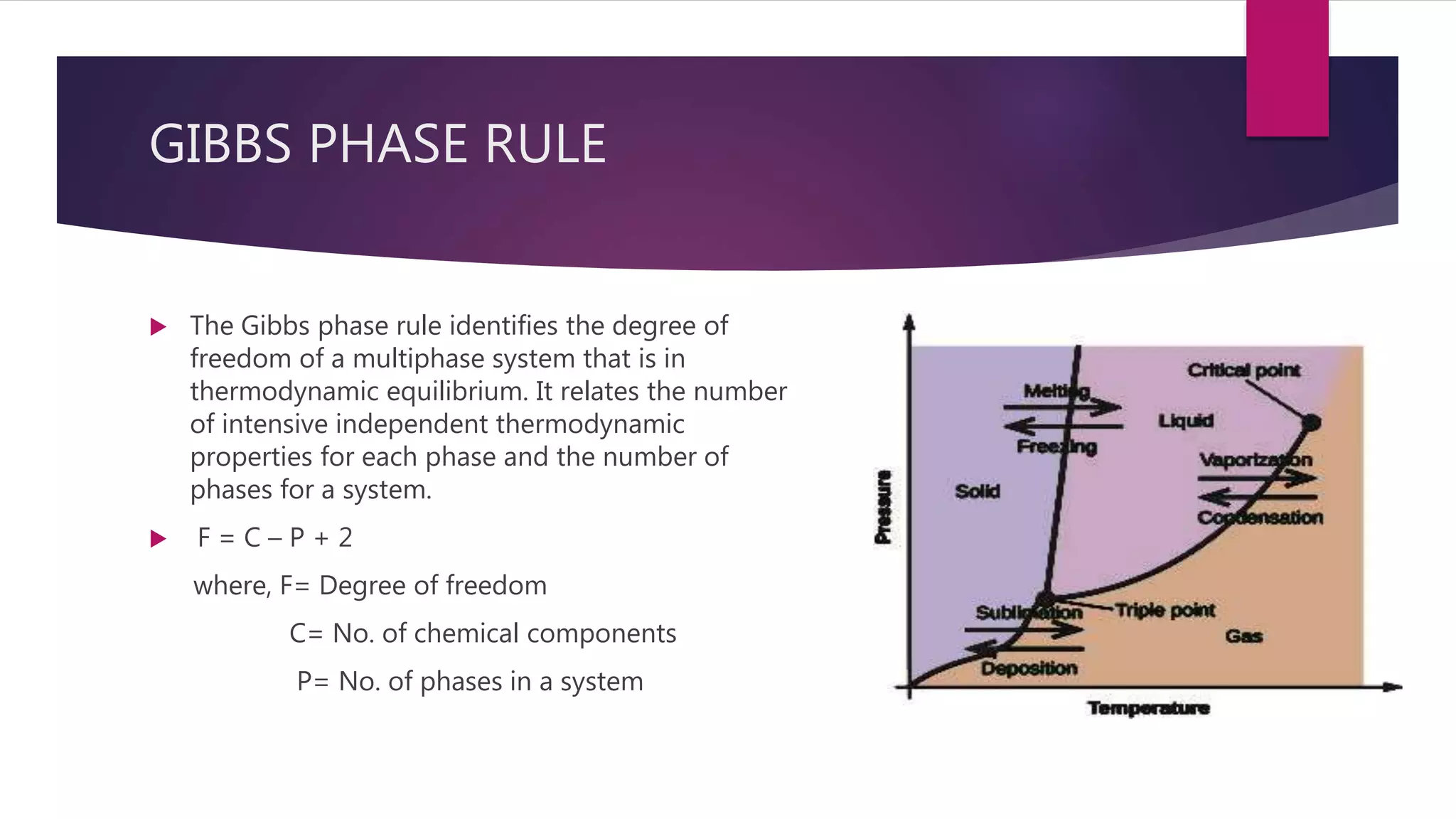

Understanding the behavior of materials under varying conditions is crucial in fields such as materials science, chemistry, and engineering. One fundamental concept that aids in this understanding is the Gibbs Phase Rule. This rule provides a systematic way to predict the number of degrees of freedom in a system at equilibrium, which is essential for designing and optimizing processes involving phase transitions. This post delves into the Gibbs Phase Rule, its applications, and its significance in various scientific and engineering disciplines.
Understanding the Gibbs Phase Rule
The Gibbs Phase Rule is a fundamental principle in thermodynamics that helps determine the number of degrees of freedom in a system at equilibrium. It was formulated by Josiah Willard Gibbs, a pioneering figure in the field of thermodynamics. The rule is expressed mathematically as:
📝 Note: The Gibbs Phase Rule is given by F = C - P + 2, where F is the number of degrees of freedom, C is the number of components, and P is the number of phases.
To break it down:
- Degrees of Freedom (F): These are the independent variables that can be changed without altering the number of phases in the system. Examples include temperature, pressure, and composition.
- Components (C): These are the chemically distinct species in the system. For example, in a binary system like water and ethanol, C = 2.
- Phases (P): These are the distinct physical states of matter in the system, such as solid, liquid, and gas.
Applications of the Gibbs Phase Rule
The Gibbs Phase Rule has wide-ranging applications across various fields. Here are some key areas where it is applied:
Materials Science
In materials science, the Gibbs Phase Rule is used to understand phase diagrams, which are graphical representations of the phases of a material under different conditions of temperature and pressure. Phase diagrams are essential for:
- Designing alloys and composites with desired properties.
- Optimizing heat treatment processes to achieve specific microstructures.
- Predicting the behavior of materials under extreme conditions.
Chemical Engineering
In chemical engineering, the Gibbs Phase Rule is crucial for designing and optimizing processes involving phase transitions, such as distillation, crystallization, and extraction. It helps in:
- Determining the number of independent variables that can be controlled in a process.
- Designing separation processes to achieve high purity products.
- Optimizing reaction conditions to maximize yield and efficiency.
Geology
In geology, the Gibbs Phase Rule is used to understand the formation and behavior of minerals and rocks under varying conditions of temperature and pressure. It aids in:
- Studying the formation of igneous, sedimentary, and metamorphic rocks.
- Predicting the behavior of minerals under different geological conditions.
- Understanding the processes involved in the formation of ores and other geological deposits.
Examples of the Gibbs Phase Rule in Action
To illustrate the practical application of the Gibbs Phase Rule, let’s consider a few examples:
Example 1: Water System
Consider a system consisting of water, which can exist in three phases: solid (ice), liquid (water), and gas (vapor). The number of components © is 1, and the number of phases (P) can vary from 1 to 3. Using the Gibbs Phase Rule, we can determine the number of degrees of freedom (F) for different scenarios:
| Phases (P) | Degrees of Freedom (F) |
|---|---|
| 1 (e.g., only liquid water) | F = 1 - 1 + 2 = 2 |
| 2 (e.g., liquid water and ice) | F = 1 - 2 + 2 = 1 |
| 3 (e.g., ice, liquid water, and vapor) | F = 1 - 3 + 2 = 0 |
In the case of three phases (ice, liquid water, and vapor), there are no degrees of freedom, meaning the system is invariant, and the conditions of temperature and pressure are fixed at the triple point.
Example 2: Binary System (Water and Ethanol)
Consider a binary system consisting of water and ethanol. The number of components © is 2. The system can have different phases, such as liquid and vapor. Using the Gibbs Phase Rule, we can determine the number of degrees of freedom for different scenarios:
| Phases (P) | Degrees of Freedom (F) |
|---|---|
| 1 (e.g., only liquid mixture) | F = 2 - 1 + 2 = 3 |
| 2 (e.g., liquid and vapor) | F = 2 - 2 + 2 = 2 |
In the case of two phases (liquid and vapor), there are two degrees of freedom, meaning we can independently vary two variables, such as temperature and pressure, while maintaining the system at equilibrium.
Significance of the Gibbs Phase Rule
The Gibbs Phase Rule is a cornerstone of thermodynamics and has significant implications for various scientific and engineering disciplines. Its importance lies in:
- Predicting Phase Behavior: It helps predict the behavior of materials and systems under different conditions, which is crucial for designing and optimizing processes.
- Understanding Equilibrium Conditions: It provides a systematic way to understand the conditions under which a system is at equilibrium, which is essential for thermodynamic analysis.
- Optimizing Processes: It aids in optimizing processes involving phase transitions, leading to improved efficiency and productivity.
In summary, the Gibbs Phase Rule is a powerful tool that enables scientists and engineers to understand and predict the behavior of materials and systems under varying conditions. Its applications span across materials science, chemical engineering, geology, and other fields, making it an indispensable concept in the study of thermodynamics.
By mastering the Gibbs Phase Rule, professionals can design more efficient processes, develop new materials, and gain deeper insights into the fundamental principles governing phase behavior. This knowledge is essential for advancing research and innovation in various scientific and engineering disciplines.
In the realm of materials science, the Gibbs Phase Rule is used to design phase diagrams, which are crucial for understanding the behavior of materials under different conditions. These diagrams help in selecting the right materials for specific applications and optimizing their properties. For example, in the development of alloys, the Gibbs Phase Rule aids in determining the optimal composition and heat treatment conditions to achieve the desired microstructure and mechanical properties.
In chemical engineering, the Gibbs Phase Rule is applied to design and optimize separation processes, such as distillation and extraction. By understanding the number of degrees of freedom in a system, engineers can design processes that achieve high purity products with minimal energy consumption. For instance, in the distillation of a binary mixture, the Gibbs Phase Rule helps in determining the number of independent variables that can be controlled to achieve the desired separation.
In geology, the Gibbs Phase Rule is used to study the formation and behavior of minerals and rocks under varying conditions of temperature and pressure. This knowledge is essential for understanding the processes involved in the formation of geological deposits and predicting the behavior of minerals under different geological conditions. For example, in the study of metamorphic rocks, the Gibbs Phase Rule aids in determining the conditions under which different minerals form and how they behave under varying conditions.
In conclusion, the Gibbs Phase Rule is a fundamental concept in thermodynamics that has wide-ranging applications across various scientific and engineering disciplines. Its ability to predict the number of degrees of freedom in a system at equilibrium makes it an invaluable tool for understanding and optimizing processes involving phase transitions. By mastering the Gibbs Phase Rule, professionals can gain deeper insights into the behavior of materials and systems, leading to advancements in research and innovation. The Gibbs Phase Rule continues to be a cornerstone of thermodynamics, providing a systematic way to understand and predict the behavior of materials under varying conditions. Its significance in materials science, chemical engineering, geology, and other fields underscores its importance in the study of thermodynamics and its applications in various scientific and engineering disciplines.
Related Terms:
- gibbs phase rule constant pressure
- explain gibbs phase rule
- phase rule and diagram
- gibbs phase rule examples
- gibbs phase rule questions
- state gibbs phase rule