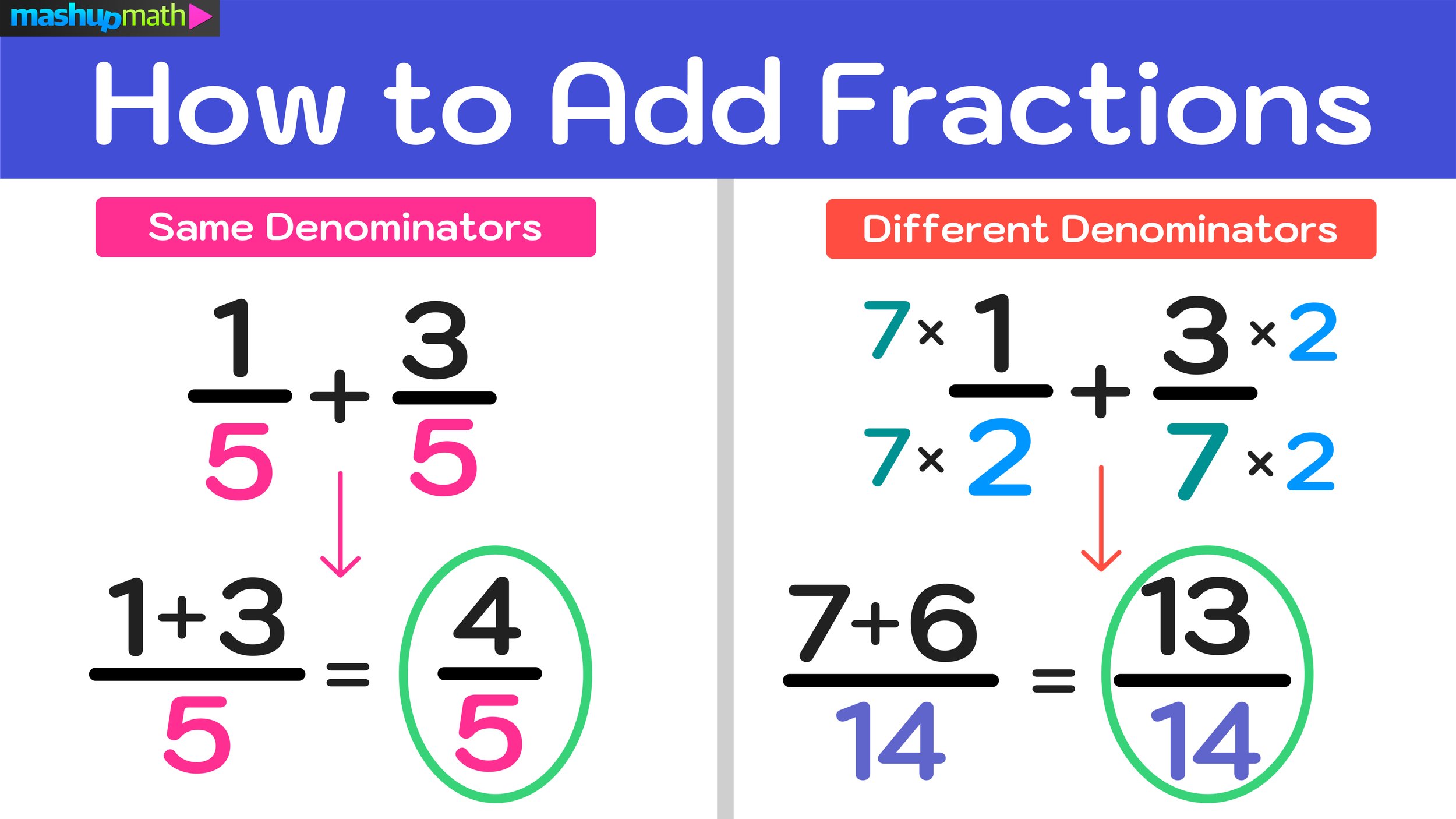

Mastering fraction addition is a fundamental skill in mathematics that opens the door to more complex mathematical concepts. Whether you're a student, a teacher, or someone looking to brush up on their math skills, understanding how to add fractions is essential. This guide will walk you through the process of adding fractions, provide example fraction addition problems, and offer tips to help you master this skill.
Understanding Fractions
Before diving into example fraction addition problems, it’s crucial to understand what fractions are. A fraction represents a part of a whole. It consists of a numerator (the top number) and a denominator (the bottom number). For example, in the fraction 3⁄4, 3 is the numerator, and 4 is the denominator.
Adding Fractions with the Same Denominator
Adding fractions with the same denominator is straightforward. You simply add the numerators and keep the denominator the same. Here’s how it works:
- Identify the fractions with the same denominator.
- Add the numerators.
- Keep the denominator the same.
For example, consider the fractions 1⁄5 and 2⁄5:
| Fraction 1 | Fraction 2 | Sum |
|---|---|---|
| 1⁄5 | 2⁄5 | 3⁄5 |
Here, the numerators 1 and 2 are added to get 3, while the denominator 5 remains the same.
Adding Fractions with Different Denominators
Adding fractions with different denominators requires a bit more work. You need to find a common denominator before adding the fractions. Here are the steps:
- Find the least common denominator (LCD) of the fractions.
- Convert each fraction to an equivalent fraction with the LCD.
- Add the numerators of the equivalent fractions.
- Keep the common denominator.
Let’s go through an example fraction addition problem to illustrate this:
Add 1⁄3 and 1⁄4.
- Find the LCD of 3 and 4, which is 12.
- Convert 1⁄3 to 4⁄12 and 1⁄4 to 3⁄12.
- Add the numerators: 4⁄12 + 3⁄12 = 7⁄12.
So, 1⁄3 + 1⁄4 = 7⁄12.
Adding Mixed Numbers
Mixed numbers are whole numbers combined with fractions. To add mixed numbers, follow these steps:
- Add the whole numbers.
- Add the fractions.
- Combine the results.
For example, add 2 1⁄3 and 1 2⁄3:
- Add the whole numbers: 2 + 1 = 3.
- Add the fractions: 1⁄3 + 2⁄3 = 3⁄3 = 1.
- Combine the results: 3 + 1 = 4.
So, 2 1⁄3 + 1 2⁄3 = 4.
💡 Note: When adding mixed numbers, if the sum of the fractions is greater than 1, convert the fraction to a mixed number and add it to the whole number part.
Practical Tips for Adding Fractions
Here are some practical tips to help you master fraction addition:
- Practice Regularly: The more you practice, the more comfortable you’ll become with adding fractions.
- Use Visual Aids: Drawing diagrams or using fraction strips can help you visualize the addition process.
- Check Your Work: Always double-check your answers to ensure accuracy.
- Understand the Concept: Focus on understanding the concept of fractions and common denominators rather than just memorizing steps.
Common Mistakes to Avoid
When adding fractions, it’s easy to make mistakes. Here are some common errors to avoid:
- Not Finding a Common Denominator: Always ensure you have a common denominator before adding fractions with different denominators.
- Incorrect Conversion: Double-check your conversions to equivalent fractions.
- Forgetting to Simplify: After adding fractions, simplify the result if possible.
🚨 Note: Simplifying fractions involves dividing both the numerator and the denominator by their greatest common divisor (GCD).
Example Fraction Addition Problems
Let’s go through a few more example fraction addition problems to solidify your understanding:
1. Add 2⁄5 and 3⁄5.
- Since the denominators are the same, add the numerators: 2 + 3 = 5.
- The sum is 5⁄5, which simplifies to 1.
2. Add 1⁄6 and 1⁄3.
- Find the LCD of 6 and 3, which is 6.
- Convert 1⁄3 to 2⁄6.
- Add the fractions: 1⁄6 + 2⁄6 = 3⁄6.
- Simplify the result: 3⁄6 = 1⁄2.
3. Add 3 1⁄4 and 2 3⁄4.
- Add the whole numbers: 3 + 2 = 5.
- Add the fractions: 1⁄4 + 3⁄4 = 4⁄4 = 1.
- Combine the results: 5 + 1 = 6.
By practicing these example fraction addition problems, you’ll gain confidence in adding fractions with different denominators and mixed numbers.
Adding fractions is a fundamental skill that requires practice and understanding. By following the steps outlined in this guide and practicing with various example fraction addition problems, you’ll become proficient in fraction addition. Remember to check your work, use visual aids, and focus on understanding the concepts. With dedication and practice, you’ll master this essential mathematical skill.
Related Terms:
- adding 2 proper fractions worksheet
- printable fraction addition worksheets
- free fraction addition worksheet
- improper to proper fraction worksheet
- adding fractions sample problems
- worksheet on addition of fractions