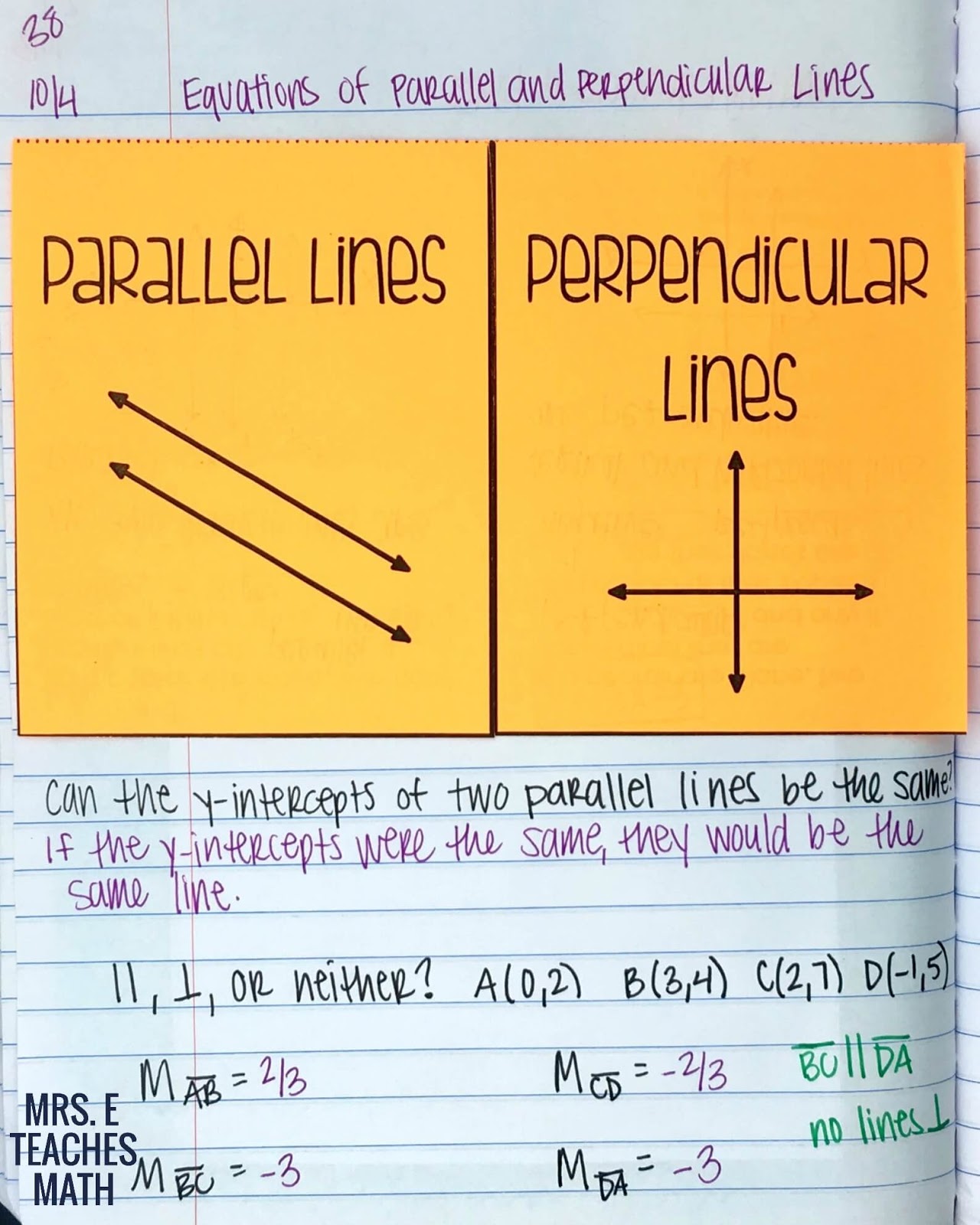

Understanding the concept of the equation of line perpendicular is crucial in various fields of mathematics and physics. This concept helps in determining the slope and orientation of lines that intersect at right angles. Whether you are a student studying geometry, a professional in engineering, or someone interested in the mathematical foundations of computer graphics, grasping this concept can significantly enhance your problem-solving skills.
Understanding Perpendicular Lines
Perpendicular lines are two lines that intersect at a right angle (90 degrees). In a Cartesian coordinate system, the slope of a line is a measure of its steepness and is often denoted by the letter 'm'. For two lines to be perpendicular, the product of their slopes must be -1. This relationship is fundamental in deriving the equation of line perpendicular to a given line.
Finding the Slope of a Perpendicular Line
To find the slope of a line perpendicular to a given line, you need to know the slope of the given line. Let's denote the slope of the given line as m. The slope of the line perpendicular to it, which we'll call m', can be found using the following formula:
m' = -1/m
For example, if the slope of the given line is 2, the slope of the line perpendicular to it would be -1/2.
Deriving the Equation of a Perpendicular Line
Once you have the slope of the perpendicular line, you can derive its equation. The general form of the equation of a line is:
y = mx + b
where m is the slope and b is the y-intercept. To find the equation of the perpendicular line, you need to know a point through which the line passes. Let's denote this point as (x1, y1). Using the point-slope form of the equation of a line, you can write:
y - y1 = m'(x - x1)
Substituting m' with -1/m, you get:
y - y1 = (-1/m)(x - x1)
This is the equation of line perpendicular to the given line passing through the point (x1, y1).
Examples and Applications
Let's go through a few examples to solidify the concept.
Example 1: Finding the Equation of a Perpendicular Line
Suppose you have a line with the equation y = 3x + 2. The slope of this line is 3. To find the equation of the line perpendicular to it, we first determine the slope of the perpendicular line:
m' = -1/3
Now, let's say the perpendicular line passes through the point (1, 4). Using the point-slope form:
y - 4 = (-1/3)(x - 1)
Simplifying this, we get:
y - 4 = -x/3 + 1/3
y = -x/3 + 13/3
So, the equation of the line perpendicular to y = 3x + 2 and passing through (1, 4) is y = -x/3 + 13/3.
Example 2: Real-World Application
In engineering, the concept of perpendicular lines is often used in structural design. For instance, when designing a building, engineers need to ensure that the walls are perpendicular to the floor. This ensures stability and structural integrity. By using the equation of line perpendicular, engineers can calculate the exact angles and slopes needed for the construction.
Special Cases
There are a few special cases to consider when dealing with perpendicular lines:
- Horizontal and Vertical Lines: A horizontal line has a slope of 0, and a vertical line has an undefined slope. The line perpendicular to a horizontal line is vertical, and vice versa.
- Lines with Slope 1 and -1: Lines with slopes of 1 and -1 are perpendicular to each other. This is because the product of their slopes is -1.
Understanding these special cases can help in quickly identifying perpendicular lines without needing to calculate slopes.
Practical Tips for Solving Problems
When solving problems involving the equation of line perpendicular, keep the following tips in mind:
- Always start by identifying the slope of the given line.
- Use the formula m' = -1/m to find the slope of the perpendicular line.
- If you have a point through which the perpendicular line passes, use the point-slope form to derive the equation.
- Simplify the equation to the standard form y = mx + b for clarity.
💡 Note: Remember that the slope of a line perpendicular to a horizontal line is undefined, and the slope of a line perpendicular to a vertical line is 0.
By following these steps and tips, you can efficiently solve problems related to perpendicular lines.

Advanced Topics
For those interested in delving deeper, there are advanced topics related to the equation of line perpendicular that can be explored:
- Parametric Equations: Parametric equations can be used to represent lines in a more flexible manner, especially in three-dimensional space.
- Vector Calculus: In vector calculus, the concept of perpendicular lines is extended to vectors and their dot products.
- Linear Algebra: Linear algebra provides a more abstract and powerful framework for understanding lines and their relationships, including perpendicularity.
These advanced topics can provide a deeper understanding of the underlying mathematics and its applications in various fields.
In conclusion, the equation of line perpendicular is a fundamental concept in mathematics with wide-ranging applications. By understanding the relationship between the slopes of perpendicular lines and how to derive their equations, you can solve a variety of problems in geometry, engineering, and other fields. Whether you are a student, a professional, or simply curious about mathematics, mastering this concept can greatly enhance your analytical skills and problem-solving abilities.
Related Terms:
- how to solve perpendicular equations
- identifying parallel lines from equations
- finding equations for perpendicular lines
- 2 perpendicular lines equation
- formula for a perpendicular line
- how to calculate perpendicular lines