
Understanding the principles of physics can often seem daunting, but delving into the conservation of angular motion reveals a fascinating world of rotational dynamics. This fundamental concept is crucial in various fields, from engineering and astronomy to sports and everyday activities. By exploring the principles and applications of the conservation of angular motion, we can gain a deeper appreciation for how objects move and interact in our universe.
Understanding Angular Motion
Angular motion refers to the movement of an object along a circular path. Unlike linear motion, which involves straight-line movement, angular motion is characterized by rotation around a fixed point or axis. The key parameters in angular motion include angular velocity, angular acceleration, and angular momentum.
Key Concepts in Angular Motion
To grasp the conservation of angular motion, it’s essential to understand the following key concepts:
- Angular Velocity: This is the rate at which an object rotates around an axis, measured in radians per second.
- Angular Acceleration: This is the rate of change of angular velocity, measured in radians per second squared.
- Angular Momentum: This is the product of the moment of inertia and the angular velocity of an object. It is a vector quantity that describes the rotational equivalent of linear momentum.
The Principle of Conservation of Angular Momentum
The conservation of angular motion is a fundamental principle in physics that states that the total angular momentum of a closed system remains constant unless acted upon by an external torque. This principle is analogous to the conservation of linear momentum in translational motion. In a closed system, if no external torques are applied, the angular momentum before and after any interaction will be the same.
Mathematical Representation
The mathematical representation of the conservation of angular motion can be expressed as:
Linitial = Lfinal
Where L represents angular momentum, which is given by:
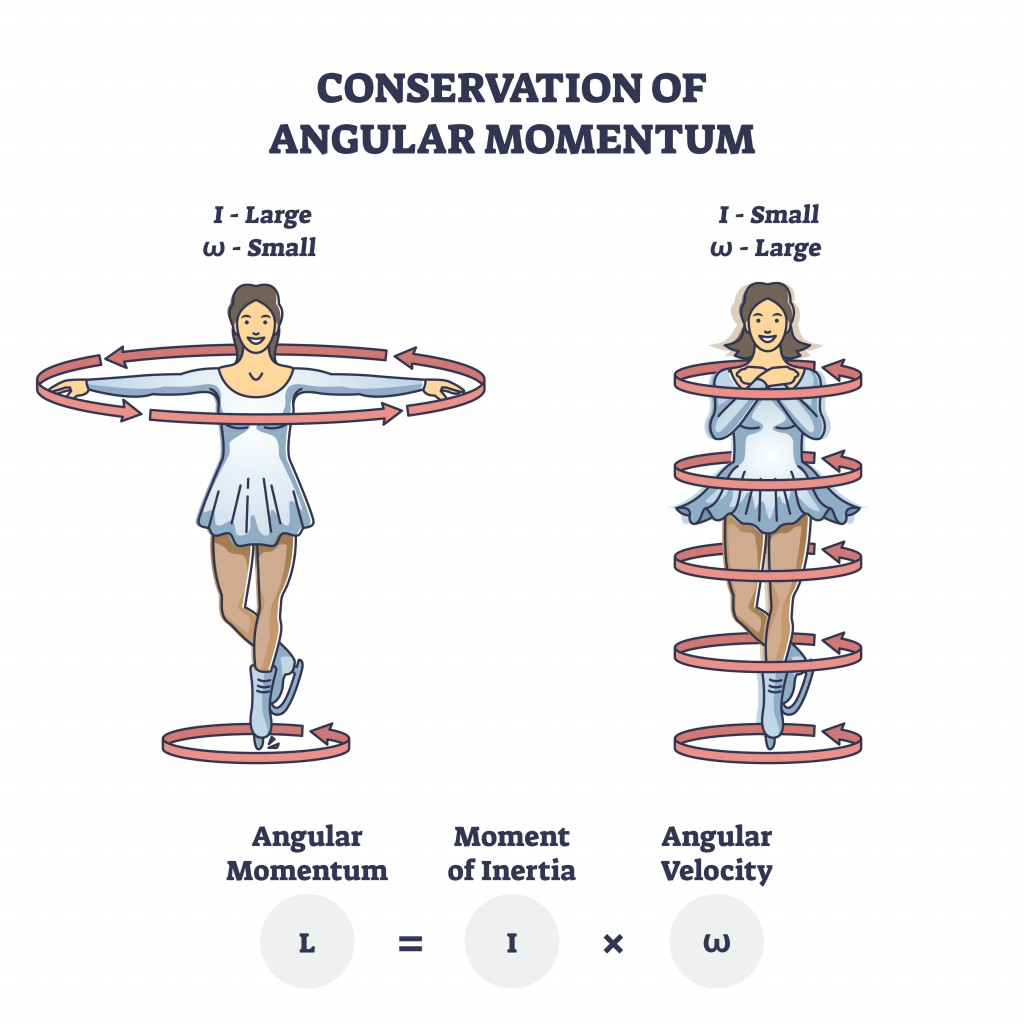
L = Iω
Here, I is the moment of inertia, and ω is the angular velocity.
Applications of Conservation of Angular Momentum
The conservation of angular motion has numerous applications in various fields. Some of the most notable applications include:
Space Exploration
In space exploration, the conservation of angular motion is crucial for understanding the behavior of satellites and spacecraft. For example, when a satellite adjusts its orientation using thrusters, the change in angular momentum must be accounted for to maintain stability. This principle is also used in designing spacecraft that need to change their orientation without using excessive fuel.
Sports
In sports, the conservation of angular motion plays a significant role in activities like figure skating, gymnastics, and diving. For instance, a figure skater can increase their rotational speed by pulling their arms and legs closer to their body, thereby reducing their moment of inertia. This action conserves angular momentum, resulting in a faster spin.
Engineering
In engineering, the conservation of angular motion is essential for designing rotating machinery, such as turbines, engines, and gyroscopes. Engineers use this principle to ensure that these machines operate efficiently and safely. For example, in the design of a turbine, the conservation of angular momentum helps in optimizing the blade angles to maximize energy conversion.
Astronomy
In astronomy, the conservation of angular motion helps explain the behavior of celestial bodies. For instance, the rotation of planets and stars can be understood through this principle. The conservation of angular momentum also plays a role in the formation of galaxies and the dynamics of binary star systems.
Examples of Conservation of Angular Momentum
To better understand the conservation of angular motion, let’s consider a few examples:
Ice Skater Spinning
When an ice skater spins, they can increase their rotational speed by pulling their arms and legs closer to their body. This action reduces their moment of inertia, causing their angular velocity to increase. The angular momentum before and after the change remains the same, demonstrating the conservation of angular motion.
Satellite Orbit
A satellite in orbit around the Earth experiences the conservation of angular motion. If the satellite’s orbit is circular, its angular momentum remains constant. However, if the satellite’s orbit is elliptical, the angular momentum changes as the satellite moves closer to or farther from the Earth, but the total angular momentum of the system (satellite + Earth) remains constant.
Gyroscope
A gyroscope is a device that uses the conservation of angular motion to maintain its orientation. When a gyroscope is spinning, it resists changes to its axis of rotation, making it useful in navigation and stabilization systems. The conservation of angular momentum ensures that the gyroscope’s orientation remains stable unless an external torque is applied.
Importance of Conservation of Angular Momentum
The conservation of angular motion is a cornerstone of modern physics and engineering. It provides a framework for understanding and predicting the behavior of rotating objects in various scenarios. By applying this principle, scientists and engineers can design more efficient and reliable systems, from spacecraft and turbines to sports equipment and astronomical instruments.
Moreover, the conservation of angular motion helps in solving complex problems in mechanics and dynamics. It allows for the simplification of equations and the development of models that accurately describe the behavior of rotating systems. This principle is also essential in educational settings, providing students with a fundamental understanding of rotational dynamics and its applications.
💡 Note: The conservation of angular motion is a fundamental principle that applies to all rotating systems, regardless of their size or complexity. Understanding this principle is crucial for anyone studying physics, engineering, or related fields.
In summary, the conservation of angular motion is a powerful concept that underpins many aspects of our understanding of the physical world. From the rotation of celestial bodies to the design of advanced machinery, this principle plays a vital role in explaining and predicting the behavior of rotating objects. By exploring the key concepts, applications, and examples of the conservation of angular motion, we can gain a deeper appreciation for the intricate dance of angular momentum in our universe.
Related Terms:
- angular momentum book pdf
- angular momentum diagram
- large angular momentum
- conservation of angular momentum
- angular momentum physics
- net angular momentum