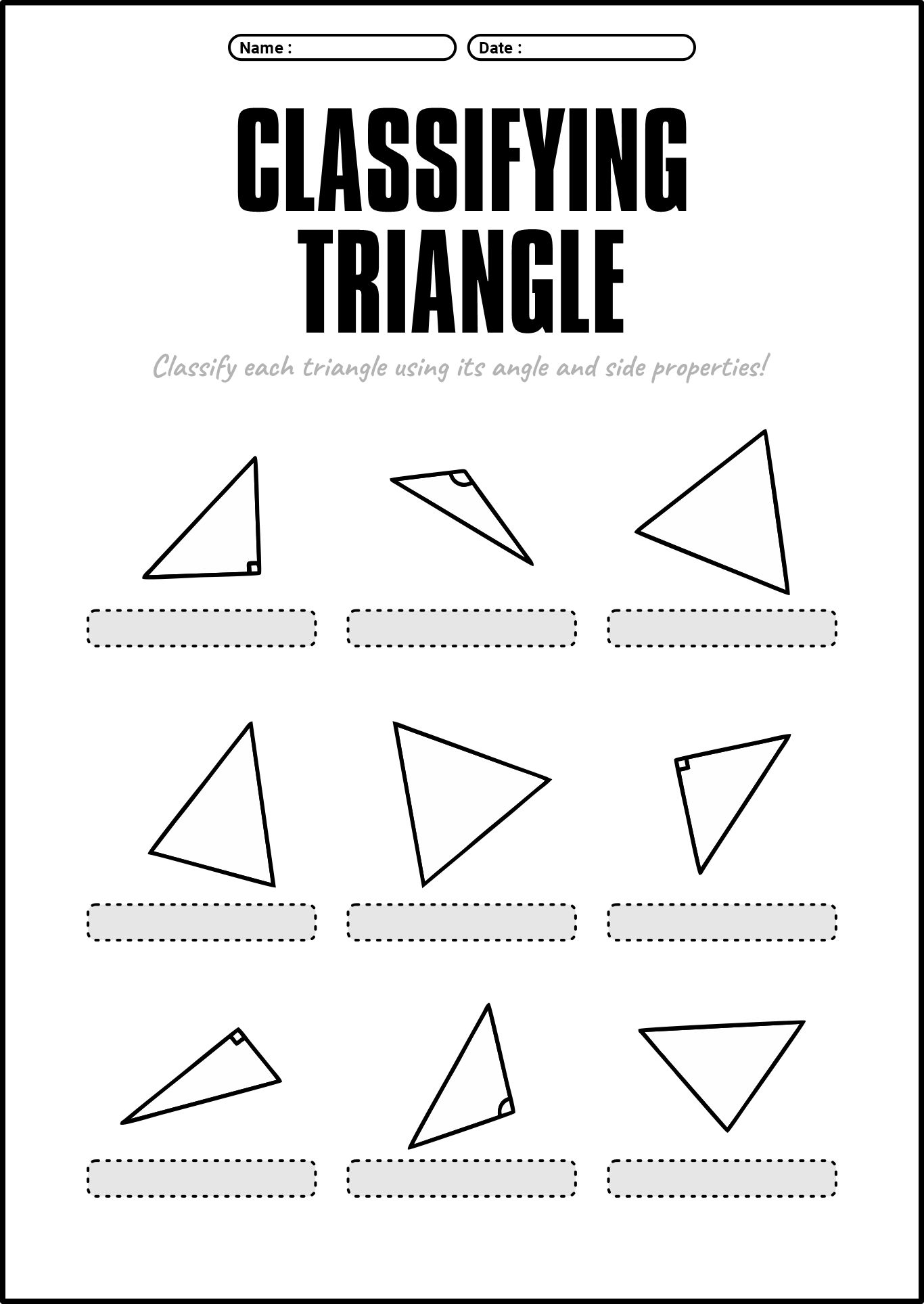

Understanding the properties of triangles is a fundamental aspect of geometry, and one of the key skills students need to master is classifying triangles. A Classifying Triangles Worksheet is an invaluable tool for educators and students alike, providing a structured way to practice and reinforce these concepts. This post will delve into the importance of classifying triangles, the different types of triangles, and how to effectively use a Classifying Triangles Worksheet to enhance learning.
Importance of Classifying Triangles
Classifying triangles is more than just a geometric exercise; it lays the groundwork for more complex mathematical concepts. By understanding the different types of triangles, students develop a deeper appreciation for shapes, angles, and sides. This foundational knowledge is crucial for advanced topics in geometry, trigonometry, and even calculus. Moreover, the ability to classify triangles helps students in real-world applications, such as architecture, engineering, and design.
Types of Triangles
Triangles can be classified based on their sides and angles. Understanding these classifications is essential for solving problems and applying geometric principles.
Classification Based on Sides
Triangles are classified into three types based on the lengths of their sides:
- Equilateral Triangle: All three sides are of equal length.
- Isosceles Triangle: Two sides are of equal length.
- Scalene Triangle: All three sides are of different lengths.
Classification Based on Angles
Triangles are also classified based on their angles:
- Acute Triangle: All angles are less than 90 degrees.
- Right Triangle: One angle is exactly 90 degrees.
- Obtuse Triangle: One angle is greater than 90 degrees.
Using a Classifying Triangles Worksheet
A Classifying Triangles Worksheet is a practical tool that helps students identify and categorize triangles. These worksheets typically include a variety of triangles, and students are required to classify them based on their sides and angles. Here’s how to effectively use a Classifying Triangles Worksheet:
Step-by-Step Guide
1. Introduction to the Worksheet: Begin by explaining the purpose of the worksheet and the types of triangles students will encounter. Provide examples of each type to ensure clarity.
2. Identifying Sides: Ask students to measure the sides of each triangle using a ruler. This step helps them understand the differences between equilateral, isosceles, and scalene triangles.
3. Identifying Angles: Use a protractor to measure the angles of each triangle. This step is crucial for classifying triangles as acute, right, or obtuse.
4. Classification: Have students classify each triangle based on their measurements. They should record their findings in a table or on the worksheet itself.
5. Review and Discussion: After completing the worksheet, review the answers as a class. Discuss any challenges students faced and clarify any misunderstandings.
📝 Note: Encourage students to double-check their measurements to ensure accuracy. Mistakes in measurement can lead to incorrect classifications.
Sample Classifying Triangles Worksheet
Below is a sample layout for a Classifying Triangles Worksheet. This layout can be adapted to suit different educational levels and needs.
| Triangle Number | Side Lengths (cm) | Angle Measures (degrees) | Type Based on Sides | Type Based on Angles |
|---|---|---|---|---|
| 1 | 5, 5, 5 | 60, 60, 60 | Equilateral | Acute |
| 2 | 4, 4, 6 | 45, 45, 90 | Isosceles | Right |
| 3 | 3, 4, 5 | 37, 53, 90 | Scalene | Right |
| 4 | 7, 7, 10 | 40, 40, 100 | Isosceles | Obtuse |
| 5 | 8, 9, 10 | 50, 60, 70 | Scalene | Acute |
📝 Note: Ensure that the triangles on the worksheet are clearly labeled and that students have access to the necessary tools (ruler, protractor) for accurate measurements.
Benefits of Using a Classifying Triangles Worksheet
Using a Classifying Triangles Worksheet offers several benefits for both students and educators:
- Hands-On Learning: Worksheets provide a hands-on approach to learning, making the concepts more tangible and easier to understand.
- Practice and Reinforcement: Regular practice with worksheets helps reinforce the concepts and improves retention.
- Immediate Feedback: Worksheets allow for immediate feedback, helping students correct mistakes and understand their errors.
- Assessment Tool: Educators can use worksheets to assess students’ understanding and identify areas that need further instruction.
Common Challenges and Solutions
While using a Classifying Triangles Worksheet, students may encounter several challenges. Here are some common issues and solutions:
Challenge: Inaccurate Measurements
Solution: Encourage students to measure carefully and double-check their work. Provide examples of accurate measurements and discuss common errors.
Challenge: Confusion Between Types
Solution: Use visual aids and real-world examples to illustrate the differences between equilateral, isosceles, and scalene triangles, as well as acute, right, and obtuse triangles.
Challenge: Difficulty with Angles
Solution: Spend extra time on angle measurement techniques. Ensure students understand how to use a protractor correctly and practice with various angles.
📝 Note: Be patient and provide additional support to students who struggle with these concepts. Extra practice and one-on-one instruction can be very beneficial.
Conclusion
Classifying triangles is a crucial skill in geometry that lays the foundation for more advanced mathematical concepts. A Classifying Triangles Worksheet is an effective tool for teaching and reinforcing these concepts. By providing hands-on practice, immediate feedback, and a structured approach to learning, worksheets help students develop a deep understanding of triangles and their properties. Whether used in the classroom or for independent study, a well-designed Classifying Triangles Worksheet can significantly enhance the learning experience and prepare students for future mathematical challenges.
Related Terms:
- classifying triangles question
- classify triangles by sides worksheet
- classifying triangles activity
- classify triangles by angles worksheet
- classifying triangles by angles worksheet