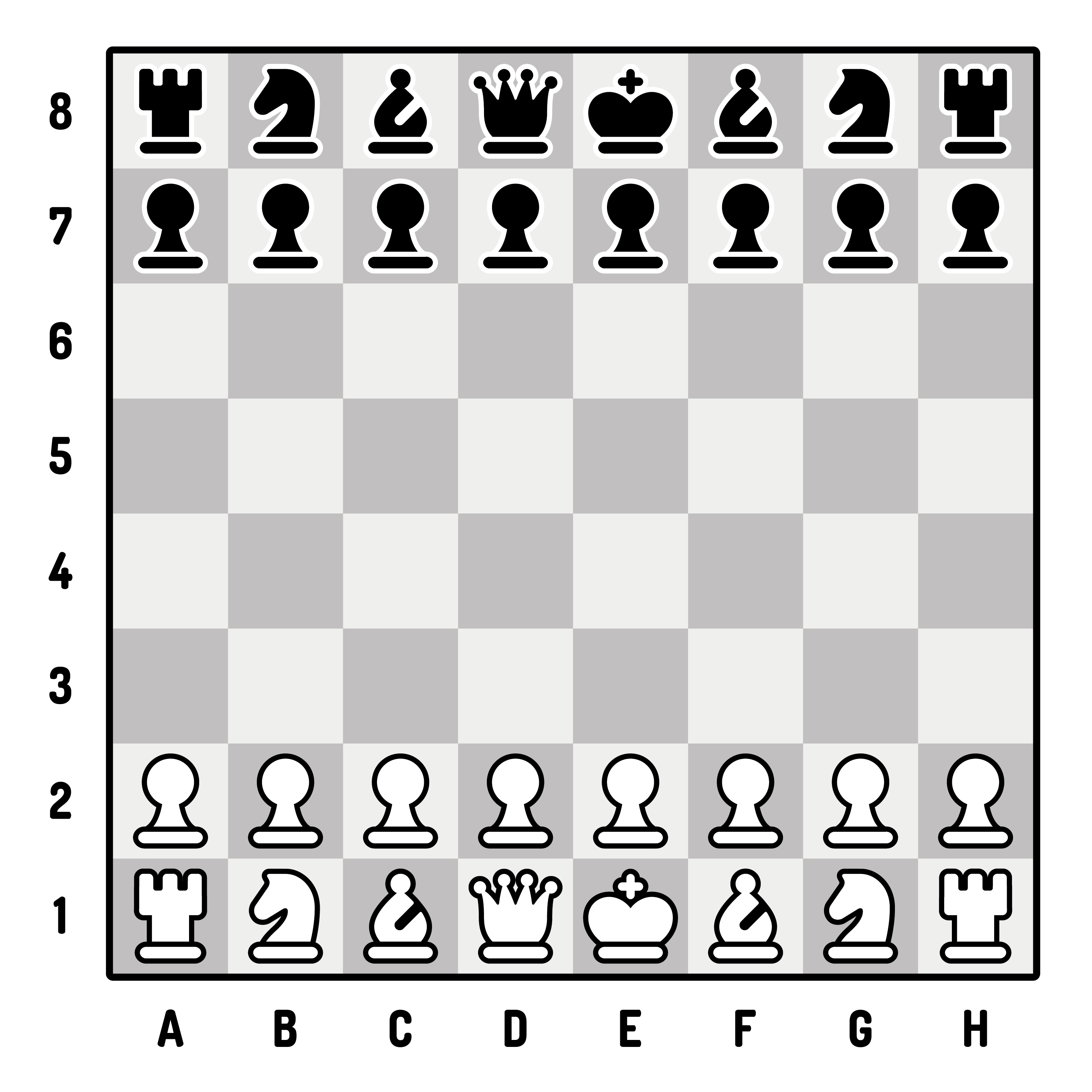

Chess is a game of strategy and tactics that has captivated players for centuries. One of the fascinating aspects of chess is the Chess Board Numbers, which are the coordinates used to identify each square on the board. Understanding these numbers is crucial for both beginners and advanced players, as they form the basis for describing moves and strategies. This post will delve into the intricacies of Chess Board Numbers, their significance, and how they are used in the game.
Understanding the Chess Board
The chessboard is an 8x8 grid, consisting of 64 squares. Each square is uniquely identified by a combination of a letter and a number. The letters range from ‘a’ to ‘h’ and represent the columns, while the numbers range from 1 to 8 and represent the rows. This system allows players to easily reference any square on the board.
The Significance of Chess Board Numbers
The Chess Board Numbers are essential for several reasons:
- Communication: They enable players to communicate their moves clearly and concisely. For example, saying “e4” means moving a piece to the square at the intersection of the ‘e’ column and the 4th row.
- Strategy: Understanding the Chess Board Numbers helps players develop and discuss strategies. For instance, controlling the center squares (e4, d4, e5, d5) is a fundamental strategy in chess.
- Analysis: Chess Board Numbers are used in chess notation to record and analyze games. This allows players to study their games and improve their skills.
How to Use Chess Board Numbers
Using Chess Board Numbers effectively requires familiarity with the board layout and the algebraic notation system. Here’s a step-by-step guide:
- Identify the Squares: Each square on the board is identified by a letter and a number. The letters ‘a’ to ‘h’ represent the columns, and the numbers 1 to 8 represent the rows.
- Move Notation: When describing a move, you write the piece’s initial followed by the destination square. For example, “Nf3” means the knight moves to the square at the intersection of the ‘f’ column and the 3rd row.
- Capture Notation: If a piece captures another, an ‘x’ is added. For example, “Bxc6” means the bishop captures the piece on the ‘c’ column and the 6th row.
- Check and Checkmate: If a move puts the opponent’s king in check, a ‘+’ is added. If it results in checkmate, a ‘#’ is added. For example, “Qh5#” means the queen moves to ‘h5’ and delivers checkmate.
Common Chess Board Numbers
Certain squares on the chessboard are frequently referenced due to their strategic importance. Here are some of the most common Chess Board Numbers:
| Square | Significance |
|---|---|
| e4 | Central control, common opening move. |
| d4 | Central control, common opening move. |
| e5 | Central control, common response to e4. |
| d5 | Central control, common response to d4. |
| f7 | Weak square in the opponent’s camp, often targeted in attacks. |
| f2 | Weak square in your camp, often targeted by the opponent. |
📝 Note: The significance of these squares can vary depending on the specific game and strategy being employed.
Advanced Use of Chess Board Numbers
For advanced players, Chess Board Numbers are used in more complex strategies and analyses. Here are some advanced concepts:
- Pawn Structure: Understanding the Chess Board Numbers helps in analyzing pawn structures. For example, an isolated pawn on d4 can be a strength or a weakness depending on the position.
- Piece Placement: Advanced players use Chess Board Numbers to describe optimal piece placement. For instance, placing a knight on f3 or c3 is a common strategy in many openings.
- Endgame Strategy: In the endgame, Chess Board Numbers are crucial for describing key squares and pawn breaks. For example, advancing a pawn to a7 or h7 can be decisive in certain endgames.
Chess Board Numbers in Chess Notation
Chess notation is a standardized way of recording chess moves using Chess Board Numbers. There are two main types of notation: algebraic and descriptive. Algebraic notation is more commonly used today and is based on the Chess Board Numbers.
Here is an example of algebraic notation:
- 1. e4 e5
- 2. Nf3 Nc6
- 3. Bb5 a6
- 4. Ba4 Nf6
- 5. O-O Be7
- 6. Re1 b5
- 7. Bb3 d6
- 8. c3 O-O
- 9. h3 Na5
- 10. Bc2 c5
This notation allows players to record and analyze games accurately, making it an essential tool for improving chess skills.
📝 Note: Descriptive notation was commonly used in the past but has largely been replaced by algebraic notation due to its simplicity and clarity.
Chess Board Numbers in Chess Puzzles
Chess puzzles are a great way to improve your tactical skills, and Chess Board Numbers are integral to solving them. Puzzles often require you to visualize moves and understand the board layout. Here’s how Chess Board Numbers come into play:
- Identify the Position: Use the Chess Board Numbers to set up the initial position accurately.
- Plan Your Moves: Visualize the moves using the Chess Board Numbers to find the best solution.
- Check Your Solution: Verify your moves using the Chess Board Numbers to ensure accuracy.
Puzzles can range from simple mate-in-one problems to complex tactical exercises. Solving puzzles regularly can significantly enhance your understanding of Chess Board Numbers and improve your overall chess skills.
Chess puzzles often involve identifying patterns and tactics that can be applied in real games. For example, recognizing a fork or a pin can be crucial in both puzzles and actual gameplay. Understanding Chess Board Numbers helps in quickly identifying these patterns and executing the correct moves.
Here is an example of a simple chess puzzle:
White to move and mate in one. The position is as follows:
| r | n | b | q | k | b | n | r |
| p | p | p | p | p | p | p | p |
| P | P | P | P | P | P | P | P |
| R | N | B | Q | K | B | N | R |
The solution involves moving the queen to h5, delivering checkmate. This puzzle highlights the importance of understanding Chess Board Numbers in identifying the correct move.
📝 Note: Regularly solving chess puzzles can significantly improve your tactical skills and understanding of Chess Board Numbers.
Chess puzzles are not only fun but also educational. They help players develop a keen eye for tactics and improve their ability to visualize moves on the board. By practicing with puzzles, players can enhance their understanding of Chess Board Numbers and apply this knowledge in real games.
Chess puzzles can be found in various books, online platforms, and mobile apps. They cater to different skill levels, from beginners to advanced players. Solving puzzles regularly can help players improve their chess skills and enjoy the game even more.
Chess puzzles often involve identifying patterns and tactics that can be applied in real games. For example, recognizing a fork or a pin can be crucial in both puzzles and actual gameplay. Understanding Chess Board Numbers helps in quickly identifying these patterns and executing the correct moves.
Here is an example of a simple chess puzzle:
White to move and mate in one. The position is as follows:
| r | n | b | q | k | b | n | r |
| p | p | p | p | p | p | p | p |
| P | P | P | P | P | P | P | P |
| R | N | B | Q | K | B | N | R |
The solution involves moving the queen to h5, delivering checkmate. This puzzle highlights the importance of understanding Chess Board Numbers in identifying the correct move.
📝 Note: Regularly solving chess puzzles can significantly improve your tactical skills and understanding of Chess Board Numbers.
Chess puzzles are not only fun but also educational. They help players develop a keen eye for tactics and improve their ability to visualize moves on the board. By practicing with puzzles, players can enhance their understanding of Chess Board Numbers and apply this knowledge in real games.
Chess puzzles can be found in various books, online platforms, and mobile apps. They cater to different skill levels, from beginners to advanced players. Solving puzzles regularly can help players improve their chess skills and enjoy the game even more.
Chess puzzles often involve identifying patterns and tactics that can be applied in real games. For example, recognizing a fork or a pin can be crucial in both puzzles and actual gameplay. Understanding Chess Board Numbers helps in quickly identifying these patterns and executing the correct moves.
Here is an example of a simple chess puzzle:
White to move and mate in one. The position is as follows:
| r | n | b | q | k | b | n | r |
| p | p | p | p | p | p | p | p |
| P | P | P | P | P | P | P | P |
| R | N | B | Q | K | B | N | R |
The solution involves moving the queen to h5, delivering checkmate. This puzzle highlights the importance of understanding Chess Board Numbers in identifying the correct move.
📝 Note: Regularly solving chess puzzles can significantly improve your tactical skills and understanding of Chess Board Numbers.
Chess puzzles are not only fun but also educational. They help players develop a keen eye for tactics and improve their ability to visualize moves on the board. By practicing with puzzles, players can enhance their understanding of Chess Board Numbers and apply this knowledge in real games.
Chess puzzles can be found in various books, online platforms, and mobile apps. They cater to different skill levels, from beginners to advanced players. Solving puzzles regularly can help players improve their chess skills and enjoy the game even more.
Chess puzzles often involve identifying patterns and tactics that can be applied in real games. For example, recognizing a fork or a pin can be crucial in both puzzles and actual gameplay. Understanding Chess Board Numbers helps in quickly identifying these patterns and executing the correct moves.
Here is an example of a simple chess puzzle:
White to move and mate in one. The position is as follows:
<| r | n | b | q | k | b | n | r |
| p | p | p | p | p | p | p | p |
Related Terms:
- chessboard with letters and numbers
- chess board layout numbers
- chess board numbering and lettering
- chess board grid numbers
- how are chess boards numbered
- old chess notation