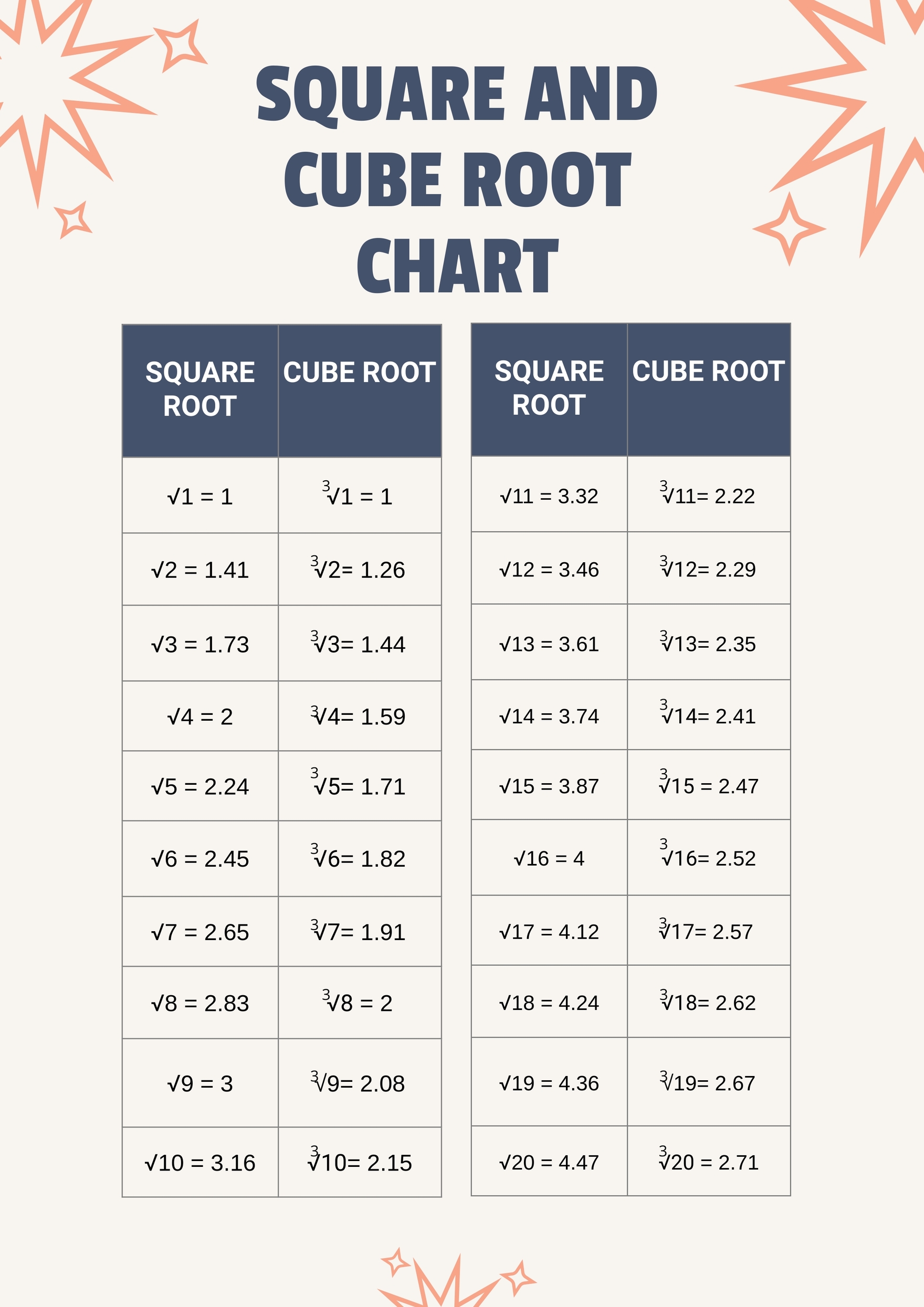

Understanding the concept of square roots is fundamental in mathematics, and visualizing these concepts through charts can significantly enhance comprehension. Charting square roots not only helps in grasping the relationship between numbers and their square roots but also aids in solving complex mathematical problems. This post delves into the intricacies of charting square roots, providing a comprehensive guide on how to create and interpret these charts effectively.
Understanding Square Roots
Before diving into the process of charting square roots, it’s essential to understand what square roots are. A square root of a number is a value that, when multiplied by itself, gives the original number. For example, the square root of 9 is 3 because 3 * 3 = 9. Square roots can be positive or negative, but in most mathematical contexts, we consider the positive square root.
Importance of Charting Square Roots
Charting square roots serves several purposes:
- Visual Representation: Charts provide a visual representation of the relationship between numbers and their square roots, making it easier to understand and remember.
- Pattern Recognition: By plotting square roots on a chart, patterns and trends become more apparent, aiding in problem-solving and hypothesis testing.
- Educational Tool: For students, charting square roots can be an effective educational tool, helping them grasp abstract concepts more concretely.
Types of Charts for Square Roots
There are various types of charts that can be used to represent square roots. The choice of chart depends on the specific needs and the data being presented. Some common types include:
- Line Charts: These are useful for showing trends over a continuous range of numbers.
- Bar Charts: These are effective for comparing square roots of different numbers.
- Scatter Plots: These can show the relationship between a number and its square root in a more detailed manner.
Creating a Chart of Square Roots
Creating a chart of square roots involves several steps. Below is a detailed guide on how to create a line chart of square roots using a spreadsheet program like Microsoft Excel or Google Sheets.
Step 1: Prepare Your Data
First, you need to prepare your data. Create a table with two columns: one for the numbers and one for their square roots. For example:
| Number | Square Root |
|---|---|
| 1 | 1 |
| 4 | 2 |
| 9 | 3 |
| 16 | 4 |
| 25 | 5 |
Step 2: Enter Data into Spreadsheet
Open your spreadsheet program and enter the data into two columns. For example, in column A, enter the numbers, and in column B, enter their corresponding square roots.
Step 3: Select Data for Charting
Highlight the data range that includes both the numbers and their square roots. This will be the data used to create the chart.
Step 4: Insert Chart
Go to the “Insert” menu and select the type of chart you want to create. For a line chart, choose the line chart option. The chart will automatically be generated based on the selected data.
Step 5: Customize the Chart
Customize the chart to make it more informative and visually appealing. You can add titles, labels, and adjust the colors and styles to better represent the data. For example, you can title the chart “Chart of Square Roots” and label the axes as “Number” and “Square Root”.
📝 Note: Ensure that the chart is easy to read and understand. Use clear labels and titles to guide the viewer through the data.
Interpreting Chart Square Roots
Once you have created your chart, the next step is to interpret the data. Here are some key points to consider:
- Trend Analysis: Look for trends in the data. For example, as the numbers increase, do the square roots also increase in a predictable pattern?
- Pattern Recognition: Identify any patterns or anomalies in the data. For instance, do certain numbers have square roots that stand out?
- Comparison: Use the chart to compare the square roots of different numbers. This can help in understanding the relative sizes of square roots.
Applications of Charting Square Roots
Charting square roots has numerous applications in various fields. Some of the key areas where this technique is useful include:
- Mathematics Education: Teachers can use charts to explain square roots to students, making the concept more accessible and understandable.
- Engineering: Engineers often need to calculate square roots for various applications, such as in signal processing and data analysis.
- Finance: In finance, square roots are used in calculating standard deviations and other statistical measures, which are crucial for risk management.
Advanced Techniques in Charting Square Roots
For more advanced users, there are several techniques that can enhance the charting of square roots. These include:
- Logarithmic Scales: Using logarithmic scales can help in visualizing square roots over a wide range of numbers more effectively.
- Interpolation: Interpolation techniques can be used to estimate square roots for numbers that are not explicitly listed in the chart.
- Dynamic Charts: Dynamic charts that update in real-time can be useful for applications where the data is constantly changing.
📝 Note: Advanced techniques require a good understanding of both mathematics and the charting software being used. It's important to practice and experiment with these techniques to gain proficiency.
Common Mistakes to Avoid
When charting square roots, there are several common mistakes to avoid:
- Incorrect Data Entry: Ensure that the data entered into the spreadsheet is accurate. Incorrect data can lead to misleading charts.
- Inadequate Labels: Always include clear labels and titles on your charts. This helps viewers understand the data being presented.
- Overcomplicating the Chart: Keep the chart simple and easy to read. Avoid cluttering it with too much information.
By avoiding these mistakes, you can create charts that are both accurate and informative.
In conclusion, charting square roots is a powerful tool for visualizing and understanding mathematical concepts. Whether you are a student, teacher, engineer, or finance professional, mastering the art of charting square roots can significantly enhance your ability to solve problems and make informed decisions. By following the steps outlined in this post and avoiding common mistakes, you can create effective and informative charts that will aid in your mathematical endeavors.
Related Terms:
- square root anchor chart
- all square root numbers
- square roots cheat sheet
- square roots chart printable
- list of common square roots
- perfect square chart