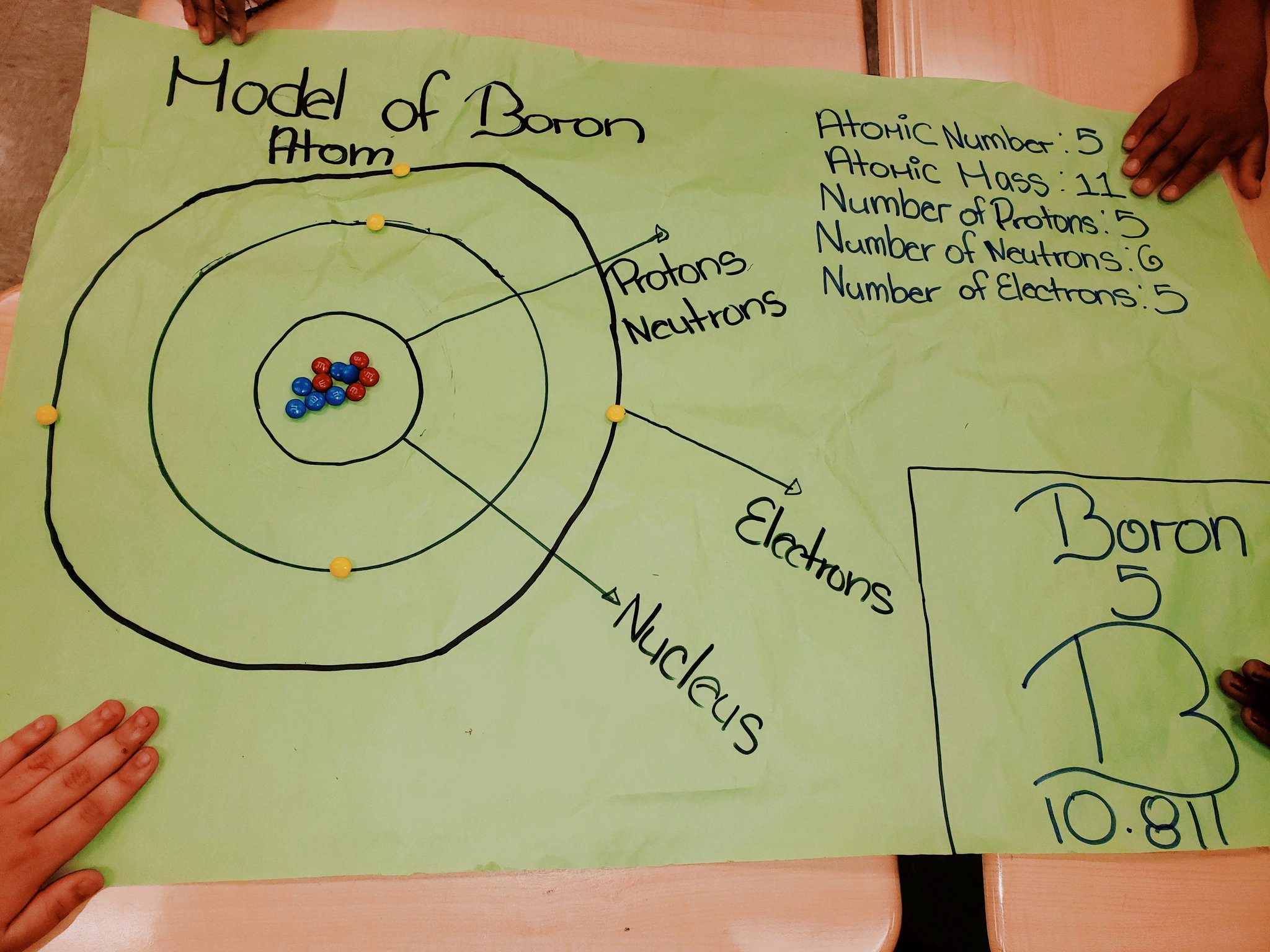

The study of atomic structure has been a cornerstone of modern chemistry and physics, with the Bohr model being one of the most foundational theories. Among the elements, the Boron Bohr Model provides a fascinating insight into the electronic configuration and behavior of boron atoms. This post delves into the intricacies of the Bohr model, focusing specifically on boron, and explores its significance in understanding atomic properties.
The Bohr Model: A Brief Overview
The Bohr model, proposed by Niels Bohr in 1913, revolutionized the understanding of atomic structure. It introduced the concept of discrete energy levels, where electrons orbit the nucleus at specific distances. This model, though simplified, laid the groundwork for more complex theories like quantum mechanics. The key features of the Bohr model include:
- Electrons orbit the nucleus in fixed, circular paths called orbits or shells.
- Each orbit corresponds to a specific energy level.
- Electrons can jump between orbits by absorbing or emitting energy.
- The model is particularly useful for explaining the hydrogen atom and other one-electron systems.
The Boron Atom
Boron, with the atomic number 5, is a metalloid element found in Group 13 of the periodic table. Its electronic configuration is crucial for understanding its chemical properties. The Bohr model of boron helps visualize how electrons are arranged around the nucleus.
The Boron Bohr Model
The Boron Bohr Model depicts boron with five electrons. These electrons are distributed across two energy levels or shells. The first shell can hold a maximum of two electrons, while the second shell can hold up to eight electrons. For boron, the electronic configuration is as follows:
- First shell: 2 electrons
- Second shell: 3 electrons
This configuration can be represented diagrammatically, with the nucleus at the center and electrons in their respective orbits. The Boron Bohr Model is particularly useful for understanding boron’s reactivity and bonding behavior.
Electronic Configuration and Valency
The electronic configuration of boron, as depicted in the Boron Bohr Model, directly influences its valency. Boron has three electrons in its outermost shell, making it trivalent. This means boron can form three covalent bonds with other atoms. The valency of boron is crucial in its chemical reactions and compound formation.
Chemical Properties of Boron
Boron’s chemical properties are largely determined by its electronic structure. Some key properties include:
- High Melting Point: Boron has a high melting point due to its strong covalent bonds.
- Low Density: Despite its high melting point, boron has a relatively low density.
- Chemical Reactivity: Boron is highly reactive and forms compounds with many elements, including oxygen, nitrogen, and halogens.
- Electrical Conductivity: Boron is a poor conductor of electricity but can be doped to enhance its conductivity.
Applications of Boron
Boron and its compounds have a wide range of applications in various industries. Some notable uses include:
- Agriculture: Boron is an essential micronutrient for plants, promoting growth and development.
- Glass and Ceramics: Boron compounds are used in the production of glass and ceramics to enhance their properties.
- Semiconductors: Boron is used as a dopant in semiconductor materials to modify their electrical properties.
- Nuclear Reactors: Boron is used in control rods to absorb neutrons and regulate nuclear reactions.
Comparative Analysis with Other Elements
To better understand the Boron Bohr Model, it is helpful to compare boron with other elements in its group and period. The following table provides a comparative analysis:
| Element | Atomic Number | Electronic Configuration | Valency |
|---|---|---|---|
| Boron | 5 | 1s22s22p1 | 3 |
| Carbon | 6 | 1s22s22p2 | 4 |
| Nitrogen | 7 | 1s22s22p3 | 3 |
| Aluminum | 13 | 1s22s22p63s23p1 | 3 |
The Boron Bohr Model highlights the unique electronic configuration of boron, which sets it apart from other elements in its group. This configuration influences boron's chemical behavior and reactivity.
📝 Note: The Bohr model is a simplified representation and may not accurately depict the complex behavior of electrons in larger atoms. For a more precise understanding, quantum mechanical models are recommended.
Boron's unique properties and applications make it a valuable element in various fields. Its electronic configuration, as illustrated in the Boron Bohr Model, provides a foundational understanding of its chemical behavior. By studying the Bohr model of boron, we gain insights into the broader principles of atomic structure and chemical reactivity.
In summary, the Boron Bohr Model offers a clear and concise representation of boron’s electronic structure. This model helps explain boron’s chemical properties, reactivity, and applications. Understanding the Bohr model of boron is essential for grasping the fundamentals of atomic theory and its practical implications in chemistry and physics.
Related Terms:
- boron quantum mechanical model
- boron atomic structure diagram
- diagram of a boron atom
- labelled diagram of boron atom
- shell diagram for boron
- niels bohr atomic model name