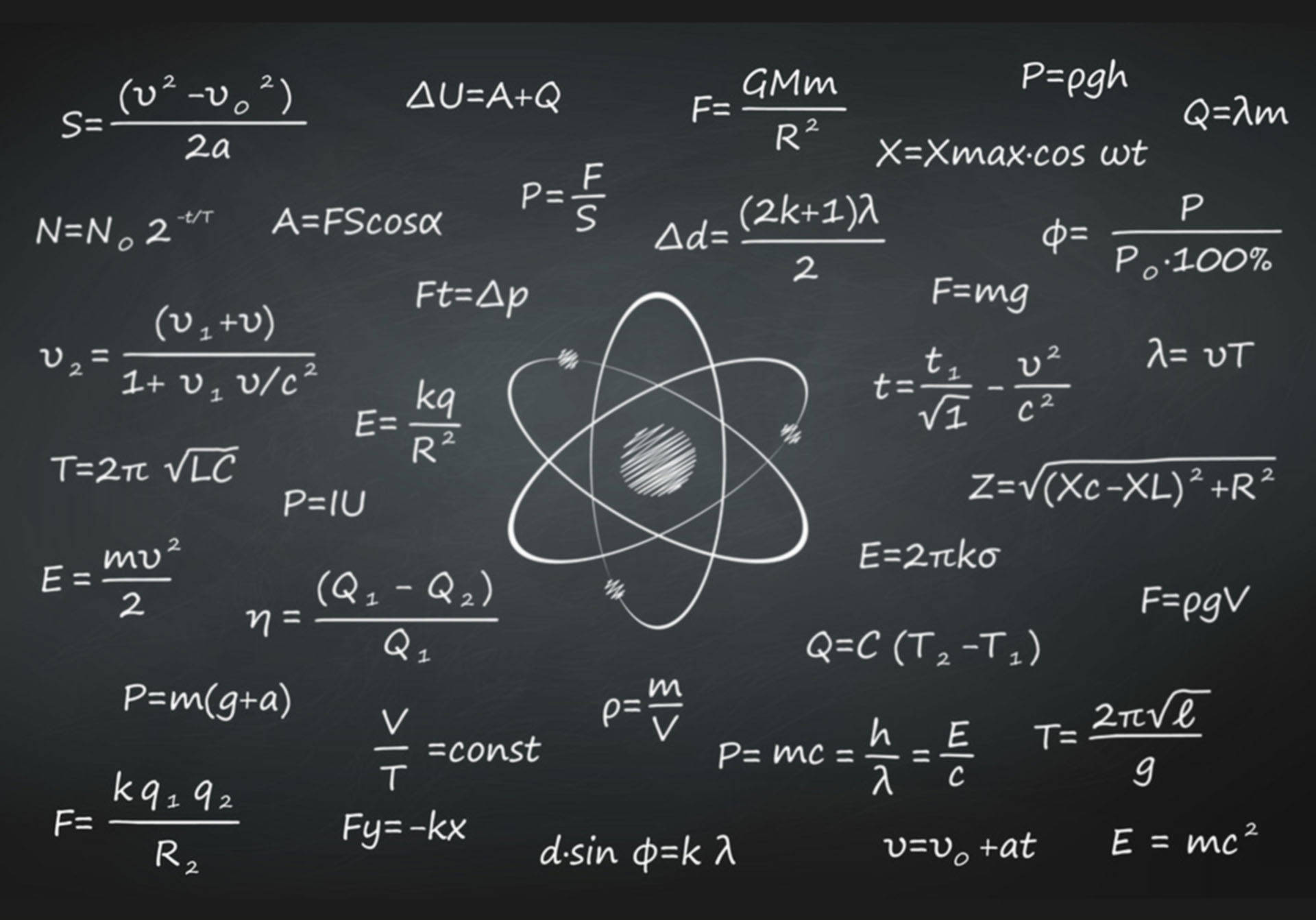

Mastering AP Physics Equations is a crucial step for students aiming to excel in their Advanced Placement (AP) Physics exams. These equations form the backbone of understanding various physical concepts and solving complex problems. Whether you are preparing for AP Physics 1, AP Physics 2, or AP Physics C, a solid grasp of these equations is essential. This guide will walk you through the key AP Physics Equations, their applications, and tips for effective study.
Understanding the Basics of AP Physics Equations
Before diving into specific equations, it's important to understand the fundamental principles that govern them. AP Physics covers a wide range of topics, including mechanics, electricity and magnetism, waves, and thermodynamics. Each of these areas has its own set of AP Physics Equations that students must master.
Mechanics is one of the most foundational areas in AP Physics. It includes topics such as kinematics, dynamics, and energy. Key equations in mechanics include:
- Kinematic Equations: These equations describe the motion of objects without considering the forces acting on them. The four basic kinematic equations are:
| Equation | Description |
|---|---|
| v = u + at | Final velocity (v) is equal to initial velocity (u) plus acceleration (a) times time (t). |
| s = ut + ½at² | Displacement (s) is equal to initial velocity (u) times time (t) plus half of acceleration (a) times time squared (t²). |
| v² = u² + 2as | Final velocity squared (v²) is equal to initial velocity squared (u²) plus two times acceleration (a) times displacement (s). |
| s = ½(v + u)t | Displacement (s) is equal to half the sum of final velocity (v) and initial velocity (u) times time (t). |
Dynamics involves the study of forces and their effects on motion. Key equations in dynamics include:
- Newton's Second Law: F = ma, where F is the force, m is the mass, and a is the acceleration.
- Weight: W = mg, where W is the weight, m is the mass, and g is the acceleration due to gravity.
- Friction: Ff = μN, where Ff is the frictional force, μ is the coefficient of friction, and N is the normal force.
Energy is another critical concept in mechanics. Key equations include:
- Kinetic Energy: KE = ½mv², where KE is the kinetic energy, m is the mass, and v is the velocity.
- Potential Energy: PE = mgh, where PE is the potential energy, m is the mass, g is the acceleration due to gravity, and h is the height.
- Work-Energy Theorem: W = ΔKE, where W is the work done, and ΔKE is the change in kinetic energy.
Electricity and Magnetism is another major area covered in AP Physics. Key equations include:
- Coulomb's Law: F = k(q1q2/r²), where F is the force, k is Coulomb's constant, q1 and q2 are the charges, and r is the distance between them.
- Electric Field: E = F/q, where E is the electric field, F is the force, and q is the charge.
- Electric Potential: V = kq/r, where V is the electric potential, k is Coulomb's constant, q is the charge, and r is the distance.
- Ohm's Law: V = IR, where V is the voltage, I is the current, and R is the resistance.
- Magnetic Force: F = qvBsin(θ), where F is the magnetic force, q is the charge, v is the velocity, B is the magnetic field, and θ is the angle between the velocity and the magnetic field.
Waves and Thermodynamics also have their own sets of AP Physics Equations. For waves, key equations include:
- Wave Speed: v = λf, where v is the wave speed, λ is the wavelength, and f is the frequency.
- Wave Equation: y(x,t) = A sin(kx - ωt), where y is the displacement, A is the amplitude, k is the wave number, x is the position, ω is the angular frequency, and t is the time.
For thermodynamics, key equations include:
- Ideal Gas Law: PV = nRT, where P is the pressure, V is the volume, n is the number of moles, R is the ideal gas constant, and T is the temperature.
- First Law of Thermodynamics: ΔU = Q - W, where ΔU is the change in internal energy, Q is the heat added to the system, and W is the work done by the system.
Applying AP Physics Equations
Understanding the equations is just the first step. Applying them to solve problems is where the real learning happens. Here are some tips for effectively applying AP Physics Equations:
- Identify the relevant equations: Before solving a problem, identify which equations are relevant. This will help you focus on the key concepts and avoid getting overwhelmed.
- Draw diagrams: Visualizing the problem with diagrams can help you understand the relationships between different variables and apply the equations more accurately.
- Use dimensional analysis: Check the units of your answers to ensure they make sense. This can help you catch mistakes early in the problem-solving process.
- Practice regularly: The more you practice applying these equations, the more comfortable you will become with them. Regular practice will also help you identify patterns and shortcuts.
Let's look at an example problem to illustrate how to apply AP Physics Equations.
Example Problem: A car accelerates from rest at a constant rate of 2 m/s² for 10 seconds. What is the final velocity of the car?
Solution:
1. Identify the relevant equation: The kinematic equation v = u + at is appropriate here because we are dealing with constant acceleration and need to find the final velocity.
2. Plug in the values: u = 0 m/s (initial velocity), a = 2 m/s² (acceleration), and t = 10 s (time).
3. Calculate the final velocity: v = 0 + (2 m/s² * 10 s) = 20 m/s.
💡 Note: Always double-check your units to ensure they are consistent and correct.
Study Tips for Mastering AP Physics Equations
Mastering AP Physics Equations requires a combination of understanding, practice, and effective study strategies. Here are some tips to help you excel:
- Create a study schedule: Allocate specific times for studying different topics and equations. Consistency is key to retaining information.
- Use flashcards: Flashcards are an excellent tool for memorizing equations and key concepts. You can use physical flashcards or digital apps like Quizlet.
- Practice with past exams: Solving past AP Physics exams will give you a sense of the types of questions you can expect and help you apply the equations in a test-like environment.
- Join a study group: Collaborating with peers can provide different perspectives and help you understand difficult concepts more clearly.
- Seek help when needed: Don't hesitate to ask your teacher or tutor for help if you're struggling with a particular concept or equation.
Memorization Techniques: Memorizing AP Physics Equations can be challenging, but there are techniques to make it easier:
- Mnemonics: Create mnemonics to help remember complex equations. For example, for the kinematic equation v = u + at, you might use "Velocity equals initial plus acceleration times time."
- Visualization: Visualize the equations in your mind. Draw diagrams or write them down repeatedly to reinforce memory.
- Repetition: Regularly review the equations. Repetition is a powerful tool for memorization.
Practice Problems: Solving practice problems is crucial for mastering AP Physics Equations. Here are some types of problems you should focus on:
- Kinematics Problems: Problems involving motion without considering forces.
- Dynamics Problems: Problems involving forces and their effects on motion.
- Energy Problems: Problems involving kinetic and potential energy.
- Electricity and Magnetism Problems: Problems involving electric and magnetic fields, forces, and potentials.
- Waves and Thermodynamics Problems: Problems involving wave properties and thermodynamic principles.
Common Mistakes to Avoid: When studying AP Physics Equations, be aware of common mistakes:
- Incorrect Units: Always ensure your units are consistent and correct.
- Misinterpretation of Variables: Make sure you understand what each variable in the equation represents.
- Skipping Steps: Don't rush through problems. Take your time to understand each step.
- Ignoring Signs: Pay attention to the signs of the variables, especially in vector equations.
💡 Note: Regularly review your mistakes and learn from them to avoid repeating them in future problems.
Advanced Topics in AP Physics Equations
As you progress in your studies, you will encounter more advanced topics that require a deeper understanding of AP Physics Equations. These topics include:
- Rotational Motion: Equations involving angular velocity, angular acceleration, and torque.
- Gravitation: Equations involving gravitational force and potential energy.
- Electromagnetic Waves: Equations involving the properties of electromagnetic waves.
- Quantum Mechanics: Basic equations and principles of quantum mechanics.
Rotational Motion involves equations such as:
- Angular Velocity: ω = θ/t, where ω is the angular velocity, θ is the angular displacement, and t is the time.
- Angular Acceleration: α = Δω/Δt, where α is the angular acceleration, Δω is the change in angular velocity, and Δt is the change in time.
- Torque: τ = r × F, where τ is the torque, r is the position vector, and F is the force.
Gravitation involves equations such as:
- Gravitational Force: F = G(m1m2/r²), where F is the gravitational force, G is the gravitational constant, m1 and m2 are the masses, and r is the distance between them.
- Gravitational Potential Energy: U = -G(m1m2/r), where U is the gravitational potential energy, G is the gravitational constant, m1 and m2 are the masses, and r is the distance between them.
Electromagnetic Waves involve equations such as:
- Wave Equation: ∇²E - (1/c²)∂²E/∂t² = 0, where E is the electric field, c is the speed of light, and t is the time.
- Maxwell's Equations: A set of four equations that describe how electric and magnetic fields are generated and altered by each other and by charges and currents.
Quantum Mechanics involves equations such as:
- Schrödinger Equation: iħ(∂ψ/∂t) = Ĥψ, where i is the imaginary unit, ħ is the reduced Planck constant, ψ is the wave function, and Ĥ is the Hamiltonian operator.
- Heisenberg Uncertainty Principle: ΔxΔp ≥ ħ/2, where Δx is the uncertainty in position, Δp is the uncertainty in momentum, and ħ is the reduced Planck constant.
Practice Problems for Advanced Topics: Solving advanced problems will help you apply these equations more effectively. Focus on problems that involve:
- Rotational Dynamics: Problems involving torque, angular momentum, and rotational kinetic energy.
- Gravitational Interactions: Problems involving the gravitational force between multiple objects.
- Electromagnetic Interactions: Problems involving electric and magnetic fields and their interactions.
- Quantum Phenomena: Problems involving wave-particle duality, superposition, and quantum entanglement.
Common Mistakes in Advanced Topics: Be aware of common mistakes when dealing with advanced AP Physics Equations:
- Misinterpreting Vector Quantities: Ensure you understand the direction and magnitude of vector quantities.
- Ignoring Boundary Conditions: Pay attention to boundary conditions in problems involving waves and fields.
- Overlooking Quantum Superposition: Understand the principles of superposition and entanglement in quantum mechanics.
💡 Note: Advanced topics often require a deeper understanding of mathematical concepts, so brush up on your calculus and linear algebra skills.
Real-World Applications of AP Physics Equations
Understanding AP Physics Equations is not just about passing exams; it's about applying these principles to real-world situations. Here are some examples of how these equations are used in everyday life:
- Engineering: Engineers use AP Physics Equations to design structures, machines, and systems. For example, civil engineers use equations of motion to design bridges and buildings that can withstand various forces.
- Astronomy: Astronomers use equations of gravitation to study the motion of planets, stars, and galaxies. Understanding these equations helps in predicting celestial events and exploring the universe.
- Electronics: Electronics engineers use equations of electricity and magnetism to design circuits, devices, and systems. These equations are crucial for understanding how electrical components work and interact.
- Medicine: Medical professionals use principles of physics to understand the human body and develop diagnostic tools. For example, MRI machines use magnetic fields and radio waves to create detailed images of the body.
Engineering Applications: In engineering, AP Physics Equations are used to solve complex problems involving motion, forces, and energy. For example:
- Structural Analysis: Engineers use equations of statics and dynamics to analyze the stability and strength of structures.
- Mechanical Design: Equations of kinematics and dynamics are used to design machines and mechanisms that perform specific tasks.
- Electrical Systems: Equations of electricity and magnetism are used to design and analyze electrical circuits and systems.
Astronomy Applications: In astronomy, AP Physics Equations are used to study the motion of celestial bodies and understand the universe. For example:
- Orbital Mechanics: Equations of gravitation are used to calculate the orbits of planets, satellites, and other celestial objects.
- Astrophysics: Equations of thermodynamics and quantum mechanics are used to study the properties and behavior of stars, galaxies, and other astrophysical phenomena.
Electronics Applications: In electronics, AP Physics Equations are used to design and analyze electrical and magnetic systems. For example:
- Circuit Design: Equations of electricity and magnetism are used to design circuits that perform specific functions.
- Signal Processing: Equations of waves and electromagnetism are used to analyze and process signals in communication systems.
Medical Applications: In medicine, AP Physics Equations are used to understand the human body and develop diagnostic tools. For example:
- Imaging Techniques: Equations of waves and electromagnetism are used to develop imaging techniques like MRI and ultrasound.
- Biomechanics: Equations of mechanics are used to study the motion and forces acting on the human body.
Practice Problems for Real-World Applications: Solving problems that relate to real-world applications will help you understand how AP Physics Equations are used in practice. Focus on problems that involve:
- Structural Engineering: Problems involving the design and analysis of structures.
- Astronomical Observations: Problems involving the motion of celestial bodies.
- Electrical Engineering: Problems involving the design and analysis of electrical circuits.
- Medical Diagnostics: Problems involving the use of physics in medical imaging and diagnostics.
Common Mistakes in Real-World Applications: Be aware of common mistakes when applying AP Physics Equations to real-world situations:
- Ignoring Real-World Constraints: Consider the practical constraints and limitations of real-world applications.
- Overlooking Environmental Factors: Pay attention to environmental factors that can affect the behavior of physical systems.
- Misinterpreting Data: Ensure you correctly interpret data and measurements in real-world problems.
💡 Note: Real-world applications often require a multidisciplinary approach, so be prepared to integrate knowledge from different fields.
In conclusion, mastering AP Physics Equations is essential for excelling in AP Physics exams and understanding the fundamental principles of physics. By understanding the basics, applying the equations to solve problems, and practicing regularly, you can build a strong foundation in physics. Additionally, exploring advanced topics and real-world applications will deepen your understanding and prepare you for future studies and careers in science and engineering.
Related Terms:
- ap physics cheat sheet
- ap physics equations sheet
- physics 1 equation sheet ap
- ap physics 2 equation sheet
- college physics 1 equation sheet