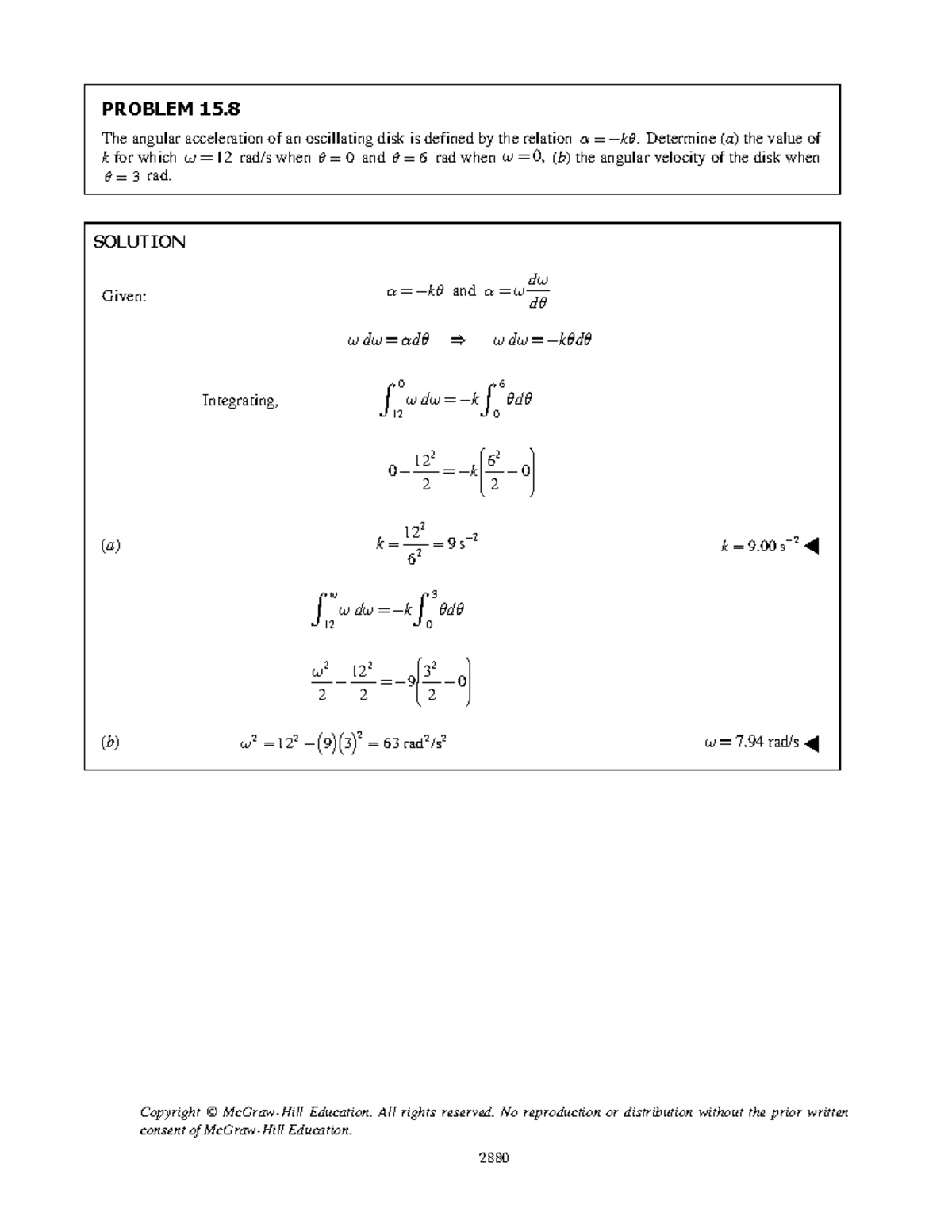

Understanding the principles of motion is fundamental to various fields of science and engineering. One of the key tools used to analyze and predict the behavior of objects in motion is the Angular Kinematic Equations. These equations are essential for describing the rotational motion of objects, providing insights into how angular velocity, angular acceleration, and angular displacement are interrelated. This post will delve into the Angular Kinematic Equations, their applications, and how they can be used to solve real-world problems.
Understanding Angular Kinematic Equations
The Angular Kinematic Equations are analogous to the linear kinematic equations but are specifically designed for rotational motion. They describe the relationship between angular displacement, angular velocity, angular acceleration, and time. The four primary Angular Kinematic Equations are:
- θ = θ₀ + ω₀t + ½αt²
- ω = ω₀ + αt
- ω² = ω₀² + 2α(θ - θ₀)
- θ - θ₀ = ½(ω₀ + ω)t
Where:
- θ is the final angular displacement
- θ₀ is the initial angular displacement
- ω is the final angular velocity
- ω₀ is the initial angular velocity
- α is the angular acceleration
- t is the time interval
Applications of Angular Kinematic Equations
The Angular Kinematic Equations have wide-ranging applications in various fields, including physics, engineering, and robotics. Some of the key areas where these equations are applied include:
- Mechanical Engineering: In the design and analysis of rotating machinery, such as turbines, engines, and gears.
- Robotics: In the control and movement of robotic arms and other mechanical components.
- Astronomy: In studying the motion of celestial bodies, such as planets and satellites.
- Sports Science: In analyzing the motion of athletes and improving performance.
Solving Problems with Angular Kinematic Equations
To solve problems involving rotational motion, it is essential to understand how to apply the Angular Kinematic Equations. Let's go through an example to illustrate the process.
Consider a wheel that starts from rest and accelerates uniformly to reach an angular velocity of 10 rad/s in 5 seconds. We need to find the angular acceleration and the total angular displacement during this time.
Given:
- Initial angular velocity (ω₀) = 0 rad/s
- Final angular velocity (ω) = 10 rad/s
- Time (t) = 5 s
Using the second Angular Kinematic Equation (ω = ω₀ + αt), we can find the angular acceleration (α):
10 rad/s = 0 rad/s + α(5 s)
Solving for α:
α = 10 rad/s / 5 s = 2 rad/s²
Now, using the first Angular Kinematic Equation (θ = θ₀ + ω₀t + ½αt²), we can find the total angular displacement (θ):
θ = 0 + 0 + ½(2 rad/s²)(5 s)²
θ = ½(2 rad/s²)(25 s²)
θ = 25 rad
Therefore, the angular acceleration is 2 rad/s², and the total angular displacement is 25 rad.
📝 Note: Ensure that all units are consistent when using the Angular Kinematic Equations. Incorrect units can lead to erroneous results.
Comparing Linear and Angular Kinematic Equations
While the Angular Kinematic Equations are similar to their linear counterparts, there are key differences that need to be understood. The table below highlights these differences:
| Linear Kinematic Equations | Angular Kinematic Equations |
|---|---|
| x = x₀ + v₀t + ½at² | θ = θ₀ + ω₀t + ½αt² |
| v = v₀ + at | ω = ω₀ + αt |
| v² = v₀² + 2a(x - x₀) | ω² = ω₀² + 2α(θ - θ₀) |
| x - x₀ = ½(v₀ + v)t | θ - θ₀ = ½(ω₀ + ω)t |
As seen in the table, the variables and their relationships are analogous, but the context and units differ. Linear equations deal with linear displacement, velocity, and acceleration, while Angular Kinematic Equations deal with angular displacement, angular velocity, and angular acceleration.
Advanced Topics in Angular Kinematic Equations
For more complex problems, additional concepts and equations may be required. These include:
- Torque and Moment of Inertia: Understanding how torque (τ) and moment of inertia (I) affect rotational motion.
- Rotational Kinetic Energy: Calculating the kinetic energy of a rotating object using the formula KE = ½Iω².
- Angular Momentum: Analyzing the conservation of angular momentum in systems where no external torque acts.
These advanced topics build upon the foundational Angular Kinematic Equations and provide a deeper understanding of rotational dynamics.
For example, consider a disk rotating about its center with an angular velocity of 5 rad/s. If the moment of inertia of the disk is 2 kg·m², the rotational kinetic energy can be calculated as follows:
KE = ½Iω²
KE = ½(2 kg·m²)(5 rad/s)²
KE = ½(2 kg·m²)(25 rad²/s²)
KE = 25 J
Therefore, the rotational kinetic energy of the disk is 25 Joules.
📝 Note: Ensure that the moment of inertia is calculated correctly for the specific shape and mass distribution of the object.
Real-World Examples of Angular Kinematic Equations
To further illustrate the practical applications of the Angular Kinematic Equations, let's consider a few real-world examples:
Example 1: Car Wheels
When a car accelerates from rest, its wheels undergo rotational motion. The Angular Kinematic Equations can be used to determine the angular velocity and displacement of the wheels. For instance, if a car accelerates uniformly from rest to a speed of 60 km/h in 10 seconds, the angular velocity of the wheels can be calculated using the relationship between linear and angular velocity (v = rω), where r is the radius of the wheel.
Example 2: Merry-Go-Round
A merry-go-round is a classic example of rotational motion. If a child pushes the merry-go-round with a constant torque, the Angular Kinematic Equations can be used to find the angular acceleration and the time it takes to reach a certain angular velocity. This can help in designing safer and more enjoyable playground equipment.
Example 3: Satellite Orbits
In astronomy, the Angular Kinematic Equations are used to study the orbits of satellites and planets. By understanding the angular velocity and acceleration of these celestial bodies, scientists can predict their positions and trajectories, which is crucial for space missions and astronomical observations.
These examples demonstrate the versatility and importance of the Angular Kinematic Equations in various fields.
In the field of sports science, the Angular Kinematic Equations are used to analyze the motion of athletes. For example, in gymnastics, the rotational motion of a gymnast during a flip can be analyzed to improve performance and reduce the risk of injury. By measuring the angular velocity and acceleration, coaches can provide feedback to athletes on how to optimize their movements.
In robotics, the Angular Kinematic Equations are essential for controlling the movement of robotic arms and other mechanical components. By understanding the rotational dynamics, engineers can design more precise and efficient robots for various applications, such as manufacturing, surgery, and exploration.
In mechanical engineering, the Angular Kinematic Equations are used in the design and analysis of rotating machinery, such as turbines, engines, and gears. By understanding the rotational motion, engineers can optimize the performance and efficiency of these machines, leading to advancements in technology and industry.
In astronomy, the Angular Kinematic Equations are used to study the motion of celestial bodies, such as planets and satellites. By understanding the rotational dynamics, astronomers can predict the positions and trajectories of these bodies, which is crucial for space missions and astronomical observations.
In conclusion, the Angular Kinematic Equations are a powerful tool for analyzing and predicting the behavior of objects in rotational motion. By understanding these equations and their applications, we can gain insights into various fields of science and engineering, leading to advancements in technology and industry. Whether in mechanical engineering, robotics, astronomy, or sports science, the Angular Kinematic Equations provide a foundation for understanding and optimizing rotational motion.
Related Terms:
- rotational motion and angular quantities
- rotational inertia
- how to calculate rotational force
- rotational kinematic equations
- is angular velocity a vector
- symbol for angular displacement