
Mastering the intricacies of English grammar can be a challenging yet rewarding endeavor. Among the various components of grammar, adverbs and conjunctions play a pivotal role in shaping the structure and meaning of sentences. Understanding how to use these parts of speech effectively can significantly enhance your writing and communication skills. This post delves into the nuances of adverbs and conjunctions, providing a comprehensive guide to their usage and importance in the English language.
Understanding Adverbs
Adverbs are words that modify verbs, adjectives, or other adverbs. They provide additional information about how, when, where, or to what extent an action occurs. Adverbs can greatly enrich your writing by adding depth and clarity to your sentences. Here are some key points to consider when using adverbs:
- Types of Adverbs: Adverbs can be categorized into several types based on their function. These include adverbs of manner, time, place, frequency, degree, and cause.
- Formation of Adverbs: Many adverbs are formed by adding "-ly" to an adjective. For example, "quick" becomes "quickly," and "happy" becomes "happily." However, not all adverbs follow this rule. Some adverbs, like "fast" and "hard," remain unchanged.
- Position of Adverbs: The position of an adverb in a sentence can affect its meaning. Adverbs can appear at the beginning, middle, or end of a sentence. For instance, "Quickly, she ran to the store" emphasizes the speed of her action, while "She ran to the store quickly" places less emphasis on the speed.
Here is a table illustrating different types of adverbs and their functions:
| Type of Adverb | Function | Example |
|---|---|---|
| Adverb of Manner | Describes how an action is performed | She sings beautifully. |
| Adverb of Time | Indicates when an action occurs | I will meet you tomorrow. |
| Adverb of Place | Specifies where an action occurs | She lives here. |
| Adverb of Frequency | Indicates how often an action occurs | He visits his grandparents often. |
| Adverb of Degree | Shows the extent or intensity of an action | She is very happy. |
| Adverb of Cause | Explains why an action occurs | He stayed home because he was sick. |
📝 Note: Be mindful of overusing adverbs, as they can make your writing seem repetitive and less engaging. Aim for a balanced approach, using adverbs judiciously to enhance your sentences.
The Role of Conjunctions
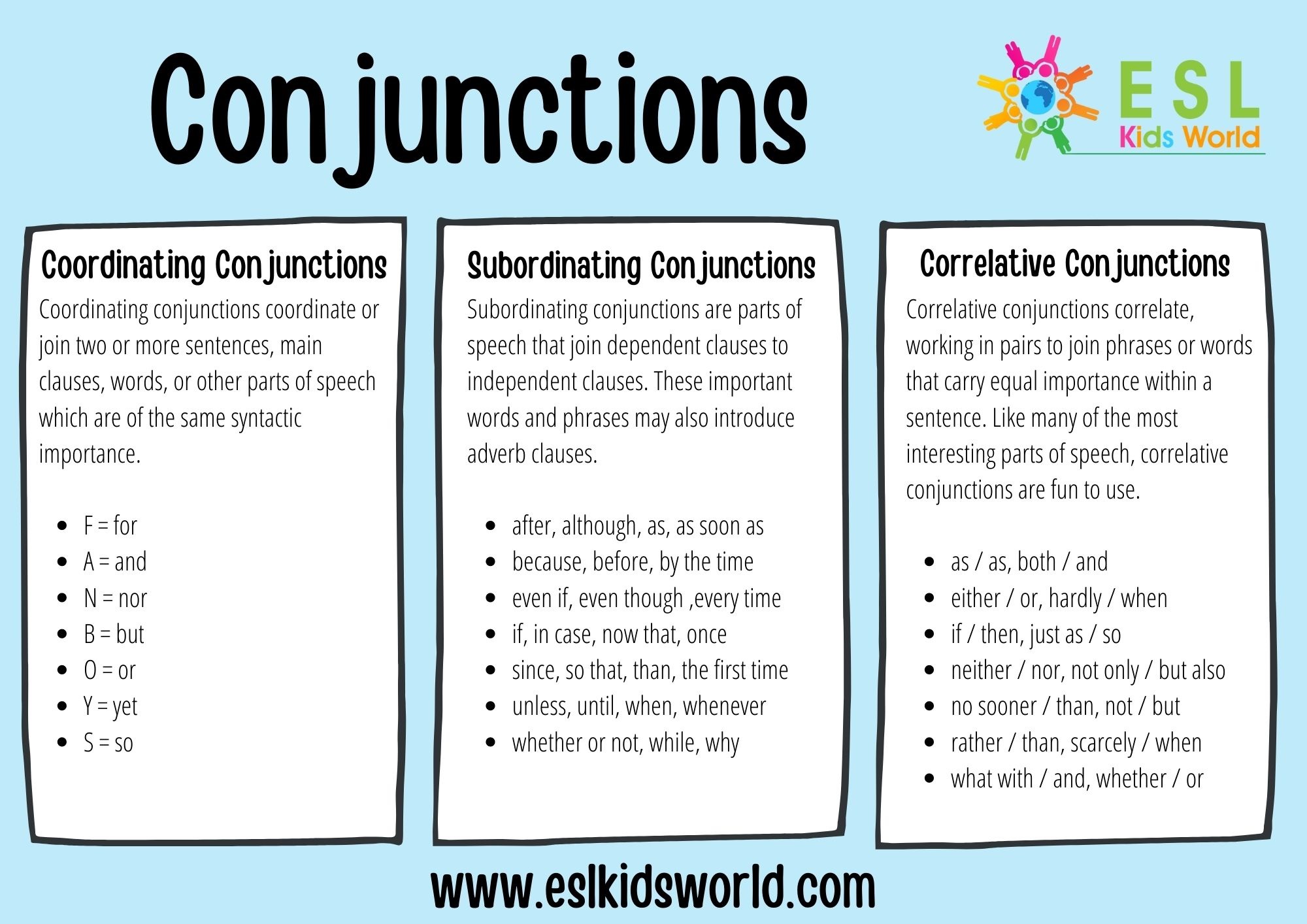
Conjunctions are words that connect words, phrases, or clauses within a sentence. They play a crucial role in creating complex and compound sentences, allowing for a smoother flow of ideas. Conjunctions can be categorized into coordinating, subordinating, and correlative conjunctions. Each type serves a unique purpose in sentence structure.
- Coordinating Conjunctions: These conjunctions connect words, phrases, or clauses of equal importance. The most common coordinating conjunctions are "for," "and," "nor," "but," "or," "yet," and "so," often remembered by the acronym FANBOYS.
- Subordinating Conjunctions: These conjunctions introduce subordinate clauses, which depend on the main clause for their meaning. Examples include "because," "although," "since," "while," and "unless."
- Correlative Conjunctions: These conjunctions work in pairs to connect words, phrases, or clauses. Common pairs include "either...or," "neither...nor," "not only...but also," and "whether...or."
Here is an example of each type of conjunction in use:
- Coordinating Conjunction: She wanted to go to the park, but it started to rain.
- Subordinating Conjunction: Because it was raining, she stayed indoors.
- Correlative Conjunction: Either you can come with us or you can stay home.
Conjunctions are essential for creating varied and interesting sentence structures. They help to connect ideas, show relationships between clauses, and enhance the overall coherence of your writing. By mastering the use of conjunctions, you can create more complex and nuanced sentences that effectively convey your thoughts and ideas.
📝 Note: Be cautious not to overuse conjunctions, as this can lead to run-on sentences and confusion. Ensure that each conjunction serves a clear purpose in connecting your ideas.
Adverbs And Conjunctions in Action
To fully grasp the importance of adverbs and conjunctions, let's examine how they function in real-world examples. Consider the following sentences and analyze the role of adverbs and conjunctions in each:
- Adverbs: She quickly finished her homework because she wanted to watch a movie. In this sentence, "quickly" is an adverb of manner that describes how she finished her homework, and "because" is a subordinating conjunction that introduces the reason for her action.
- Conjunctions: He likes to read and write, but he prefers reading. Here, "and" is a coordinating conjunction that connects two verbs, "read" and "write," while "but" introduces a contrasting idea.
By understanding how adverbs and conjunctions work together, you can create more dynamic and engaging sentences. These parts of speech help to clarify the relationships between ideas, making your writing more coherent and easier to understand.
Common Mistakes to Avoid
While adverbs and conjunctions are powerful tools in English grammar, there are common mistakes that writers often make. Being aware of these pitfalls can help you avoid them and improve your writing skills.
- Overuse of Adverbs: Using too many adverbs can make your writing seem clumsy and repetitive. For example, "She ran quickly to the store" is more effective than "She ran very quickly to the store."
- Incorrect Placement of Adverbs: The position of an adverb can change the meaning of a sentence. For instance, "She only eats vegetables" means she eats nothing but vegetables, while "She eats only vegetables" means she eats vegetables exclusively.
- Misuse of Conjunctions: Using the wrong conjunction can lead to grammatical errors and confusion. For example, "I will go to the store, and I will buy milk" is correct, but "I will go to the store, and buy milk" is incorrect because it lacks a complete clause after the conjunction.
- Run-on Sentences: Overusing conjunctions can result in run-on sentences, which are difficult to read and understand. For example, "She wanted to go to the park but it started to rain so she stayed indoors" can be improved by breaking it into separate sentences: "She wanted to go to the park. However, it started to rain, so she stayed indoors."
By being mindful of these common mistakes, you can enhance the clarity and effectiveness of your writing. Adverbs and conjunctions are essential components of English grammar, and mastering their use will significantly improve your communication skills.
📝 Note: Regular practice and attention to detail are key to avoiding these mistakes. Read widely and pay close attention to how adverbs and conjunctions are used in professional writing.
Enhancing Your Writing with Adverbs And Conjunctions
To truly excel in your use of adverbs and conjunctions, consider the following tips and strategies:
- Read Widely: Exposure to a variety of writing styles and genres can help you understand how adverbs and conjunctions are used effectively. Pay attention to how authors use these parts of speech to enhance their narratives.
- Practice Writing: Regular writing practice is essential for improving your grammar skills. Experiment with different adverbs and conjunctions in your sentences to see how they affect the meaning and flow of your writing.
- Seek Feedback: Share your writing with others and seek constructive feedback. This can help you identify areas for improvement and refine your use of adverbs and conjunctions.
- Use Grammar Tools: Utilize grammar-checking tools and resources to identify and correct errors in your writing. These tools can provide valuable insights into your use of adverbs and conjunctions.
By incorporating these strategies into your writing routine, you can develop a stronger command of adverbs and conjunctions and enhance the overall quality of your writing.
Adverbs and conjunctions are fundamental components of English grammar that play a crucial role in shaping the structure and meaning of sentences. By understanding their functions and mastering their use, you can create more dynamic, coherent, and engaging writing. Whether you are a student, a professional, or an aspiring writer, a solid grasp of adverbs and conjunctions will significantly enhance your communication skills and help you convey your ideas more effectively.
Related Terms:
- difference between conjunctions and adverbs
- adverbial conjunction examples
- list of conjunctive adverbs
- is instead a conjunctive adverb
- examples of a conjunctive adverb
- list of all conjunctive adverbs