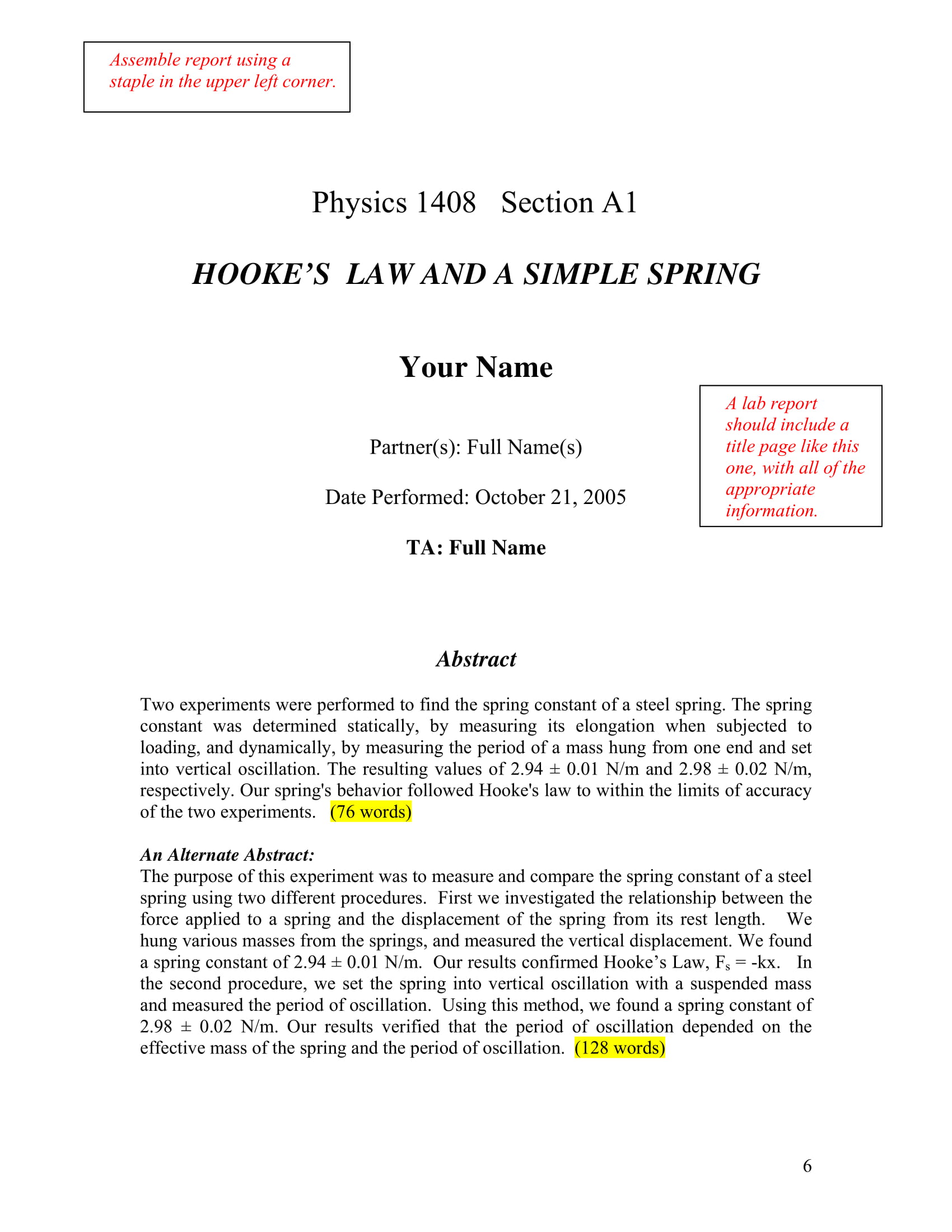

Writing a comprehensive and well-structured Sample Lab Report is a crucial skill for students and professionals in scientific fields. A lab report serves as a detailed account of an experiment, including the methods used, the results obtained, and the conclusions drawn. This guide will walk you through the essential components of a Sample Lab Report, providing tips and examples to help you create a polished and informative document.
Understanding the Purpose of a Lab Report
A Sample Lab Report is more than just a record of experimental data; it is a communication tool that conveys the findings of a scientific investigation to others. The primary purposes of a lab report include:
- Documenting the experimental process and results.
- Providing a clear and concise summary of the findings.
- Allowing others to replicate the experiment.
- Contributing to the body of scientific knowledge.
Components of a Lab Report
A well-structured Sample Lab Report typically includes the following sections:
- Title Page
- Abstract
- Introduction
- Materials and Methods
- Results
- Discussion
- Conclusion
- References
Title Page
The title page is the first section of your Sample Lab Report. It should include:
- The title of the experiment.
- The names of the authors.
- The date of submission.
- The course name and number (if applicable).
- The name of the instructor (if applicable).
Example:
| Title | Authors | Date | Course | Instructor |
|---|---|---|---|---|
| Investigation of Photosynthesis in Plants | John Doe, Jane Smith | October 15, 2023 | Biology 101 | Dr. Alice Johnson |
Abstract
The abstract is a brief summary of the entire Sample Lab Report. It should be concise and include:
- The purpose of the experiment.
- The methods used.
- The key results.
- The main conclusions.
Example:
This experiment investigated the rate of photosynthesis in plants under different light intensities. The methods involved measuring the oxygen production of leaf discs in varying light conditions. The results showed that higher light intensities increased the rate of photosynthesis. The conclusion drawn was that light intensity is a critical factor in photosynthesis.
Introduction
The introduction sets the stage for your Sample Lab Report. It should include:
- A brief background on the topic.
- The purpose of the experiment.
- The hypotheses or research questions.
- Relevant previous studies.
Example:
Photosynthesis is the process by which plants convert light energy into chemical energy. This experiment aimed to determine how different light intensities affect the rate of photosynthesis. The hypothesis was that higher light intensities would result in a higher rate of photosynthesis. Previous studies have shown that light is a crucial factor in photosynthesis, but the specific effects of varying intensities have not been fully explored.
Materials and Methods
This section describes the experimental setup and procedures in detail. It should include:
- A list of all materials used.
- A step-by-step description of the methods.
- Any controls or variables.
Example:
Materials:
- Leaf discs from spinach plants.
- Sodium bicarbonate solution.
- Light sources with varying intensities.
- Oxygen sensor.
Methods:
1. Prepare leaf discs from spinach plants.
2. Place the leaf discs in a sodium bicarbonate solution.
3. Expose the leaf discs to different light intensities (low, medium, high).
4. Measure the oxygen production using an oxygen sensor.
5. Record the data for each light intensity.
📝 Note: Ensure that the methods section is detailed enough for others to replicate the experiment.
Results
The results section presents the data collected during the experiment. It should include:
- Tables and graphs to illustrate the data.
- A description of the data trends.
- Any statistical analyses performed.
Example:
The following table shows the oxygen production (in milliliters) at different light intensities:
| Light Intensity | Oxygen Production (mL) |
|---|---|
| Low | 2.5 |
| Medium | 4.0 |
| High | 5.5 |
The data shows a clear trend of increasing oxygen production with higher light intensities.
Discussion
The discussion section interprets the results and explains their significance. It should include:
- An explanation of the results in relation to the hypothesis.
- Comparisons with previous studies.
- Possible sources of error.
- Implications of the findings.
Example:
The results support the hypothesis that higher light intensities increase the rate of photosynthesis. This finding is consistent with previous studies that have shown light to be a critical factor in photosynthesis. However, there were some limitations in the experiment, such as the use of a single plant species and the lack of control for other environmental factors. Future studies could address these limitations by including multiple plant species and controlling for temperature and humidity.
Conclusion
The conclusion section summarizes the key findings and their implications. It should include:
- A restatement of the main results.
- The significance of the findings.
- Suggestions for future research.
Example:
In conclusion, this experiment demonstrated that light intensity significantly affects the rate of photosynthesis in plants. The findings highlight the importance of light as a limiting factor in photosynthesis and suggest that optimizing light conditions could enhance plant growth and productivity. Future research should explore the effects of other environmental factors and different plant species to provide a more comprehensive understanding of photosynthesis.
References
The references section lists all the sources cited in the Sample Lab Report. It should include:
- All books, articles, and other sources mentioned in the report.
- Formatted according to a consistent citation style (e.g., APA, MLA, Chicago).
Example:
Smith, J. (2020). Photosynthesis: A Comprehensive Guide. Science Press.
Johnson, A. (2019). The Role of Light in Photosynthesis. Journal of Plant Biology, 45(3), 234-245.
Creating a well-structured Sample Lab Report requires attention to detail and a clear understanding of the experimental process. By following the guidelines outlined in this guide, you can produce a comprehensive and informative document that effectively communicates your findings to others. This not only enhances your scientific communication skills but also contributes to the broader scientific community by sharing valuable insights and data.
Related Terms:
- sample lab report apa
- sample lab report chemistry
- short lab report examples
- sample lab test report
- sample lab report pdf
- sample lab report physics