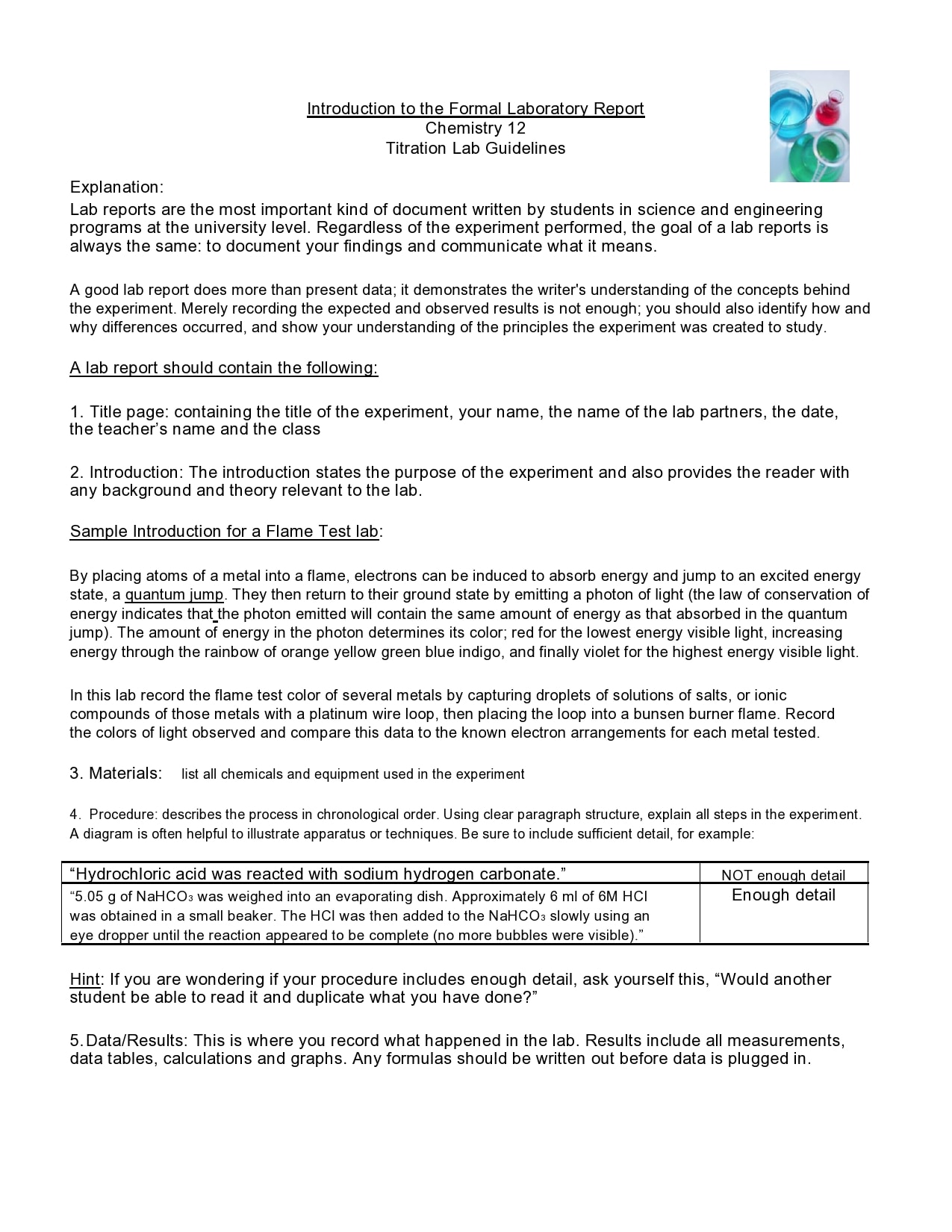

Writing a lab report is a crucial skill for students and professionals in scientific fields. It involves documenting experiments, observations, and conclusions in a clear and organized manner. Understanding how to structure a lab report effectively is essential for communicating scientific findings accurately. This guide will walk you through the process of creating a comprehensive lab report, using Lab Report Examples to illustrate key points.
Understanding the Structure of a Lab Report
A well-structured lab report typically includes several key sections. Each section serves a specific purpose and contributes to the overall clarity and coherence of the report. The main sections are:
- Title Page
- Abstract
- Introduction
- Materials and Methods
- Results
- Discussion
- Conclusion
- References
Title Page
The title page is the first section of the lab report. It should include:
- The title of the experiment
- The names of the authors
- The date of the experiment
- The course name and number
- The instructor's name
Lab Report Examples often feature a title page that is clean and uncluttered, making it easy to identify the essential information at a glance.
Abstract
The abstract is a brief summary of the entire lab report. It should be concise and provide an overview of the experiment, including the purpose, methods, results, and conclusions. The abstract is typically written last, after the rest of the report is complete.
Lab Report Examples often include an abstract that is no more than 200-300 words, providing a clear and concise summary of the experiment.
Introduction
The introduction sets the stage for the experiment. It should include:
- A brief background on the topic
- The purpose of the experiment
- The hypothesis or research question
- The significance of the study
Lab Report Examples typically have an introduction that provides enough context for the reader to understand the importance of the experiment without going into excessive detail.
Materials and Methods
This section describes the procedures and materials used in the experiment. It should be detailed enough for another researcher to replicate the experiment. Include:
- A list of all materials and equipment used
- A step-by-step description of the procedures
- Any safety precautions taken
Lab Report Examples often include a table listing all materials and equipment, followed by a detailed description of the methods used. Here is an example of how this section might look:
| Material/Equipment | Quantity |
|---|---|
| Beakers | 5 |
| Test tubes | 10 |
| Pipettes | 3 |
| Distilled water | 1 liter |
Lab Report Examples often include a table listing all materials and equipment, followed by a detailed description of the methods used.
📝 Note: Ensure that the methods section is written in the past tense, as it describes actions that have already been completed.
Results
The results section presents the data collected during the experiment. It should include:
- Tables and graphs to display data
- A description of the data
- Any observations made during the experiment
Lab Report Examples often use visual aids such as graphs and charts to present data clearly. Here is an example of how this section might look:
During the experiment, we measured the pH levels of various solutions. The results are presented in the table below:
| Solution | pH Level |
|---|---|
| Solution A | 6.5 |
| Solution B | 7.2 |
| Solution C | 5.8 |
Lab Report Examples often use visual aids such as graphs and charts to present data clearly.
Discussion
The discussion section interprets the results and explains their significance. It should include:
- An explanation of the results
- A comparison of the results with the hypothesis
- Possible sources of error
- Implications of the findings
- Suggestions for future research
Lab Report Examples often include a discussion that critically evaluates the results and provides insights into their implications. This section should not introduce new data but rather analyze the data presented in the results section.
Conclusion
The conclusion summarizes the key findings of the experiment and restates the hypothesis. It should be brief and to the point, highlighting the main outcomes and their significance.
Lab Report Examples often include a conclusion that reinforces the main points of the report and provides a clear takeaway for the reader.
References
The references section lists all the sources cited in the lab report. It should be formatted according to the citation style specified by your instructor, such as APA, MLA, or Chicago style. Include:
- Books
- Journal articles
- Websites
- Other relevant sources
Lab Report Examples often include a references section that is meticulously formatted and includes all necessary citations.
Writing a lab report can be a challenging task, but with the right structure and attention to detail, it can be a rewarding experience. By following the guidelines outlined in this guide and referring to Lab Report Examples, you can create a comprehensive and well-organized lab report that effectively communicates your scientific findings.
In summary, a well-written lab report includes a title page, abstract, introduction, materials and methods, results, discussion, conclusion, and references. Each section plays a crucial role in presenting the experiment clearly and coherently. By understanding the structure and purpose of each section, you can create a lab report that is both informative and engaging. Lab Report Examples serve as valuable resources for learning how to structure and format your own reports effectively.
Related Terms:
- lab report format example
- sample lab report
- high school lab report examples
- lab report examples pdf
- lab report example title page
- lab report pdf