
Understanding the Gaussian Curve PDF, also known as the normal distribution, is fundamental in statistics and probability theory. This curve is ubiquitous in various fields, including physics, engineering, and data science, due to its ability to model many natural phenomena. The Gaussian Curve PDF is characterized by its bell-shaped curve, which is symmetric about the mean and tapers off towards the tails. This distribution is defined by two parameters: the mean (μ) and the standard deviation (σ). The mean determines the location of the peak of the curve, while the standard deviation controls the width of the curve.
Understanding the Gaussian Curve PDF
The Gaussian Curve PDF is mathematically represented by the formula:
f(x | μ, σ²) = (1 / (σ * √(2π))) * e^(-(x - μ)² / (2σ²))
Where:
- f(x | μ, σ²) is the probability density function.
- μ is the mean of the distribution.
- σ² is the variance of the distribution.
- σ is the standard deviation of the distribution.
- e is the base of the natural logarithm.
- π is Pi, approximately 3.14159.
The Gaussian Curve PDF is crucial because it describes the distribution of many random variables, such as measurement errors, natural variations, and sampling distributions. The central limit theorem further emphasizes its importance by stating that the sum (or average) of a large number of independent, identically distributed variables will be approximately normally distributed, regardless of the original distribution.
Properties of the Gaussian Curve PDF
The Gaussian Curve PDF has several key properties that make it a powerful tool in statistics:
- Symmetry: The curve is symmetric about the mean. This means that the left and right halves of the curve are mirror images of each other.
- Bell Shape: The curve has a characteristic bell shape, with the peak at the mean and tapering off towards the tails.
- Empirical Rule: Approximately 68% of the data falls within one standard deviation of the mean, 95% within two standard deviations, and 99.7% within three standard deviations. This is often referred to as the 68-95-99.7 rule.
- Area Under the Curve: The total area under the curve is equal to 1, representing the total probability.
These properties make the Gaussian Curve PDF a versatile tool for modeling and analyzing data.
Applications of the Gaussian Curve PDF
The Gaussian Curve PDF has wide-ranging applications across various fields. Some of the most notable applications include:
- Data Analysis: In data science and statistics, the Gaussian Curve PDF is used to model data distributions, perform hypothesis testing, and construct confidence intervals.
- Signal Processing: In engineering, the Gaussian Curve PDF is used in signal processing to model noise and filter signals.
- Physics: In physics, the Gaussian Curve PDF is used to describe the distribution of particles in a gas, the spread of light in optical systems, and the uncertainty in measurements.
- Finance: In finance, the Gaussian Curve PDF is used to model the distribution of stock prices, interest rates, and other financial variables.
These applications highlight the versatility and importance of the Gaussian Curve PDF in various scientific and engineering disciplines.
Calculating the Gaussian Curve PDF
To calculate the Gaussian Curve PDF, you need to know the mean (μ) and the standard deviation (σ) of the distribution. Here is a step-by-step guide to calculating the Gaussian Curve PDF:
- Determine the Mean (μ): Identify the mean of the distribution. This is the central value around which the data is distributed.
- Determine the Standard Deviation (σ): Calculate the standard deviation of the distribution. This measures the spread of the data around the mean.
- Apply the Formula: Use the Gaussian Curve PDF formula to calculate the probability density for a given value of x.
For example, if you have a distribution with a mean of 5 and a standard deviation of 2, the Gaussian Curve PDF for x = 6 would be calculated as follows:
f(6 | 5, 2²) = (1 / (2 * √(2π))) * e^(-(6 - 5)² / (2 * 2²))
This calculation gives you the probability density at x = 6 for the given distribution.
📝 Note: The Gaussian Curve PDF is a continuous probability distribution, meaning it describes the probability density over a range of values rather than discrete probabilities.
Visualizing the Gaussian Curve PDF
Visualizing the Gaussian Curve PDF can provide valuable insights into the distribution of data. Here is a step-by-step guide to plotting the Gaussian Curve PDF:
- Choose a Range of Values: Select a range of x-values over which to plot the curve. This range should cover the area where most of the data is concentrated.
- Calculate the PDF Values: For each x-value in the range, calculate the corresponding Gaussian Curve PDF value using the formula.
- Plot the Curve: Use a plotting tool or software to create a graph of the x-values against the PDF values.
Here is an example of how to plot the Gaussian Curve PDF using Python and the Matplotlib library:
import numpy as np
import matplotlib.pyplot as plt
from scipy.stats import norm

# Define the mean and standard deviation
mu = 5
sigma = 2

# Generate a range of x-values
x = np.linspace(mu - 4*sigma, mu + 4*sigma, 1000)

# Calculate the PDF values
pdf_values = norm.pdf(x, mu, sigma)

# Plot the Gaussian Curve PDF
plt.plot(x, pdf_values, label='Gaussian Curve PDF')
plt.xlabel('x')
plt.ylabel('Probability Density')
plt.title('Gaussian Curve PDF')
plt.legend()
plt.show()
This code will generate a plot of the Gaussian Curve PDF with a mean of 5 and a standard deviation of 2.
📝 Note: The range of x-values should be chosen carefully to ensure that the entire curve is visible. A common practice is to use a range of μ ± 4σ.
Comparing Different Gaussian Curves
Different Gaussian Curves can be compared by varying the mean and standard deviation. Here is a table showing the effects of changing these parameters:
| Mean (μ) | Standard Deviation (σ) | Description |
|---|---|---|
| 5 | 1 | Narrow curve, tightly clustered around the mean. |
| 5 | 2 | Wider curve, more spread out around the mean. |
| 10 | 1 | Curve shifted to the right, tightly clustered around the new mean. |
| 10 | 3 | Curve shifted to the right and wider, more spread out around the new mean. |
By comparing these curves, you can see how changes in the mean and standard deviation affect the shape and position of the Gaussian Curve PDF.
Special Cases of the Gaussian Curve PDF
There are several special cases of the Gaussian Curve PDF that are worth mentioning:
- Standard Normal Distribution: This is a Gaussian Curve PDF with a mean of 0 and a standard deviation of 1. It is often used as a reference distribution in statistics.
- Cumulative Distribution Function (CDF): The CDF of the Gaussian Curve PDF gives the probability that a random variable is less than or equal to a given value. It is calculated by integrating the PDF from negative infinity to the given value.
- Quantile Function: The quantile function (inverse CDF) gives the value of x for a given probability. It is useful for generating random variables from a Gaussian distribution.
These special cases provide additional tools for working with the Gaussian Curve PDF in various applications.
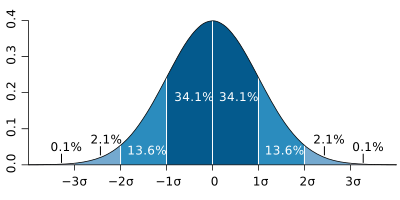
This image illustrates the standard normal distribution, which is a special case of the Gaussian Curve PDF with a mean of 0 and a standard deviation of 1.
Understanding the Gaussian Curve PDF and its properties is essential for anyone working in statistics, data science, or related fields. By mastering the concepts and applications of the Gaussian Curve PDF, you can gain valuable insights into data distributions and make informed decisions based on statistical analysis.
Related Terms:
- bell curve
- normal distribution curve
- gaussian curve function
- gaussian curve equation
- bell curve formula
- gaussian distribution